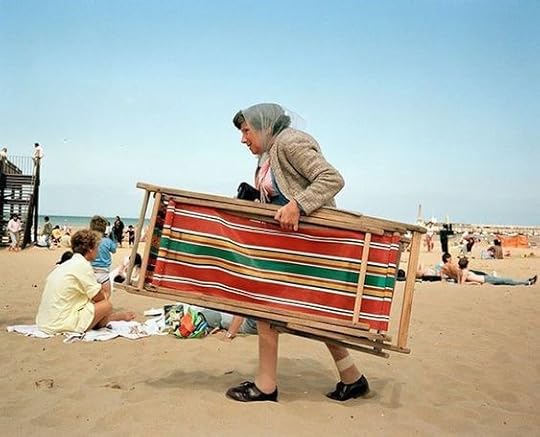
Small World is a biting and very funny satire in which Martin Parr observes global tourism and the tourist’s search for authentic cultures that are themselves destroyed in that search. Martin Parr has worked on numerous photographic projects and developed an international reputation for his innovative imagery, his oblique approach to social documentary, and his input to photographic culture within the United Kingdom and abroad. In 2002 a major retrospective exhibition was initiated by The Barbican in London and is touring internationally to 2008.
Martin Parr was born in Epsom, Surrey, UK in 1952. When he was a boy, his budding interest in the medium of photography was encouraged by his grandfather George Parr, himself a keen amateur photographer.
Parr studied photography at Manchester Polytechnic, from 1970-1973. Since that time, Martin Parr has worked on numerous photographic projects. He has developed an international reputation for his innovative imagery, his oblique approach to social documentary, and his input to photographic culture within the UK and abroad.
In 1994 he became a full member of Magnum Photographic Corporation. In recent years, he has developed an interest in filmmaking, and has started to use his photography within different conventions, such as fashion and advertising.
In 2002 the Barbican Art Gallery and the National Media Museum initiated a large retrospective of Parr's work. This show toured Europe for the next 5 years.
Parr was appointed Professor of Photography in 2004 at The University of Wales Newport campus. He was Guest Artistic Director for Rencontres D'Arles in 2004. In 2006 he was awarded the Erich Salomon Prize and the resulting Assorted Cocktail show opened at Photokina. In 2008 he was guest curator at the New York Photo Festival, curating the New Typologies exhibition. At PhotoEspana, 2008, he won the Baume et Mercier award in recognition of his professional career and contributions to contemporary photography.
para mí, este era mucho más repetitivo (compositivamente y en cuanto al sujeto, también) que the last resort. Muchos hombres con cámaras demasiado cerca. Aunque había unos cuantos spreads muy chulos
Capolavoro della fotografia - e più in generale della sociologia - contemporanea. Il minuzioso studio di Parr sull'ethos del turista, attuato con i suoi colori saturi e il non raro uso del flash, restituisce una umanità globale a tinte forti, affaticata dal "travel" (che in fondo è anche un travaglio, come nota la profonda introduzione di Simon Winchester) e dalla ricerca di sé intorno al mondo.
I got a copy of the newest version of Small World, I'm not sure if its 2024 or 2025, anyhow.
In Small World, Martin Parr presents us with some shots he got while travelling and touristing around the world. His photography here has nice vibrant colors and most of the time they are filled with genuine human expressions.
He doesn't take his photography too seriously in a sense that he isn't photographing scenes with a profound or obscure meaning. His pictures are simply engaging. Beautiful, entertaining and filled with meaning.
I love his work and this one particularly clicked with me. It inspires me to go out and shoot more. If this isn't a 5 star rating, I don't know what it is. But I can accept that his style might not be to everyone's taste and might look too simple or lazy. I guess people see what they want to see.
Martin is a genius and one of my faves ever. He’s always been more of an anthropologist than a photographer to me, capturing ordinary people and their behaviours in daily situations with tons of humour. In this collection Martin explores the tourist and “the touristic experience”, which places people out of their comfort zone, in a slightly vulnerable position. They came to have fun, but they’re also kind of lost, sometimes even helpless- like children that need a guiding hand. The photographs capture them looking puzzled and goofy, shameless and so so human.
The book suggests that in Parr's photographs, 'place' and visitor diminish each other; however, I disagree. In my view, people play a crucial role in shaping the essence of any location, and tourists contribute significantly to the allure of monuments, landscapes, and streets. But I do recognize that there can be something akin to too many tourists. That's me, a tourist, complaining about other tourists. Ironic.
Dyer's perspective concerning modern tourists, who may engage in more superficial or fleeting experiences reminiscent of faithless pilgrimages might have some merit.
This book has a wonderful introduction by Geoff Dyer. It's about traveling and tourism. The photos are all of tourists on vacation. Most are having their photo taken by someone else in the frame or are taking a photo. It has a sense of humor that isn't necessarily mean-spirited even if you don't have sympathy for the subjects of the photos. It appeals to me as a traveler, a photographer, and to my sense of humor and politics. This book is great.
This book has quite a literary introduction by Geoff Dyer. However, though book has some intriguing pictures of touristy places, somewhat mocking the tourists. There are several unconventional compositions with almost every frame featuring a tourist trying to pose or click. I missed that magical, pleasing quality that I seek in photography books.