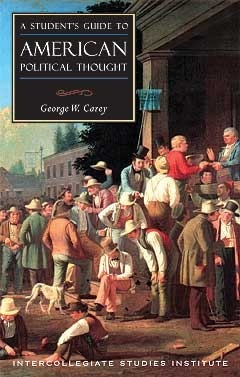
Who are the most influential thinkers, and which are the most important concepts, events, and documents in the study of the American political tradition? How ought we regard the beliefs and motivations of the founders, the debate over the ratification of the Constitution, the historical circumstances of the Declaration of Independence, the rise of the modern presidency, and the advent of judicial supremacy? These are a few of the fascinating questions canvassed by George W. Carey in A Student's Guide to American Political Thought. Carey's primer instructs students on the fundamental matters of American political theory while telling them where to turn to obtain a better grasp on the ideas that have shaped the American political heritage.
Dr. George W. Carey was Professor of Government at Georgetown University. He taught political theory in that department from 1961 to 2013.
A Georgetown University tribute described him as "an expert on American political thought, especially The Federalist Papers and the Constitution", whose work "was marked by a deep knowledge of the Constitution and founding period, coupled with a vigorous defense of traditional approaches to the Constitution and government."
I am of somewhat mixed feelings regarding this book. On the one hand, I love the book's content and have found myself pondering the sort of issues this book discusses concerning the implications of the political thought of the founders on contemporary political issues [1]. On the other hand, though, I think this book's focus on the founders might confuse many readers of the book, since I thought it was going to focus on contemporary political thought and not constitutional thought, although there is a great deal of overlap between the two, in that one's political thought has implications on one's constitutional thinking and vice versa. The author is certainly to be praised for grasping the nettle of America's founding politics and laying out the various views of the American founding that are present in the contemporary academy as well as the author's own worldview. Given that the book is about 100 pages, it makes for a quick read and also a genuinely informative one, one that many people will appreciate, especially if they do not come into reading this book with a firm knowledge of the continuing relevance of the constitution on contemporary political thought.
The contents of the book itself are surprisingly focused. A book as short as this one can either focus on breadth of subjects touched upon or focus in depth on what it views as fundamentals and essentials, and the author of the book has chosen the founding of the United States as the essential aspect of American political history that needs a lot of focus, with less attention paid to the outgrowths of that. After a short introduction, the author spends a lot of time talking about the "common ground" of discussions of American political thought in the era of the founding, including the search for the deeper meaning of the founding, questions as to whether the founders were sincere or disingenuous in their approach, a look at the broader picture of historical and contemporary comparative political science, the serious complications and multiple influences that the founders dealt with in their own attempts to construct a harmonious republic, the relationship between the Constitution and the Federalist essays, as well as the competing traditions that carry on to this day in the aftermath of the passage of the Constitution. After this there is discussion about the continuing issues of federalism as well as the challenge of the separation of powers, before the book closes with a discussion on limited government and the thorny problem of virtue.
In looking at this book, there is a lot more that I wanted. For one, I wanted the author to provide a selection of books that would help the reader to better grasp American political thought, including the writings of the Founding era and the Federalist and Antifederalist papers, which can be found inexpensively, along with some of the most thoughtful discussions of American political history and political philosophy. I would have liked to have seen more information about the Civil War and the falsity of the connection made both at the time and to the present day by neo-Confederates relating to slavery and state's rights. To be sure, some mention is given to these matters, but there is a lot more that could have been said. However, all of that aside, one reviews not the book one would have preferred to have read, even if it would have been longer and more contentious, but rather the book one has actually read, and even with some reservations about what it does not include, this is still a worthwhile and enjoyable book.
Carey may be peerless in the ample insight he supplies concerning our Founder’s intent. This short historical survey of American political thought processes and their conclusions provides a first-rate foundation for the neophyte, or the advanced, pigeonholed in some specific corner of law or politics – quite suitable for the harried American. Though Carey holds a position (and after all what is education if not a search for the right answers?) he is remarkably adept at presenting other sides without torpedoing their thesis. But he doesn’t need to, as that is done by carefully reading The Federalist. However, were it not for books like this, revision - conservative or liberal - would have a free hand, putting words in the Founder’s mouth, or obfuscating what can be complex Founding issues, not so much through the inertia of these concepts but by their subtleties. Unlike science where erroneous understandings are rejected by nature or refined analysis, these subtleties are what makes the Founding intent a minefield, more open to alteration. Unfortunately, English has not the precision of mathematics, but Carey points us to clarification from the Founders and they’re reasonably clear, most often crystal.
Right from the beginning Carey sets the table: “On what principles is the government based? How is authority allocated within it? What is its primary purpose? Are there limitations to its powers? How can it be altered? On what assumptions about human nature is it based?” Past civilizations were “ordained by the gods” or “given by a mythical lawgiver,” but America’s Founding was a reasoned struggle, not only at the Convention but over decades of debate and State testing, resulting in the “will of the people,” not a god. The Federalist as defense of the proposed Constitution addressed these matters. It is, though, a “nuts and bolts” approach, writes Carey, not an extensive theoretical or philosophical treatise – practical vs. idealistic. And this is where much political thought separates from The Federalist, attempting to redraft its meaning to satisfy “the way things ought to be” regardless of what works. An example follows fifty years after our most lethal war with resulting elevation of the Lincoln era, retroactively recasting the Constitution in light of our Declaration through Lincoln’s moving speeches, making rights and equality paramount. For such interpretations, writes Carey “…democracy is primarily government ‘for the people’ not necessarily ‘by the people’,” bearing “a close relationship to those [ideals] that inspired the French Revolution.” The Constitution is then judged by how well it lives up to The Declaration. But Carey argues it does live up to central themes expressed there and is a continuation of the same political thought – once again by reference to The Federalist - just not the way revisionists want it to be.
Reading the Constitution cold is likely to leave one under-whelmed, but Carey transforms it. Like lifeless mathematical equations as abstract markings on paper, grasping their meaning and implications converts them to revelation, lifting them from the page to fly. Carey does this for the Founding, through him our Founders nearly live again. But based on our mutilation of their intent they’d probably rather be dead.