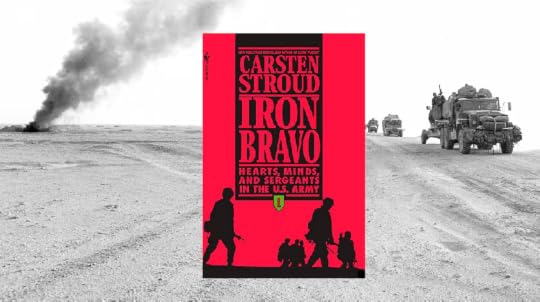
Here is the reality of military life as Crane sees it: the constant wariness, bred in Vietnam, that Crane wears like a second skin; the grueling training in the Mojave Desert, where he watches raw young recruits learn state-of-the-art warfare. Then comes the call to the Gulf and the weeks of tedious waiting in the cold, barren Saudi desert ("Wall-to-Wall Fuck All" they name it), weeks that culminate at last in the exhilarating, terrifying dash across the sands into the teeth of battle, moments that change the men forever, especially those who witness the unspeakable spectacle of two thousand Iraqi soldiers buried alive by U.S. earthmovers. Here, too, is the story of First Sergeant Dee Crane, member of a vanishing breed, caught between the uncompromising traditions of Fort Riley's legendary history, from Custer to Patton, and the changing needs of a society that too often derides and discards the soldiers who protect it. And here is the face of modern war itself - its mask of high-tech marvels disguising the bedrock reality of grunts who must take and hold ground as they always have: with blood and bravery. Through it all Stroud weaves the distinguished fighting history of the Big Red One, christened in the fiery crucible of the First World War, tempered by its massive defeat at the Kasserine Pass in the Second World War, battered in the grinding carnage of Vietnam, and resurrected with the strategies of Air Land Battle that proved so devastatingly effective in Desert Storm.
Carsten Stroud is the author of the New York Times bestseller Close Pursuit, and the award-winning Sniper's Moon, both set in the New York City Police Department. He lives and writes in Thunder Beach, Ontario, Canada.
I like Carsten Stroud's books. He used to be an investigative journalist and he has the ability to convey the atmosphere and ideas of people who inhabit the world of the military and law enforcement. Stroud is not a strict documentarian. He gets some details wrong sometimes omits others for the sake of the story, but he gets the atmosphere right. It's an overused phrase, but there is a "truthfulness" to his writing.
This book looks at a career sergeant in the Army during Desert Shield/Storm. It also examines the history of the 1st Infantry Division (The Big Red One) - which is the sergeant's division. It doesn't glamorize the profession, but it also doesn't attack it. Stroud manages to convey the love/hate relationship that so many have with the U.S. Army which includes me.
There is very little romance or glory in soldiering. What little there is gets grabbed onto by those who have served or or currently serving.That romance is polished and buffed until it's almost blinding. This book captures that attitude. Good and bad.
Owning skills honed on the bloody battlefields of World War II and not easily transferred to the civilian world after 1945, many took advantage of the GI Bill and learned a solid trade that could easily be turned into a prosperous future following the war; acting. Lee Marvin was no exception. Named for the Civil War Confederate General Lee, Marvin hailed from military stock, testing his mettle in the USMC as a scout sniper in the Pacific Theater in WWII, thus easily transitioning to roles as heavies and military bullies in his early days as an actor. By far not his most memorable movie or by which he is mostly remembered, THE BIG RED ONE, probably one of the most expensive B-movies ever made, did not tarnish the Oscar winning actor's legacy, as he would only do four more pictures before his untimely death in 1987. As with the 1980s picture, IRON BRAVO expands the composite of the US Army's 1st Infantry Division, THE BIG RED ONE, and tells its story all the way up to and just shy of the Global War of Terror.
From the line of departure, IRON BRAVO is a stream of consciousness that, of course, starts with the Big Red One in the Iron Triangle in the Vietnam War, and transitions into the birth of that fabled Unit after the turn of the 20th century when the long placid dream of the previous century was grinding to an end and dawned the steel, iron and the blood and machines of World War I. Paying close attention to especially the vaunted engagements on the Big Red One--1st Division, the reader is treated to a history of (U.S.) warfare from Pershing's bandito hunt in Mexico, WWI, the Vietnam War, US Civil War, the Indian Wars, WWII, the Crimean War, and Gulf War I. In essence, its an admiring tribute to those who've served under the Big Red One, who took on the charge of "No Mission Too Difficult, No Sacrifice Too Great, Duty First." Also spouting a fine descriptive entry and history for the geographic and military center of the USA, Fort Riley, Kansas, IRON BRAVO is, however, a fictional telling of "The Fighting First" through the eyes of its foremost combat expert and Vietnam Vet, First Sergeant Dee Crane. Insisting on the tried and true axiom that Sergeants and noncoms are the essential memory line of the Army, IRON BRAVO also tenders that there comes a time for old grunts to fade away, while young men are racing past them on their way up the career ladder; playing the 'Great Game'. Tempered, naturally, to heed 'Duty, Honor, Country,' the next generation must face that there's a time to get to the answer to the only real (and relevant) firefight question--Will I fight and will I die? For in the Big Red One, there's no dogging the line. 11 Bravo--if you're not fighting, you're cargo.
IRON BRAVO is also a reminder that the world and warfare is changing, that the mid-90s were the gateway to the dubious bedrock of global military strategists and the governments they serve; seeing war, combat actions as a sensible and predictable way of implementing geopolitical goals. In specific, IRON BRAVO argues that for Bush and Clinton it was about proportionality feeling good (about military action) rather than doing good. Conducting halfhearted wars, disguised feel-good missions without clear and defined goals. Taking it a step further, the narrative also serves a scathing review and criticism of Russian military capability (in 1995!) that calls into question everyone's reaction, including experts, who were baffled and surprised of the Russian Army's ineptitude and utter uselessness but sparkling drive and brutality (almost thirty years later during the illegal invasion of 2022.) In light of Desert Storm, combat readiness of Iraq and Warsaw Pact countries were greatly overestimated, but The Fighting First believed that the odds were with them. Not even the US Army could screw up all the time. Trekking towards the finale, IRON BRAVO indulges into the weighty battle of Norfolk, the wave of American iron that rolled through Kuwait and into southeastern Iraq the night of February 27 to February 28. A righteous wave of killing and destruction, a fine madness, all thunder, speed and searing exhilaration. A complete and crushing ruin for anyone facing the United States Army that turned the darkness literally into day with and insanity of molten iron. Like Verdun, Somme, Dresden. Deep in the red thundering heart of war, the cracking open of the world--a solid sheet of fire.
Seemingly somewhat the basis for THREE KINGS and JARHEAD, IRON BRAVO turns out glowing praise for the M1 Abrams tank, used to obliterate Iraqi and used Russkie T-72 and T-62 tanks that February 1991. Putting eyes to page nigh thirty years after publication, IRON BRAVO features interesting use of the Internet, plasma screens and satellites for tank warfare in Desert Storm. Alongside a nostalgic reference to Homey the Clown, IRON BRAVO also reminds of the undying importance of logistics in war and that no one gets out of war without being touched by fire--and that fire changes everything, changes it forever. Well researched and going deep, IRON BRAVO dishes often interesting dialogue and Army idioms and phrases like Rankers, PUNTS, Boston Marriages, ambition for rank, kakeshya torture, gravity ordnance, hull-down, tracer burn-out, and Semper Gumby. If the saying goes "war is hell", IRON BRAVO is kicking in the front door of hell. Allowing a harrowing fall forward into chaos, IRON BRAVO is a helluva ride that tests even the most tempered literary fortitude.