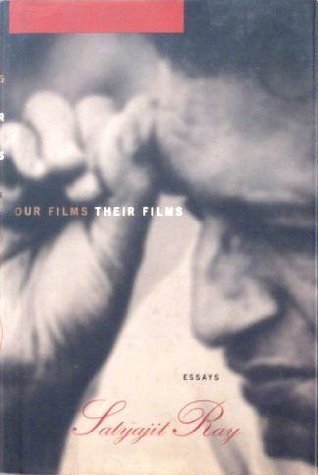
This book brings together Satyajit Ray's major writings and talks on film making and film makers, and presents them in two sections. 'Our Films' is devoted mainly to his own experiences and contains many interesting anecdotes, but also has observations to offer on trends in Indian films. 'Their Films' deals with some films from abroad that have become landmarks in the history of the cinema from the silent era to the present day.
Satyajit Ray (Bengali: সত্যজিৎ রায়) was an Indian filmmaker and author of Bengali fiction and regarded as one of the greatest auteurs of world cinema. Ray was born in the city of Calcutta into a Bengali family prominent in the world of arts and literature. Starting his career as a commercial artist, Ray was drawn into independent filmmaking after meeting French filmmaker Jean Renoir and watching Vittorio De Sica's Italian neorealist 1948 film, Bicycle Thieves.
Ray directed 36 films, including feature films, documentaries and shorts. He was also a fiction writer, publisher, illustrator, calligrapher, graphic designer and film critic. He authored several short stories and novels, primarily aimed at children and adolescents.
Ray's first film, Pather Panchali (1955), won eleven international prizes, including Best Human Documentary at the Cannes Film Festival. This film, Aparajito (1956) and Apur Sansar (1959) form The Apu Trilogy. Ray did the scripting, casting, scoring, and editing, and designed his own credit titles and publicity material. Ray received many major awards in his career, including 32 Indian National Film Awards, a number of awards at international film festivals and award ceremonies, and an Academy Award in 1992. The Government of India honoured him with the Bharat Ratna in 1992.
Early Life and Background: Ray's grandfather, Upendrakishore Ray Chowdhury was a writer, illustrator, philosopher, publisher, amateur astronomer and a leader of the Brahmo Samaj, a religious and social movement in nineteenth century Bengal. Sukumar Ray, Upendrakishore's son and father of Satyajit, was a pioneering Bengali author and poet of nonsense rhyme and children's literature, an illustrator and a critic. Ray was born to Sukumar and Suprabha Ray in Calcutta.
Ray completed his B.A. (Hons.) in Economics at Presidency College of the University of Calcutta, though his interest was always in Fine Arts. In 1940, he went to study in Santiniketan where Ray came to appreciate Oriental Art. In 1949, Ray married Bijoya Das and the couple had a son, Sandip ray, who is now a famous film director.
Literary Works: Ray created two of the most famous fictional characters ever in Bengali children's literature—Feluda, a sleuth in Holmesian tradition, and Professor Shonku, a genius scientist. Ray also wrote many short stories mostly centered on Macabre, Thriller and Paranormal which were published as collections of 12 stories. Ray wrote an autobiography about his childhood years, Jakhan Choto Chilam (1982). He also wrote essays on film, published as the collections: Our Films, Their Films (1976), Bishoy Chalachchitra (1976), and Ekei Bole Shooting (1979).
Awards, Honors and Recognitions: Ray received many awards, including 32 National Film Awards by the Government of India. At the Moscow Film Festival in 1979, he was awarded for the contribution to cinema. At the Berlin Film Festival, he was one of only three to win the Silver Bear for Best Director more than once and holds the record for the most Golden Bear nominations, with seven. At the Venice Film Festival, he won a Golden Lion for Aparajito(1956), and awarded the Golden Lion Honorary Award in 1982. In 1992 he was posthumously awarded the Akira Kurosawa Award for Lifetime Achievement in Directing at the San Francisco International Film Festival.
Once upon a time, I used to be a film buff. While pursuing IMDB Top250, got introduced to Apu Trilogy. And since then, have been a fan of Satyajit Ray films. This collection of essays are more like diary entries, and excerpts from his interviews from 1948 to 1968.
What I loved: -The intro, the clarity of thoughts, the learnings from his shoots. -What constitutes a great shot. The cinematography. The context. Why/how the director matters in hardening the theme. -That encounter and talks with the king of Jaisalmer. -Good structure and summarization of the Hollywood films which inspired him.
A must read for anyone who loves films for what goes behind the curtains.
A collection of writings by Satyajit Ray on the kind of films being made in India and abroad during his first 20 years as a filmmaker. I don't know if it is a must-read for cinephiles but it is meant only for cinephiles. The thing is I couldn't really wrap my head around many of the things he was saying coz they were about films n filmmakers not that familiar to me. I am a movie buff and I have watched my share of black n white films but still wasn't familiar with half the names. And the movies he talks about are too esoteric now. Initial 4-5 essays about how he shot certain films of his was enjoyable. His essays about Kurosawa, Chaplin, John Ford, Hitchcock and the Hollywood movie system were all very perceptive and enjoyable -though not comprehensive- due to some degree of familiarity with the work of the mentioned filmmakers (for me personally). The Kindle edition is not costly. So if you are a movie buff, I would recommend this.
An enjoyable, informative book by Satyajit Ray offering commentaries on our (Indian) films and their (rest of the world) films. Written in the manner of a discourse and observations on films it does not have a method or a definite purpose, but it is a must-read for film buffs.
A very informative read which takes us on a journey to development in movies and filmmaking. Satyajit Ray compares how filmmaking is different in the west from India most especially Bengal. We get a glimpse of the genius and his love for the craft.
Recently had the good fortune to catch "The Music Room" by Ray saheb on big screen and it just reinforced my admiration for the artist that Ray saheb was (feel uncomfortable to address him without a title). The 'Apu' trilogy were equally spectacular cinematic experience. So I was glad to chance upon these essays by the genius.
The book is a confirmation on how well Ray saheb knew this most complex and technical art form, how he was so knowledgeable on the precise requirements including the psychological aspects in creating this branch of art. Take for instance this distinction he makes between literature and movies to suggest that "a film maker who wishes to use modern idiom has even greater need of a simple framework."
"Here is a random extract from 'Ulysses'."Flood of warm jimjam lickitup secretness flowed to flow in music out,in desire, dark to lick flow, invading.Tipping her tepping her tapping her topping her. Tup..."
This cannot be read like light fiction if one is to make any sense of it. A reader who refuses to grapple with this kind of language is free to shut the book and put it away. One who does not must be prepared to take his time. But a film-goer's time is not his own time. Everything in the cinema, every kind of cinema-comic, tragic, light, serious, conventional, experimental-unreels at the constant speed of 24 frames per second. One cannot shut the film and think. One cannot go back to the passage, savour that imagery or turn of phase, ponder over that allusion and trace it to its source"
This is my first books on films, (having yet to start on Kubrick's book by Taschen) so not sure if others have made such distinction, so this was enlightening.
This book so clearly projects Ray saheb's knowledge and guidance on his craft, his opinion, that it almost felt like he was physically presenting these thoughts as a lecture, I could almost hear his voice. It felt so scholarly, possibly because he articulates them so well, so precisely. He has also penned some of his opinions quite humourously 'Those songs' which is a short critique on the elements of the song and dance routine in Indian film, not sure if it was a justification or a sarcasm.
The first part of the book 'Our Films', I felt Ray saheb expresses sympathy if not solidarity with the largely commercial nature of Indian film industry with all it shortcomings largely due to economic and resource constraints.
The book lost out on a star for me because Ray saheb sometimes appears to shift his emphasis on some of the methods and aspects of film making. As a guide, I was not sure if he insists / prefers style, technique, technology. Of course being a Master, he is an authority, but I felt some of the critiques appear too severe and harsh. He gets nostalgic and sentimental about the silent era, yet produced only 1 silent movie "Two" which was a 15 min short film and was in fact commissioned ! It could have been a bigger book if Ray saheb had brought out more of his knowledge and views on the process of film making especially cinematography and editing.
But overall, should be a great book for those interested in films.
Cinema as exposed to the general mass is mostly couched and is far away from any expression of art. This book exposed one to the finer cinema that one can truly pursue if one is interested. Satyajit Ray is a master himself in this medium and his critique even if not fully comprehensible to the common folk, has the power to open their eyes to an enriching and fulfilling work of cinematic art
I love Satyajit Ray movies because his movies are real and that he took Indian cinema to a higher level. His way of cinematic expression of pathos and revelry is moving and touching. But I never thought he was such a powerful writer. His literary style is just amazing and frankly I was glued to the book just to learn how to express one's thought process so eloquently and effectively.
A wonderful collection of essays, spanning two and a half decades, that look into the inner world of film making. As the title suggests, the book is divided into two parts. Much of the first part, Our Films, sheds light on the many occurrences behind the making of the initial Satyajit Ray films. Often both awe-inspiring and painstaking, Ray concluded that film making is a complicated business. Ray has also lucidly articulated various aspects of his craft and the flaws of Indian film making in general and Bengali films in particular, a lot of which persists even now.
'Their films' works as an introduction to a great many individuals who influenced Ray's works- Charlie Chaplin, Jean Renoir, John Ford, Akira Kurosawa. He fondly recalled watching Hollywood films during his college days and taking 'hieroglyphic notes'. He also works on highlighting aspects of films made across the world from a nuanced perspective.
A gifted storyteller, Satyajit Ray's book is a joy to read.
The book is a collection of essays by Satyajit Ray, the auteur, written with great clarity and simplicity. The book is divided into two parts. In the first part, Ray talks about his experiences, working methods, problems faced and the lessons learned during his film making endeavors in Bengal. He also delves into the subject of Indian cinema, what Indian films lack in particular when compared against western films and what are the challenges of being a Bengali filmmaker. The second part of the books is concerned with foreign films. In this part, Ray describes influences of western cinema in his formative years and his critique on the works of some of the acclaimed filmmakers of the west.
A chapter in the book is made out of an extract from a diary entry about Ray's 1956 visit to Banaras, presumably to shoot for the first film of Apu Trilogy. Ray chronicles many interesting anecdotes from his experiences of having shot a few parts of the film in the winding bylanes and on the sprawling ghats of Banaras. It also recounts an amusing incident that took place during the making of one of the iconic shots in Apur Sansar; that of a flock of pigeons taking flight and then settling down after circling in the sky. What makes it truly insightful read are Ray's keen observations about the light patterns, movements of people and how he identifies some peculiar settings to be worthy of being a potential shot. It gives us a glimpse into the inner workings of a filmmaker.
Out of the three broad stages of film making; writing, filming and editing, according to Ray, filming consumes all of one’s faculties - cerebral, physical and emotional. A writer could hole up into a secluded chamber to summon his creative spirit, an editor could slouch into his seat all day long putting all his creative energies to trim the film frame-by-frame, but a filmmaker needs to be there where the action is.
In these essays, Ray lays bare his thought process, ideas, sharp observations and perception of nuances in this art. While shooting for Bibhutibhushan Banerjee's Pather Panchali, he is confronted with practical challenges due to lack of his 'firsthand acquaintance with the milieu of the story' i.e rural setting in Bengal. So he sets about exploring a real village not very far from the city. Later as he explains his observations we begin to realize how the perception of a filmmaker goes well beyond just the audio-visual realm: " you wanted to observe and probe, to catch the revealing details, the telling gestures, the particular turns of speech. You wanted to fathom the mysteries of the ' atmosphere'. Does it consist in the sights or in the sounds? How to catch the subtle difference between Dawn and Dusk, or convey the gray humid stillness that precedes the first monsoon shower? Is sunlight in spring the same as sunlight in autumn?..."
Ray was one of those few filmmakers who borrowed greatly from literature. Most of his films were adaptations of Bengali novels with certain creative liberties taken for the medium. He never gave any ' thought to purists who rage at departure from original’. The fact that he could talk with equal ease about direction, editing, music, and cinematography speaks volumes about his deep knowledge in all the aspects of film making. “A cameraman who can not curb his instincts to take a pretty shot is often acting against the best interest of the film”. The book is replete with such interesting reflections and personal learnings.
Ray did not think highly of Hindi cinema. In Ray's view, Indian cinema lacked not only a universal appeal but also a certain standard of maturity. He believed that this was mainly due to the reason that Indian filmmakers had misunderstood the 'fundamental concept of a coherent dramatic pattern existing in time'. They mistook the action for movement and thus equated action with melodrama. American cinema in all its passing phases also exerted great influence on Indian films. Their cinema's formulaic content and ' superficial aspects' were 'imitated' in Indian films without giving much thought about cultural context. But what was impossible to achieve for Indian films was the ' technical polish which is the hallmark of a standard Hollywood product’. However on the topic of Indian new wave
Ray dedicates a chapter in the book on his interaction with the celebrated French Director, Jean Renoir whom he deeply admired. Renoir stayed in Calcutta for three months with his crew while shooting for the film ‘River’. His stay presented Ray with a rare opportunity to hold a series of tête-à-tête with him. These meetings played a vital role in shaping and reinforcing some of Ray’s views on cinematic art.
All in all the book gives an insightful peek into the mind of this multi-faceted filmmaker from our soil whose cinematic work was deeply rooted into the indian ethos and would continue to inspire generations of filmmakers to come not only in India but the world over. Thoroughly enjoyed this one. Certainly deserves a 5 star.
Sinemayı seviyorsanız, sevginizi bir kere daha tazeleyen bir kitap. Çevirisi iyi. Gerçek bir Editörlük çalışması yapılmış. Sunuş kısmında çok değerli noktalara işaret edilmiş. Bu noktaların dışında "Film Yapmak" ve " Bir Zamanlar Hollywood" başlıklı kısımlar sinema tarihi ve yapım derslerinde anlatılanları çok iyi özetliyor. Sinema ögrencileri için özellikle faydalı olabilir. Satyajit Ray kitap boyunca çok önemli sorular soruyor. Eleştirmenliği acaba yönetmenliğine göre daha doyurucu olabilir mi? diye düşündüm. Çok boyutlu bir kitap. Tekrar tekrar okunabilir.
The man who made some of my favourite films and wrote the beloved Feluda stories discourses on films at large. What comes across strongly for me is his love for Calcutta, and it is a wondrous thing to see. It is also interesting to read about the stalwarts of World Cinema in such familiar terms. A recommended read for anyone with a medium knowledge of films in general and a love for Ray's works in particular.
a nice collection of mostly short pieces reflecting ray's concerns for indian cinema and some great diary style entries he wrote while filming various projects. great for getting a bit more insight on his process and how he approaches achieving the high level of humanity that is the hallmark of his work.
I have read many works by this legend in his unique Bengali detective and Bengali scientist genres, and I had heard him speak, but I was unprepared for the depth of insight and economy of prose in his writing about the subject of cinema. Again, like George Orwell in Homage to Catalonia, a style that is simply his own.
'Our films their films' is yet another authoritative stamp on the eternal genius of Satyajit Ray. A must read for any movie buff, and before reading it, prepare to be blown by his handling of the English language. His sharp insights on foreign movies show why he is the greatest director ever from India. Respect.
کتاب در فصل اول از تجربه های ساتیاجیت رای در مورد فیلمسازی در ایالت بنگال هندوستان سخن میگه و تفاوت های فیلمسازی در هند... در بخش دوم در مقالاتی کوتاه در مورد بزرگانی چون چاپلین، فورد، هیچکاک و کوراساوا سخن میگه... اگه یک علاقهمند به سینما هستید، این کتاب رو زمین نخواهید گذاشت...همین :)
This book, the collected film writings of a man who was both an artist and a true lover of cinema, has brought me much more joy than I expected as I read and re-read the promising first words:
A filmmaker rarely writes about films. He is either too busy making one, or too unhappy not to be able to make one, or too exhausted from the last one he made.
My impression of Satyajit Ray has been that of the rare Indian artist revered by both Indian and foreign audiences, but I knew very little about his life and his personal relationship with films. As a result, some of my favourite passages from the book are the ones that seek to humanize him, revealing his boyish jubilation at meeting his favourite directors, or his frustration at seeing their decline, or his fascination during wide-eyed visits to the biggest film studios of the world. There is one particularly moving anecdote, in which he talks about the tragic deaths of two members of his crew, resulting from a faulty piece of film equipment that he had ordered:
I stood rooted to the spot, barely ten feet away, stunned by the magnitude and suddenness of the tragedy. It took me some time to realize that all this would not have happened if I had not set my mind on those overhead shots.
It is especially thrilling to read the passages in which he exhorts Indian filmmakers to forge their own unique school of cinema instead of merely aping the West:
... cinema has never been saved by writers ... No. Words are not enough. Words need the backing of action, or there is no revolution. And the only action that counts is that which a filmmaker calls into play by snapping out his word of command in his own particular field of battle. If his victory, and of many others like him, restore even a little of the dignity a great art form has lost, only then can we talk of having a revolution.
His commentary on the film culture prevailing in India is ruthlessly incisive, but not lacking in empathy. While he speaks of "lopsided film education", of a "lack of connoisseurship", and "undeveloped tastes" in reference to Indian moviegoers and critics, he is also dismissive of snide remarks against the abundance of music in Indian cinema, as he explains:
... to the vast conglomerate mass that makes up the Indian public, the cinema is the only form of available inexpensive entertainment. They have not the choice that the western public has of music halls, revues, plays, concerts, and even, sometimes, of a permanent circus. Yet the craving for spectacle, for romance, for a funny turn or two, for singing and dancing, remains and has somehow to be met. If the film does not meet it, nothing else will.
His knowledge of the history of cinema in all the major film-producing nations of the world is impressive in its detail, full of anecdotes recounted with the unmistakeable excitement of a true cinephile. Having said that, I feel that the inclusion of a few of his book reviews was a mistake as they produce a jarring shift from a man reflecting on cinema, to one dissecting books and personalities instead.
Lastly, I have to add that the official Kindle edition that I read was full of errors that were annoying and oftentimes so horrifyingly amusing that you laugh out loud, thus breaking the spell of Ray's persuasive writing. (Charlie Chaplin's The Gold Rusk, anyone?) Surely, the works of someone who can be considered one of the few renaissance artists of India deserves more than this kind of shoddy editorship.
Finally, a book on film criticism that is genuinely readable. So much writing on cinema veers into the abstract or the unintelligible, but Satyajit Ray brings clarity, precision, and a craftsman’s eye to every page. What makes this collection so compelling is that Ray isn’t writing as a detached critic—he’s writing as someone who has actually made films, solved problems on set, and thought deeply about the grammar of cinema. That practical intelligence shines through in his essays on both Indian and Western films.
The book is structured in two broad parts. 1. Indian cinema—its ecosystem, its constraints, its early infrastructure, and Ray’s own almost‑memoiristic reflections on making films in mid‑century India. 2. Western cinema—Ray’s readings of Kurosawa, John Ford, Truffaut, Griffith, and others, which feel both generous and sharply observed.
What’s especially delightful is the window it offers into the cinephile culture of 1940s and 50s Calcutta—a small but passionate community consuming world cinema with seriousness and curiosity. Ray’s essays give you a periscopic view into that world while also illuminating what he himself valued in the masters.
For anyone who loves Ray, Indian cinema, or simply wants film criticism that actually illuminates rather than obscures, this is a wonderful book. I’m glad to have found a work I can recommend not just to film students but to anyone who enjoys movies.
*Our Films, Their Films* is much more than a collection of essays on cinema; it is an invitation into the mind of one of the world's greatest filmmakers. In this thoughtful and engaging book, Satyajit Ray writes about Indian and international cinema with remarkable clarity, intelligence, and passion. His observations are sharp yet accessible, making even complex ideas about filmmaking easy to understand.
What makes the book especially rewarding is Ray's ability to connect cinema with culture, literature, music, and society. Whether discussing Hollywood classics, European masters, or the challenges facing Indian filmmakers, he brings both deep knowledge and personal insight to every page.
The essays remain surprisingly relevant decades after they were written, offering timeless reflections on storytelling and artistic integrity. For film lovers, aspiring filmmakers, and anyone interested in the creative process, *Our Films, Their Films* is an enlightening, enjoyable, and highly rewarding read.
The YouTube Algorithm ended up suggesting me a video on "Why Bollywood sucks" and the YouTuber happened to talk about this book and also recommend it. I picked it up quite impulsively after being intrigued by Ray's POV on Indian Cinema. This book gives a glimpse of his struggles to survive in a country where Hindi Films, the conventional "massy" films thrived. It starts off with him talking about the process of funding and making his films and then delves into Ray's opinions on the Indian audience, the filmmakers revered by the world, books about filmmakers and also, his tête-à-tête with a few legendary filmmakers. He comes across as quite a perfectionist and also occasionally a lil arrogant when he talks about the "uneducated Indian audience." Fans of his films will like it but even if you are not (I have only seen 2-3 films of his), you might relate to the struggle to stay true to your creative vision amidst the commercial pressures.
Rays's essays are of academic importance and are nothing short of a Bible for film-makers, aspiring or those already in the profession too. His insights on the minutest details of some classics offer pearls of wisdom on the art. He has held emotion above technicality and made an obviously intelligent comparison between the films of the West and that of the East. As a contemporary Indian with an interest in cinema - I also discovered the works of some incredible directors and I have Ray to thank for it. The book only underlines what made Ray a film-maker so ahead of his times, and a brilliant artist and critic, and an eloquent essayist.
Would have loved for this book to be a part of Film History classes in the film school I went to. It has a lot more to offer than the entire curriculum did.
A commentary of evolution of film making in India and other parts of the world
These are short articles penned by Satyajit Ray over a period of around 20 odd years from around late 1940s till around early 1970s. The first part mostly is about film making in India, more specifically in Bengal. He does not appear to be particularly enamoured of Bollywood. There are articles on the lack of availability of infrastructure and resources in Bengal. The second half of the book covers foreign film industry - French, Hollywood, Italian, Japanese. There are whole chapters devoted to a few individuals of the silent movie times and that a little later - Chaplin, Kurosawa, and the last chapter is on Ford.
A fantastic collection of essays as Ray runs a discerning eye over the many different genres, directors and movies of his time. You wish he were still alive and able to give you insights into movie making of the current day.
Read this book for my MA dissertation. A great book for laymen to get an introductory understanding of world cinema. Brief yet clear descriptions. Also, Ray's writing is so lucid, loved reading the book. Giving it a five star.
A collection of different articles by Satyajit Ray on movies and filming. A very good reference book on his own movies and also other Indian and foreign (French, Italian, British, American, Russian, Japanese) movies of his times.
Unlike Deep Focus: Reflections on Cinema, this book didn’t seem like stepping into the mind of the legend. Ray here, seems to be writing with caution, understandably so as most of the writings are from the initial period of his filmmaking.
There are several names and references that were beyond me, but I did learn a lot from this book. It’s a unique book in that it’s a filmmaking handbook as well as a film history book. Ray astounds as usual with his wide knowledge of various arts.
Intialainen mestariohjaaja kertoo näkemyksiään ja kokemuksiaan maailman elokuvista ja elokuvantekijöistä. Kirja on erinomainen lisä Rayn kirjoituksista kiinnostuneille, mutta jättänee todennäköisesti asiaan vihkiytymättömät ja Rayn näkemyksistä välittämättömät kylmäksi.