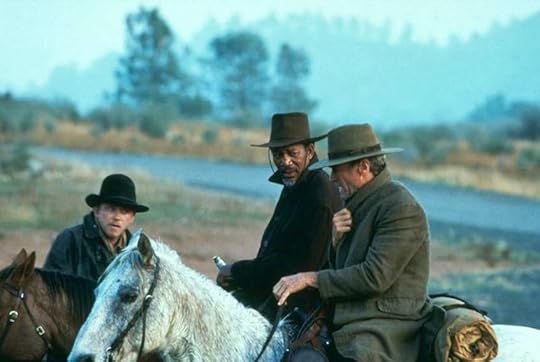
Unforgiven is dedicated to Don Siegel and Sergio Leone, Clint Eastwood's two cinematic mentors, who represent, respectively, the legacy of the classic Hollywood Western and the radical updating of the genre by Italian Westerns in the 1960s. William Munny, wonderfully played by Eastwood himself, finds himself confronted not only by the formidable sheriff Little Bill Daggett (Gene Hackman) but also by his own inner demons and the awful realities of violence and death. On its appearance in 1992 the film proved a popular and critical success, securing Academy Awards for Best Picture, for Eastwood as Director, for Gene Hackman as Best Supporting Actor, and for Joel Cox as Editor. Unforgiven is Eastwood's last Western to date, and the film may prove to be his swan song in a genre he has graced for more than forty years.
Edward Buscombe explores the ways in which Unforgiven, sticking surprisingly close to the original script by David Webb Peoples, moves between the requirements of the traditional Western, with its generic conventions of revenge and male bravado, and more modern sensitivities.
There is good violence and there is bad violence. You could say that the task of civilisation is to figure out which is which. I could say that whole movie genres are all about this question. The gangster movie, the war movie, the Western – all these show the struggle between bad violence and good violence. And the movies also demonstrate that we righteous members of the audience (and participants, however reluctantly, in real life) enjoy both types of violence. We like the gangsters roaring around in Scarface, Public Enemy, Goodfellas etc; and we like it when the FBI tough guys shut them down too. We have our cake and eat it too. The most extreme example of this bad violence/good violence problem is in the various rape-revenge movies, of which the most horrendous example is I Spit on Your Grave (what a brilliant title) – for half an hour we watch the disgusting rape of the victim; the last hour is dedicated to her violent killings of the rapists.
A lot, maybe most, of these movies are like adverts for violence.
In Unforgiven the violence becomes ever more ambiguous. Clint plays the over the hill William Munny who used to be a very bad violent man but he’s reformed and is now an unsuccessful pig farmer. But he takes up his gun again to seek vengeance for a poor prostitute who was razored by a vile cowboy at whose genitals she unfortunately scoffed. But Munny is only in it for the money. Little Bill is played by the always great Gene Hackman who loves to dish out violence, he relishes it - but wait – this is the good violence because he’s the sheriff of Big Whiskey and he is enforcing a policy of No Guns Allowed In Town. He seems to be dedicated to enforcing peace in sadistic ways. His good violence is bad violence in disguise.
Unforgiven is a great examination of the whole nasty business and this little book is an excellent discussion of it.
With these BFI Film Classic books you never know what you’re going to get, some terrible hoity toity professor writing unreadable jargon or the lovely gossip filled story of how the film was made; and all points between. But all these books are so pretty I have to forgive them.
Unforgiven by Edward Buscombe for the BFI Modern Classic series looks at what I consider to be one of the greatest western revisionist classics. It does a thorough job of debunking the myths of the west, while simultaneously creating them. I recently re-watched the film and enjoyed it as much as I did on the first viewing. It is only recently that I have been steeping myself in the genre after essentially avoiding it for years. Not so long ago I saw Peckinpah's The Wild Bunch began to wonder if I had been missing something. Buscombe gives a close reading of the film in context with the history of westerns and Clint Eastwood's career in particular. I also think it also has one of Gene Hackman's finest performances. It was interesting to know that Francis Ford Coppola originally bought the rights to the screenplay and that Eastwood didn't make significant changes to the script in the filming of this masterpiece.
Buscombe goes through "Unforgiven" from start to finish, not only commenting intelligently on the action before the viewer but placing it in the sweep of the history of the Western genre as well as in Eastwood's career.
It makes me wish Buscombe had written more about the Western.
If you like "Unforgiven" and Clint Eastwood, this is a must-read.
Buscombe provides good insight into the style, construct, and backstory of the movie Unforgiven and Clint Eastwood's role as both director and star actor, presenting his arguments and conclusions in easy-to-follow fashion. This is an excellent book for cinephiles and lovers of the Western genre.