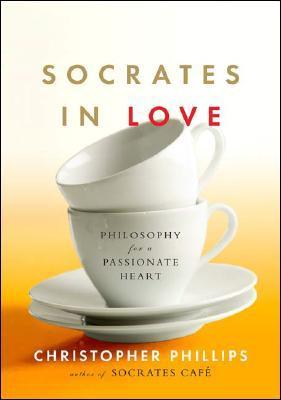
A breakout book completing a trilogy of Socratic exploration by the inimitable Johnny Appleseed of philosophy. Christopher Phillips goes to the heart of philosophy and Socratic discourse to discover what we're all looking for: the kind of love that makes life worthwhile. Love here is not defined only or even primarily as eros, but in all its classic varietiesfrom love of family and love of neighbor to love of country, love of God, love of life, and love of wisdom. Phillips's explorations take us from New Orleans at Mardi Gras and the gambling dens of Las Vegas to the last evangelical revival presided over by Billy Graham. He talks with moms and dads about "parent love," with inmates of a maximum-security prison about "unconditional love," with Hurricane Katrina refugees and a family who took them in, and with Japanese seniors and schoolchildren in Hiroshima Peace Park. Throughout, he enriches his dialogues with commentary on the great philosophers of love from the ancients to Rumi to Ayn Rand and Anais Nin.
"Christopher Phillips is the greatest living embodiment of the Socratic spirit in our catastrophic times. His global grassroots movement of Socrates Cafés and Democracy Cafés have transformed the lives of millions of people in every continent on the Earth. His brilliant and wise books have touched the minds and souls of so many of us. And his soulful style and genuine compassion have enriched the lives of we fortunate ones. When the historians write of the ugly and beautiful in our turbulent age, the Socratic words, works and deeds of my dearest brother Christopher Phillips should loom large." - so says none other than Dr. Cornel West, Dietrich Bonhoeffer Professor of Philosophy & Christian Practice, Union Theological Seminary; Author of of the classic 'Race Matters' and other works, public intellectual and civil rights activist.
Christopher Phillips has a passion for inquiry. A foremost specialist in the Socratic Method, sought after speaker, consultant and moderator, and noted author of works including the international bestsellers 'Socrates Cafe: A Fresh Taste of Philosophy,' 'Six Questions of Socrates: A Modern Day Journey of Discovery through World Philosophy', the critically acclaimed 'Constitution Cafe: Jefferson's Brew for a True Revolution', among others, including his newest work, 'Soul of Goodness' and a philosophical children's book series ('Day of Why,' 'The Philosophers' Club'), he reminds us that we ought to ask questions – “not about any chance question,” as Socrates put it in Plato’s Republic, “but about the way one should live.” He encourages us to turn on our childlike questioning lenses, and become our own best thinkers, askers, doers.
Dr. Phillips travels the world over holding dialogues with people of all walks of life. He believes that the process of dialogue and the space of human interaction are good for us as individuals and essential for us as a society. His goal is to inspire curiosity and wonder of a transformative sort, one that nurtures self-discovery, openness, empathy. The acclaimed educator exhorts his fellow inquirers to discover their own unique stores of wisdom and chart, alone and together.
Here's what two reviewers say about Christopher's newest book, 'Soul of Goodness':
"This textual gem of the heart, mind, soul, and body is an intellectual feast and existential blues song of he who decided to be true to his sacred Socratic calling and empty himself of his divine and human gifts in the open streets of the world to enrich the precious lives of us all." - Dr. Cornel West, author, Race Matters, Dietrich Bonhoeffer Professor of Philosophy and Christian Practice, Union Theological Seminary, educator, civil rights activist, author Race Matters and many other works.
"Soul of Goodness is a masterpiece which blends the images of the novel, the philosopher's wisdom and the journalist's clarity. Through an extraordinary use of these skills, Philips has given us a work of art which penetrates the nerve center of being as he patiently enters the interiors of pain, of suffering, culminating in joyous solutions as they seamlessly unravel in Global Socrates cafes to which visitors come to speak, to think and heal by the philosophical wisdoms of the vast literature of the Global South and Global North. In the hands of Phillips, philosophy becomes musical and music and poetry become philosophical. Written beautifully through the powers of images and narratives, the novel is used in the service of philosophy and philosophy itself as the dwelling place of all those who want to wonder, to imagine and be healed." -- Teodros Kiros, Professor of Philosophy at Berklee college & Harvard
كانت أسطورة إيروس التي قدمها سقراط في حوار أفلاطون هي الأحدث في سلسلة طويلة صاغها اليونانيون صانعي الأساطير. هسيود ، الشاعر اليوناني ومؤرخ الأساطير الذي عاش حوالي 700 قبل الميلاد ، يروي في كتابه Theogony ، أو "أصل الآلهة" ، أنه في التجسيدات الأولية ، ينشأ إيروس مع الآلهة الأخرى عند ولادة العالم. في أعقاب الآلهة كيوس (الهواء) وغايا (الأرض) ، خرج إيروس من الظلام البدائي وانضم إليهما كأول "الخالدين اللذين يحملون قمم أوليمبوس الثلجية". كان إيروس هو القوة الكامنة وراء ولادة كل الأشياء في الكون. في النهاية ، أصبح إيروس معارضًا لإيريس ، إله الفتنة. بينما سعى إيروس إلى ولادة جميع الكيانات التي من شأنها أن تملأ لوحة الكون ، كان إيريس عازمًا على التراجع عن جميع إبداعاته. في أساطير إيروس التي تلت ذلك ، أصبحت طبيعته وأهدافه أكثر ضبابية: يمكن أن يكون إيروس نفسه مصدر مثل هذا الصراع ، مما أدى في بعض الأحيان إلى التراجع عن إبداعاته الخاصة ، لذلك تم الاستغناء عن إيريس.
سرعان ما تحول إيروس من إله بدائي غير متبلور إلى إله ذي سمات مميزة. لقد أصبح "أجمل الآلهة التي لا تموت" ، والأكثر خداعًا - الشخص الذي "يثير أعصاب الأطراف ويتغلب على العقل والمشورات الحكيمة لجميع الآلهة وجميع البشر". كان إيروس الآن هو الإله الذي يمكن أن يولد شهوة لا يمكن السيطرة عليها ، وعاطفة ، ورغبة ، وشوق حسي. حتى معظم الحكماء لم يكونوا محصنين ضد قواه. . Christopher Phillips Socrates in Love Translated By #Maher_Razouk
“A lover in the mold of Socrates believes: I think I’m right in loving this and not that, in loving in this way and not that, but I could be wrong; I do not believe that my philosophy of love and loving is necessarily best.
When I saw Christopher Phillips’ Socrates in Love: Philosophy for a Passionate Heart at a local book store I wondered if it would improve upon Phillips’ first work in his ‘Socrates Cafe’ book series: Socrates Cafe: A Fresh Taste of Philosophy.
You can see my full review for that work here, but the gist of it is that I feel Phillips himself is an excellent person doing an admirable job inviting people, via Socrates’s Cafes, to wonder and learn from others like Plato’s Socrates. I only had two major gripes with Socrates Cafe: A Fresh Taste of Philosophy: it was marred by an clunky prose style and a bafflingly narrow use of the primary sources we have about Socrates (eg, all Plato, no Xenophon.)
Overall, Socrates in Love is a definite improvement over Socrates Cafe, though, Phillips’ prose remains just as uneven. Socrates in Love is structured into 4 sections with an introduction and conclusion. Each of the 4 section corresponds to a different type of love, respectively Eros, Storge, Philia, and Agape. Each section explores the type of love in question and is organized more or less according to this formula:
1. Phillips writes about Socrates and what he had to say about the relevant love. 2. Phillips presents a ‘dialogue’ which explores the relevant love. These ‘dialogues’ are presented as more or less faithful reimagination of an actual discussion Phillips was a part of at a Socrates Cafe. 3. Phillips writes about his conversion to the Socratic way of life, how he loves others, especially his wife while sharing personal details along the way.
I enjoyed Socrates in Love when Phillips focused on (1) and (3) rather than (2)
In other words, I thought this book was at it’s best when it focused on Phillips’ own thoughts about Socrates as a lover as well as Phillips’ own relationship to the Socratic lifestyle. As a rule, I didn’t enjoy Phillips’ written ‘dialogues,’ because I feel that just like in Socrates Cafe, the ‘dialogue’ participants all sound the same, talk past each other, and are awkwardly characterized. Consider this passage of ‘dialogue’ on how Vegas relates to Eros:
“Look I’m really glad for people like Evan and Lupe that Vegas is their pot of gold at the end of the higher passion rainbow,’ Denny says. ‘Like the McDonald’s commercial goes, they’re ‘lovin’ it’ here, and I’m lovin’ it here. We just have different reasons for escaping here and lovin’ it.
‘This place is purely impure,’ says Shelley a dancer at a strip club. ‘You can be whoever you are -transvestite, transsexual, straight, diehard Christian or atheist, a bit of all the above, whatever. It’s genderblind, classblind, colorblind. No one could care less where you’re from, what your politics are, your ethnicity, your academic pedigree or lack thereof. Our philosophy is ‘live and let live.’ Imagine what a lovely and lovable world it would be if all of it was like Sin City.
Harold, a lay minister, comments, ‘Just about an hour down the road is the Nevada Test Site, where the United States has conducted its nuclear weapons tests. It’s the ‘temple’ of destructive base passions. I’ve spent a lot of my life protesting at it’s entrance with other peace activists. People say, ‘Oh we’d never use nuclear weapons.’
Yet we have them, we have used them, and I fear we’ll use them again. I’ve met many who love the idea of what a nuclear weapon is capable of doing. And look at how so many these days, of so many religious persuasions, find the ultimate passion in killing the innocent-the more the better. Vegas is harmless in comparison, even beneficial in some ways as an outlet for venting one’s darker impulses from time to time-but in moderation.’
Now I admit that perhaps I don’t know enough strippers, and while perhaps plenty of them may be anxious about their education level, I do seriously question how many of them would say that what Vegas truly offers is in regards to Eros is the ability to be appreciated regardless of your ‘academic pedigree or lack thereof.’ Phillips’ stripper, like most of his characters, sound awkward at best and unbelievable at worst.
Now, in fairness to Phillips, this passage is the most awkward I noticed, which is why I selected it. Still I think this passage is a fair representative of how each dialogue is structured, if not how stilted each dialogue participant sounds.
Generally, Phillips’ ‘dialogues’ possess no genuine back and forth, it’s just a group of people monologuing in the each other’s vicinity. Participants talk past each other, not to each other. As I result, I never felt these ‘dialogues’ builds towards anything, even aporia. This meandering meaninglessness inspired me to skip Philipp’s dialogues after the Eros section. I found that after I stopped trying to read the dialogues, and focused on what Phillips himself thought about Socrates that I particularly enjoyed this book.
Hopefully Phillips will learn to better cull and compose his future dialogues. Part of me wonders if the monologue nature of his dialogues comes from the fact that actual Socrates Cafes are groups of people talking to each other rather than a discussion which more or less focuses on two people, you know, as in actual dialogues.But now, with these gripes out of the way, I’d like to focus on the strengths of Socrates in Love and give Phillip’s a well deserved encomium.
Whatever’s it’s stylistics stumbles,Socrates in Love does a great job making Socrates on the subjects of love, friendship, and family accessible to a general audience, and given this is Phillip’s admirable goal, on these merits alone, I’d say the book is a success, whatever it’s other faults.
One thing I particularly appreciated about Socrates in Love, (as opposed to the earlier Socrates Cafe) is that Phillip’s integrates both Xenophon and Plato’s accounts of Socrates on love, friendship, and family. To give an example of this, Socrates on family is what I’ll focus the rest of this review on, because Phillip’s brought my attention to a familial side of Socrates I myself had entirely ignored, a side of the Socrates I suspect is often overlooked even by professional philosophers.
Conventional wisdom has it that Socrates wasn’t much of a father, or as the Stoic philosopher Epictetus would put it, Socrates’s role as a philosopher more than occasionally conflicted with his role as a father, and he often played the philosopher role at the expense of the father role. Yet, as Christopher Phillip’s makes clear through his careful and sustained reading of Xenophon, a conclusion like Epictetus’s isn’t necessary. There is strong evidence to suggest that Socrates saw parenting well as a model for cultivating virtue.
Phillips suggests this by drawing the reader's attention to a passage in Xenophon where Socrates lectures his son, Lamprocles, for his ingratitude towards Xanthippe, who was Lamprocles’ mother and Socrates’ wife. In this passage -for which I will provide a link to the original here and paraphrase below- Socrates shows Lamprocles why he should be grateful rather than frustrated for the attention his mother pays him with a series of arguments uncannily akin to those a Confucian might make about filial piety and ancestor worship.
Here’s my somewhat liberal paraphrase of the passage from Xenophon:
“SOCRATES: So my son Lamprocles, let's recall the argument so far.
We know you believe your mother has done you no wrong, only good, and yet you remain frustrated with her. You also believe you should concern yourself with earning the goodwill of total strangers. You wish to be known as a grateful and just person.
Yet, at the same time you see no need to show consideration for your mother, who has done you more good and loves you more than anyone else?
I suggest you reconsider your attitude if you wish anyone to consider you a just person.
Don’t you know that the State ignores most kinds of ingratitude, and prescribes no penalty for it, turning a blind eye when most beneficiaries fail to repay favors; but if anyone shows no consideration for his parents, the State imposes a penalty upon him and disqualifies him from holding public office?
Why? Because the State rightly assumes that the official sacrifices a public servant is required to perform could not be performed on behalf of the State with the necessary proper piety if a foolishly ungrateful child performed them.
Similarly, the State also rightly assumes that no other important public rituals which require an attitude of respect or gratitude can be well and duly carried out by foolishly ungrateful children.
For the same reasons, anyone who wishes to be become a candidate for public offices finds their familial conduct scrutinized by the State, especially those who fail to reverently and regularly tend the graves of their dead parents.
‘So my son Lamprocles, if you are sensible you will beseech the gods to pardon any disregard that you have shown towards your mother. Otherwise the gods themselves may count you as ungrateful and refuse to do you good.
And so too with your mortal fellows.
You should also take care that your fellow men don’t observe you neglecting your parents because then they too will have reason to lose all respect for you and abandon you, leaving you without friends.
Wouldn't you be wary of anyone dismissive of the value of gratitude for good parents? Consider your lack of piety and gratitude from another's perspective.
If your friends -or anyone else- knew you were constitutionally incapable of being grateful to even your parents -who you yourself admit have only done you good- why would anyone consider it reasonable to trust you or expect gratitude from you whenever they did you a favor or gave you a gift?’
Xenophon’s Socrates sees the role of the family and gratitude towards them as integral in creating a virtuous character, living a good life, and creating a good society.
Contra Plato’s Socrates in the Republic, Xenophon’s Socrates suggests that our political and social order grows naturally from how our moral character is shaped within our families. For Xenophon’s Socrates, the family is the bedrock of the just state, rather than the first social group we need to abolish to create a just state. This Socrates shows a distinct Confucian streak, one which contrasts with Socrates's informal reputation as an absentminded professor or dead beat dad of sorts.
While I had read Xenophon before reading Phillips I had completely overlooked this passage. And if it weren’t for Phillips I still would be forgetful of it. I suspect I am not alone.
Phillips has clearly done a very close reading of Xenophon, and in doing so has made me sensitive to a side of Socrates I -and I am sure many others- have completely overlooked. Yet impressively, Phillips has done all this not in an academic tome, but in a readable book for a public audience.
Phillip’s has come a long way since Socrates Cafe. Now he knows his Xenophon just as well as he knows his Plato. So, if you are the kind of person that enjoys sharing your love for Socrates with others this book will at least amuse if not outright delight you. Finally, to leave you with a positive taste of what to expect in Socrates in Love, I’ll close with Phillips on the subject of what he believes it means to be a lover like Socrates:
“A lover in the mold of Socrates believes: I think I’m right in loving this and not that, in loving in this way and not that, but I could be wrong; I do not believe that my philosophy of love and loving is necessarily best. Rather, it can be supported or refuted only be methodical inquiry with others, who also have carefully considered and cultivated passions that may be quite different than my own. It is critical that I weight mine against theirs, seeking to discover what speaks for and against each.
Moreover, I operate from the premise that there is always more to know about love and what I already know likely is always wrong to some degree, or at least is never altogether correct. I will not emerge unchanged from my enquiries on matters of love, no more than will those who inquire with me, and that is to the good. It is how we grow together as individuals and and as a community; it is how we push forward the boundaries of knowledge about love and loving in ways that, at their best, can help us sculpt a more participatory world.”
There are two types of philosophy books. There are the serious types that you typically read in philosophy classes and that professional philosophers read. They present problems in philosophy and are asked to be taken seriously. Then there are the fun types. Good examples of these books are Family Guy and Philosophy, South Park and Philosophy, Simpsons and Philosophy, and Plato and the Platypus, and so on.
Socrates in Love falls somewhere in the middle. Phillips has started a concept called Socrates’ Cafes. What are Socrates’ Cafes you ask? It’s where you get a group of people (where most of them haven’t studied philosophy professionally) and then you ask simple questions. “Why are we here?” “What do you consider friendship?” “What is the good life?”
In this book, the author goes to different places asking questions that pertains to love. He goes to Las Vegas and asks “What is passion?” He goes to Iraq and asks soldiers “What do you consider your duty?” He goes to New Orleans and asks “What is a community?” after Hurricane Katrina hit. He goes to a maximum security prison and asks “what is unconditional love?” He goes to an evangelical conference and asks “what is humanitarian love?”
The book talks about what these average people have said, then the author sprinkles in some anecdotes about what historical philosophers have said, as if it as apropos to what the average people have said. For example, someone says that passion is doing what you love doing best, and gaining pleasure from it. To which the author switches to saying something like, “ahh, well that reminds me of what Socrates said, he said. . .” At first, it can get irksome, but you get used to it.
Some of these answers were interesting, but I wouldn’t take it seriously. It seems that the author only puts in positive aspects of his Socrates’ Cafes experiences. I wonder if any of them have failed. At the same time, it seems that he doesn’t go further with the Socratic method. He takes in a simple answer and leaves it at that, whereas Socrates would’ve really pursued further in the hopes to the truth. Most of the answers that the people gave, I found, were too simple and didn’t have a lot of philosophical underpinnings. But then again, these people don’t have any philosophical training.
Someone who has little philosophical training might like this, perhaps may even be inspired with this, but like I said, this isn’t serious philosophy. Others might read this as a self-help book, which I wouldn’t consider at all. I didn’t really see this as “inspriational,” but more about “here’s what people have to say about love.”
There is so much love in this book for everyone; yourself, your lover, your family and friends, the wider community and for the sake of mankind. How can I not love then?
The story of Arete via Eros, Storge, Xenia, Philia and Agape. The five forms of "love" that bring us toward each other and the universe. This is not a fluffy self-help book about loving yourself. You won't find any traditional relationship advice here either. This is Phillips telling us about Socrates once again, focusing on Socrates' all-around purpose, to reach Arete, excellence in moral virtue using the elements of love, love for our partners, love of strangers, love of family, love of friends, love through sacrifice, without condition. He shares how Socrates attempts to teach us these loves using his method of interrogation and critique, reform and revision in order to heal Athens and the world. This is the story of philosophy in a nutshell.
Phillips also gives me a long list of suggested books to read, philosophers he mentions throughout his book that I want to review.
Read for program planning purposes. This book and Socrates Cafe (by the same author) are good resources to execute a successful Philosophy discussion group.
2.75* because I read this book for school and I usually base my ratings off of enjoyment this is slightly low, but overall it was still super interesting. it was also my first time reading any type of philosophical book, so that was interesting as well.
I enjoyed this particular book by Christopher Phillips the same way I appreciated his other works, "Socrates Cafe" and "Six Questions of Socrates." Like other pop philosophers, such as Alan De Botton, I like Phillips's books because they turn philosophy into, in the words of Tavis Smiley, useable knowledge. The book thoroughly covers in very accessible prose the six types of love elaborated by Socrates. In delving into each type of love, Phillips also incorporates insightful musings of a diverse range of other wonderful thinkers and concrete ethical examples. One may find his dialogues with everyday people to be totally contrived. These random people, from evangelists to stay-at-home moms, to young kids, may have the ethical astuteness of philosophers, but they totally sound like one too, bantering with esoteric vocabulary as if it is everyday language. And one may also find his philosophizing a bit too loose and flowery. But the virtue of this book is that one does learn many cool concepts and insights that are relevant to one's own life. The book is enriching. It is a book that blends both intellectualism and romantic passion.
Provocative and moving. A smorgasbord of questions leads to some striking conclusions as well as unanswered proposals. There is much here to contemplate. It is also fun and enlightening about how we make decisions about what to do with our lives. The examined life is what we are looking for at all times.
The people that the author encounters are by turns helpful and difficult. As in life there are no easy answers and also no easy questions. What does it mean to be in love? How should we proceed after falling in love? What does it mean to love country, family and ideals? Yes, the big questions. In a series of symposiums the participants from an extremely and surprisingly varied palette bring their own set of beliefs. The outcomes are just as varied.
You will want to start your own group upon reading this. We all should. Christopher Phillips deserves accolades for a noble experiment in what philosophy is really about and who should be about it.
Socrates in Love explores the significance of the five types of love as defined in ancient Athens: eros (erotic-romantic love), storge (familial love), xenia (love of strangers), philia (communal love), and agape (self-sacrificial or unconditional love). In each chapter, Phillips provides insights from various philosophers and then shares discussions that took place in various Socrates Cafés.
The first discussion that occurs in the eros chapter takes place in New Orleans during Mardi Gras. One girl says eros is free love and a dentist counters that uninhibited sex trivializes eros. Another adds his take: “Eros is what you covet so much you’re a slave to it…It’s what you can never get enough of, no matter how often you get a fix of it.”
In these discussions, Phillips doesn’t offer a right or wrong answer; he merely provides enough viewpoints to get the reader thinking. A great read for anyone with an open mind.
Christopher Phillips here writes another Socrates Cafe style book involving engagement in philosophical discourse with various groups of people all over the world; this book regards Socrates five categories of love. Chapters are broken down by each of these, and throughout offers both classical definitions of these terms and forms, all the while providing dialogue of those discourses revolving around each form of love. The book reads wonderfully, and is a true testament to the binding power of love throughout humanity: it is something we all share. By questioning and bringing to light how love is created and brought to life amidst all of us, Phillips brilliantly brings Socratic philosophy to today's reader. Arete!!!
Fabulous book for anybody interested in philosophy or love. Really, who isn't interested in love? I would describe this as "philosophy for the normal person." From romantic love to family love to love of society everybody can get something out of this and will find themselves looking at their own lives a little more deeply. I found myself highlighting so many great passages and taking a look at my own life.
I embarked on this reading journey without any preconceived notions of love in a philosophical context. I am glad I chose this book because I have come out the other end more enlightened than before. The personal accounts of all the people who contributed (in their dialogues) towards the book sets the warm tone - And that personally for me was the best way to learn about "love"
Highly recommended to anyone who wants to start somewhere on what love is all about!
A good overview of the five types of love (eros, philia, xenia, storge and agape) for anyone not familiar with the subject. The book is a little bit chaotic in presentation due to the author's choice to break each section into small, related chunks instead of solid chapters. Overall, I really enjoyed the quick look into the philosophical meaning behind and overarching themes of love in its many incarnations.
The most intriguing part of this book was that the author actually travels around and talks about philosophy w/ groups of people th/out the world. Kind of as you would imagine Socrates himself doing (geographically more limited of course).
I found the book somewhat thought provoking and educational, although not a favorite read of mine by far.
Excellent Book!!! This will not be my last time reading this selection. I absolutely love in depth explanations given for each of the 5 kinds of love. The most important thing is that I found out that I'm not as perfect as I once believed. I felt like I was in such a good place while reading this title. LOVE, LOVE, LOVE!!!!!
Excellent Book!!! This will not be my last time reading this selection. I absolutely love the in depth explanations given for each of the 5 kinds of love. The most important thing is that I found out that I'm not as perfect as I once believed. I felt like I was in such a good place while reading this title. LOVE, LOVE, LOVE!!!!!
Insights about relationships between individuals and about how one fits into a political body, drawn in part from interviews and discussions with people identified by first name only. A good explanation of the meaning of Socrates' life and work and why the authorities in Athens could not bear the kind of dialogue and inquiry he encouraged.
He gives a brush stroke overview of the history of philosophy and how it relates today. I would recommend it for someone taking a new interest in philosophy. It too light for the more philosophically advanced
The 3rd in the series of Christoper Phillips' books on modern philosophy. Like the 2nd book of his, I enjoyed it, but not as much as his 1st which I gave 5 stars to.