After describing the parts of a bird, the book has a table of contents which is also a quick reference list for bird classification. Maps give the location of the area in which the bird is found.
Herbert Spencer Zim (July 12, 1909 – December 5, 1994) was a naturalist, author, editor and also known as the fonder and editor in chief of the Golden Guides series of nature books. He wrote or edited more than one hundred scientific books, and in a thirty-year career teaching in the public schools introduced laboratory instruction into elementary school science. He is best known as the founder in 1945, of the Golden Guides, pocket-size introductions for children to such subjects as fossils, zoology, microscopy, rocks and minerals, codes and secret writings, trees, wildflowers, dinosaurs, navigation and more. He was the sole or co-author for many of the books, which were valued for their clarity, accuracy and attractive presentation helped by the illustrations of James Gordon Irving. He continued to work on the Golden Guides series until Alzheimer's disease forced him to slow down in the 1990s. He died in 1994 at Plantation Key, Florida.
When we were young kids, my brother was given a BB gun, while I was given this book. He and his friends used to shoot at the birds in our apricot tree in the summer months when the fruit had ripened. I could never stop him since he was bigger than me, and because I was not a brave little girl in spite of my giving a boy a bloody nose when I was in the second grade. I just love thinking about that one and had to add it.
Well, I should have climbed up the tree and refused to get down. I am not sure what he would have done then. When he wasn't around shooting at birds, I would do just that, climb into the tree and pick the earwigs out of the fruit, letting those nasty bugs drop to the ground while I gorged up the fruit. Having done that as a child I am sure I can still pick bugs out of fruit and eat, not the bugs, but the fruit. But we don't get bugs in our fruit trees; the squirrels steal the fruit first, and what they steal isn't that great because the fruit has brown rot, and I am not interested is spraying with a fungicide.
Anyway, I loved my little book. I learned the name of birds, my favorite being the yellowbellied sapsucker, which name I would call my brother when I wanted to irritate him. We used to pick names out of the dictionary and call each other strange animal names, like Platypus, Anteater or Armadillo. Maybe even Bug Eye. I like that one. I never saw a yellowbellied sapsucker, but three years ago I found a feather from one in our backyard. You see, I learned how to ID bird feathers after moving to Oklahoma. At least you get to see part of a bird that way.
We live on a migratory route now, and it goes right through our yard. My husband put up a clothesline for me, and I thought maybe we would always have clothing with bird poop on them. No, never happened. Actually, I am spoiled by the dryer in our house.
I missed the pelicans that they have in Morro Bay, CA when I lived near there, but then I learned if you take a drive to one of the lakes here you can see pelicans, white pelicans. Wow!
And then there are the bald eagles that nest near here. One day when I was driving in the country I saw a bald eagle sitting on a fence post and just as I was driving by it flew into the air. I was in awe over its size, to even think I saw one.
We feed the birds here, but we don't have as many as there were before the earth began grumbling and the birds and other creatures began dying off or being killed by people. If people are hungry, then I can understand killing, but they had better be poor too.
We have starlings at our cat feeding station in the winter, because it is cold, and they are hungry. Some people hate them, but while they are eating us out of house and home, we still let them eat the cat food, and then when they fly off, we put out more cat food for our seven feral cats, which by the way, just leave them alone as they are not much into hunting.
When we lived in the country in Creston, CA we used to get starlings on foggy days. I would hear them and look outside, and there they were, hundreds of them in the trees. The sound always took me back to the jungle in Palenque, Mexico where the birds were so vocal and the night when my friend Julie and I slept in my VW bug on a lagoon across from Isla Mujeres. The night sounds woke me up and actually frightened me for a moment, but when I woke up the next morning, I saw all these pink flamingos sitting on broken pier posts making the same racket as what I had heard that night.
A couple of years ago when we went back east to check out the beaches, we drove to Florida's swamp, and there was a road that went right though it where alligator's basked in the sun along the road. Rather unnerving. All the sudden we saw a large feather coming down in front of the car and a great heron flying overhead. We stopped, back up the car to the feather, and I looked around to see if there were any alligators nearby, open the door a crack and quickly grabbed the feather. Then I thanked the great heron for the gift.
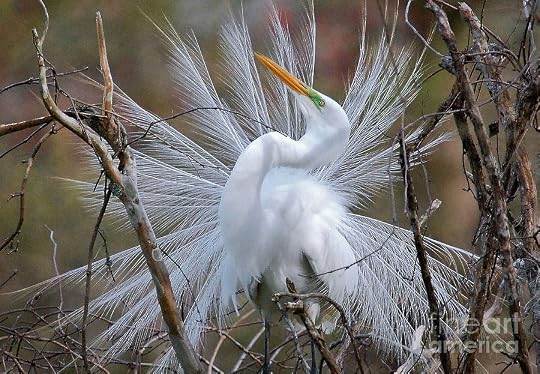
Just before getting to Florida, miles before, we were on St. Helena Island, and when we were driving along we saw a tree in a field that looked like it had white plastic garbage bags in it. We stopped, got out our binoculars and found that they were not bags but great white egrets, and when they flapped their wings it was just beautiful. Here's a photo:
Wouldn't it be nice to have an egret tree?
And yesterday, as I am updating this, when I walked my dog it was foggy, and the trees were filled with starlings. I thought of Creston, not Mexico. Note: My brother Bill doesn't harm birds anymore. Nor did he become a hunter. He became an artist instead.
I got this years ago and hung on to it. I think I moved and then mom scooped it out of the Goodwill bag. Glad she did. I keep seeing either Titmouses or something I already forgot that I keep seeing in the media.
A whole bunch of these Golden Guides were at grandmother Lajla's summer house in SW Michigan when I was growing up and I likely read all of them on cool fall evenings when there was nothing else to do and Dad was listening to classical music on the radio. They were hardbound, those early copies, pocket-sized and cheap. I particularly liked the distribution maps.
It's amazing to realize how many birders - probably well over a hundred thousand - grew up since the 1950's with the memory of this as their first bird guide. I hope it continues to play that role forever.
This was my bird book as a child and now it is my son's. It's a well-drawn, simple bird book appropriate for children that can help start a life-long appreciation of birds and nature.
These have lovely art and provide a nice brief description of each bird. Not really a usable "guide" but a nice introductory book on birds of north america.
I really liked this book, because I was interested in many animals, so I was able to get information that might be unfamiliar to me about birds. It was good to know exactly about the bird's body structure from the beginning through this bird, and it was even better to be able to see accurate and detailed pictures of the bird. Also, I liked this book because I was able to get information about the characteristics, appearance, and region. For example, through this book, page 101, I got to know a bird called the American Redstart, males have orange and black colors, females yellow and olive gray, and are constantly flying, preying on insect flycatcher fashions, and the evergreens of Arizona and New Mexico. We've also been informed that the forest has a red chest and a gorgeous white tail patch. Finally, these detailed pictures and detailed information have been a great experience and opportunity for me as I want to become a veterinarian.
Accurate title, all birds and bird details. Had me looking up the calls of many birds I read about. I have the older run that had illustrations instead of photography and I have to say I prefer it this way. Great way to kill a few hours.
My little neighbors gave me this book to borrow since they always visit me while I’m working and I’m never not gonna read a book about birds 😍 love me a highly detailed children’s book! Published before either of my parents were born!!
I've been so interested in bird-watching lately and would really like to develop such a pasttime / hobby. This book was a great introduction to the fascinating world of our feathery friends =)
I love and cherish this book! It was passed down to me by my grandmother before she moved to Ohio. It may be tattered and worn, with a faded cover but I love looking up birds in it to this day. I think of her every time I look through it. She bough it in the late 1950's brand new when she was in her early 40's. When I was a child growing up and went to visit her, she would tell me what the birds at the bird feeder where named. So if I saw something new I would ask her what it was called, if she didn't know she would pull out her bird book and we would look it up together.
This is a great book to have on hand to identify birds--I learned so much! Ira N. Gabrielson should not be listed as the first author, though. The first author is Herbert S. Zim, Ph.D.