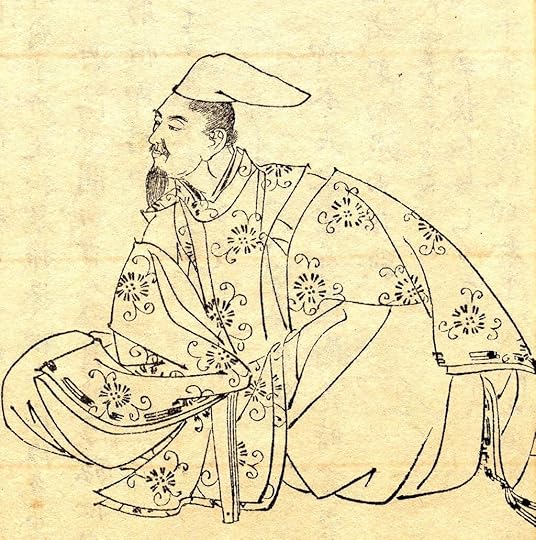
Helen Craig McCullough (February 17, 1918 – April 6, 1998) was an American academic, translator, and Japanologist. She is best known for her 1988 translation of The Tale of the Heike.
'Japanese poetry has the human heart as seed and myriads of words as leaves. It comes into being when men use the seen and the heard to give voice to feelings aroused by the innumerable events in their lives. The song of the warbler among the blossoms, the voice of the frog dwelling the water—these teach us that every living creature sings. It is song that moves heaven and earth without effort, stirs emotions in the invisible spirits and gods, brings harmony to the relations between men and women, and calms the hearts of fierce warriors.
Our poetry appeared at the dawn of creation. But that which survives goes back to Shitateruhime in the eternal heavens and to Susanoo-no-mikoto on the ore-rich earth. In the era of the mighty gods, the number of syllables in a poem was unregulated and statements were artless, so that it must have been difficult to grasp nuances of meaning. When the human era began, Susanoo-no-mikoto introduced the thirty-one-syllable poem. Thenceforth, conceptions and words became multifold and diverse as poets praised blossoms, admired birds, felt emotion at the sight of haze, and grieved over dew. As a long journey begins with an initial step and continues for months or years, or as a high mountain grows from the dust and mud at its base to tower where heavenly clouds trail, so too must it have been with poetry.'
naniwazu ni saku ya ko no hana fuyugomori ima wa harube to saku ya ko no hana
Flowers on the trees in bloom at Naniwazu say, "Now the winter yields its place to the springtime!" Flowers blooming on the trees.
saku no hana ni omoitsuku mi no ajiki nasa mi ni itazuki no iru mo shirazute
What a foolish thrush! Enthralled by blossoming flowers, he has no knowledge of the arrow someone shoots to penetrate his body.
kimi ni kesa ashita no shimo no okite inaba koishiki goto ni kie ya wataramu
If on this morning you go your way and leave me as frost leaves the sky, will my spirit melt in grief each time I long to see you?
wa ga koi wa yomu tomo tsukiji arisoumi no hama no masago wa yomitsukusu tomo
If someone might count every tiny grain of sand on a rocky shore, he still could not reckon up the number of my yearnings.
itsuwari no naki yo nariseba ika bakari hito no koto no ha ureshikaramashi
If this were a world in which there were no such thing as false promises, how great would be my delight as I listened to your words!
'Because people nowadays value outward show and turn their minds toward frivolity, poems are mere empty verses and trivial words. The art of composition has become the province of the amorous, as unnoticed by others as a log buried in the earth; no longer can it be put forward in public as freely as the miscanthus flaunts its tassels.
In the beginning, it was entirely different. Whenever there were flowery spring mornings or moonlit autumn nights, the Emperors of past generations summoned their attendants and commanded them to compose poems suitable to the occasion. Sometimes the poets strayed in unknown places, drawn by the blossoms; sometimes they groped in unfamiliar darkness, hoping to see the moon; and we may suppose that the Emperor understood which man was wise and which foolish when he perused their sentiments.
Nor was the practice of the art restricted to such times. Men found comfort in composing poems in which they expressed wishes for a lord's long life or for patronage through comparisons with pebbles or allusions to Mount Tsukuba, or in which they gave voice to gratitude for favors beyond their stations or for benefactions that filled their hearts to overflowing, or in which they compared romantic passion to Mount Fuji's smoke, or yearned for friends at the sound of waiting-insects, or in which they thought of growing old in the company of the Takasago and Suminoe pines, or recalled past days when they were like Man Mountain, or sighed over the brief blossoming of the maidenflower.
Likewise, they turned to poetry when they saw blossoms scattering on a spring morning, or heard leaves falling on an autumn evening, or lamented as the years bought snow and waves [white hair and wrinkles] to the reflections in their mirrors, or recognized in dismay their resemblance to dew on the grass or foam on the water, or lost yesterday's prosperity, or were treated coldly by former intimates after falling on hard times, or linked their love to the waves at Matsuyama, or drank from field water, or gazed at the lower leaves of bush clover, or emulated the restlessness of the snipe beating his wings before dawn, or spoke to others of trials as numerous as the joints on black bamboo, or made reference to the Yoshino River to complain about the ephemerality of relations between the sexes. When people today hear that smoke no longer rises about Mount Fuji, or that the Nagara Bridge has been rebuilt, the poetry [of the past] is their sole consolation.
Poetry is thus of great antiquity, but it was not until the reign of the Nara Emperor that composition became widespread. (It may have happened because His Majesty was especially skilled in the art.) During that reign, there appeared a poetic genius called Kakinomoto Hitomaro of Senior Third Rank. With such a poet in such a reign, there must have been a perfect union of Emperor and subject. To the Emperor's eyes, colored leaves, floating on the Tatsuta River of an autumn evening, resembled brocade; to Hitomaro's mind, cherry trees, blooming in the Yoshino Mountains on a spring morning, seemed exactly like clouds. There was another man, Yamanobe Akahito, who was also an extraordinary poet. It was impossible for Hitomaro to excel Akahito, or for Akahito to rank below Hitomaro.'
'Not many people have known of the achievements of the past or been able to compose poetry of their own. We shall discuss the ones who have done so, omitting those of exalted rank and office as a matter of discretion.
Among well-known recent poets, Archbishop Henjō masters style but is deficient in substance. It is no more satisfying to read one of his poems than to fall in love with a woman in a picture. The poetry of Ariwara no Narihira tries to express too much content in too few words. It resembles a faded flower with a lingering fragrance. Fun'ya no Yasuhide's language is skillful, but his style is inappropriate to his content. His poems are like peddlers tricked out in fancy costumes. The language of the Ujiyama monk Kisen is veiled, leaving us uncertain about his meaning. Reading him is like trying to keep the autumn moon in sight when a cloud obscures it before dawn. Since not many of his poems are known, we cannot study them as a group in order to evaluate them. Ono no Komachi belongs to the same line as Sotoorihime of old. Her poetry is moving and lacking in strength. It reminds us of a beautiful woman suffering from an illness. Its weakness is probably due to her sex. The style of Ōtomo Kuronushi's poems is crude. They are like a mountain peasant resting under a flowering tree with a load of firewood on his back.'
'[His Majesty] concerns himself with many matters when his innumerable state duties allow him leisure. Thus it happened that, desirous of preserving the memory of the past and of renewing what had grown old, and also having in mind both a personal inspection and a transmission to posterity, he addressed Major Private Secretary Ki no Tomonori, Mifumidokoro Librarian Ki no Tsurayuki, Former Kai Lesser Clerk Ōshikōchi Mitsune, and Right Gate Guards Aide Mibu no Tadamine and caused them to present him with old poems missing from Man'yōshū, and also with compositions of their own. The date was the Eighteenth of the Fourth Month in the fifth year of Engi [905]. At his command, selections were made from among the poems—first, compositions dealing with plum blossoms worn on the head, followed by poems on hearing cuckoos, picking autumn leaves, and looking at snow; also poems in which masters were revered and friends congratulated with mentions of cranes and turtles; also poems in which the sight of autumn bush clover or summer grasses evoked nostalgia for a wife; also poems offering prayers to the travel gods at Ōsaka Mountain; also miscellaneous compositions unsuited to seasonal categories. In all, there are 1,000 poems and twenty books. The name Kokin wakashū [Collection of Early and Modern Japanese Poetry] has been chosen.
Thanks to this collection, poetry will survive as eternally as water flows at the foot of a mountain; thanks to the assembling of these poems in numbers rivaling the sands of a beach, there will be had no complaints of the art's declining as pools in the Asuka River dwindle into shallows; there will be rejoicing for as long as a pebble takes to grow into a mighty rock.
We, the compilers, regret that our own compositions lack the beauty of spring flowers, and that our reputations, though they may have endured like an autumn night, are not grounded in solid achievement. We shrink before the ears of others and contemplate the art of poetry with humiliation. But whether we are sitting, or rising like a trailing cloud, or lying in bed, or getting up like a calling stag, there is never a time when we, Tsurayuki and the others, do not rejoice to have been born in this era and to have lived to see poetry receive official recognition. Hitomaro is dead, but poetry lives. Time may pass and circumstances may change, pleasures and sorrows may succeed one another, but these poems will endure. If this collection survives—if the length of its life is like a long green willow branch, if it is no more scattered and lost than are the needles of a pine tree, if it goes on and on like a vine, if it lingers like a bird's track, then those who understand the nature of poetry, and who have grasped the essence of things, will not fail to look up to the past as to the moon in the vast heavens, nor will they withhold their affectionate regard from our own times.'
I love poetry and poems; I truly love them. I love reading them, I love writing them, and I love reciting them. There is a part of me that will always be a nerd for poetry. It’s hard to find someone who can truly appreciate not only my rational side, but also this part of me that loves poems, writing, and love letters. Most people belittle it, calling it “weird,” “useless,” saying there’s “no more time for that kind of thing,” or that “it doesn’t make money” but the heck, I don’t care.
I think this book reminds me why I love poetry in the first place. How can a string of simple words uplift your mood and play with your imagination so effortlessly? There is something profoundly beautiful about watching people play with language in this book, so classic, so simple yet deep and the English translation is just.. uncannily beautiful. The Japanese know how to express depth through simplicity. We can see this most clearly in their architectural design, and now I see it in their poetry as well. There are many poems in the Kokin Wakashū that speak only of daily life; observing how snow settles on tree branches, how a bird beats its wings, or the fleeting moment of seeing lovers talk in a park. The book underscores the sensitivity to fleeting moments. These are simple slices of life, mundane moments that often slip past our eyes because we are too busy searching for a larger meaning in everything. It humbles me to appreciate small things in life more often. It transports me into visions of Japan’s beauty, and it has somehow made me certain that spring is my favorite season, even though I’ve never visited Japan in spring. Truly, it is one of the most magical books I have ever read.
Helen McCullough does a wonderful job of translating into English these classical Japanese poems while balancing maintaining the clarity, syllable structure, and artistic prose.