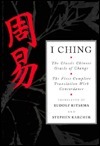
The I Ching is an oracle. Its answers change the way you see things. Your anxieties, fears and desires emerge to be recognised and resolved, and hidden transformative energies are released.
Developed as an essential wisdom system over 3000 years ago in China, the I Ching was originally reserved for the use of rulers but later its help became available to individuals in troubled times like our own.
Inspired by C.G. Jung's insights into the psyche, and researched for more than 50 years through the aid of the Eranos Foundation of Switzerland, this edition is much more than another new translation. it presents the oracular core of the I Ching as a psychological tool, a way of connecting with the creative imagination that underlies all philosophies and systems.
We need this book most when we stand at a crossroads of the soul, failed by rational thinking and with insufficient facts to guide us. In these situations it gives voice to a spirit concerned with how we can best live as individuals in contact with both inner and outer worlds.
The transforming power is achieved by focusing on the book as an oracle, a method developed over many years by the translation o team to preserve the original wealth of the imagery. the result is a network of meaning that, when accessed correctly, provides insight into the hidden forces behind the very situation which prompted you question. The oracular symbols interact with our minds the way dreams images do. This is the language of the I Ching. It is an active sourcebook for the care of the soul.
I read a little bit of this book almost every day. I can usually find a sentence or more that resonates with me on that day. The ancients believed that this book was a representation of the voices of spirits. It is thousands of years old. I don't know how to use divination with it, but I feel like it is a reliable friend who always gives good advice pertinant to my situation. My favorite line today is, "Everything that gives light is dependent on something to which it clings, in order that it may continue to shine" (119, trigram 30, The Clinging, Fire). This is how I feel about books. Books are the things to which I cling and which allow me to contribute any portion of light to the world (ie. not dwell entirely in despair and darkness).
I change, and you change. Each of our lives is a book of change; and every day, each one of us wonders how our fortunes may change in the future. Therefore, it is perfectly understandable that one of the oldest known books is a divination manual from ancient China, titled I Ching (The Book of Change).
Scholars estimate that the I Ching dates back to around 825 B.C.; in other words, it predates Homer’s Iliad by 75 years or so. As the I Ching is a divination manual, I expect that many readers will respond to it in terms of their feelings about divination. For my part, I see the I Ching as a chapter – an early chapter – in the ongoing story of human beings seeking to find meaning in their existence, to discern order and pattern in what often seems a difficult and chaotic world. John Blofeld, the editor and translator of this 1968 Penguin Books edition of the I Ching, does believe in the efficacy of this book as a means of anticipating the future. But you don’t have to believe in the I Ching as divination manual to get something out of it.
For the benefit of the uninitiated, the method of divination set forth by the I Ching involves the manipulation of divining sticks, each of which displays either a solid pattern, or one that is broken in the middle. Place the sticks in groups of six, and the possible patterns that those six sticks can make total 64. Each of these groups of six sticks is known as a hexagram; and from the way these divining sticks combine into hexagrams, the diviner is said to be able to offer advice regarding the suitability (or lack thereof) of a proposed action. This method of divination seems analogous to (though less messy than) the ancient Greek practice of reading the entrails of birds in order to divine the future.
Translator and editor Blofeld provides helpful commentary that shows how the people who composed the I Ching looked at fortune in human life. Blofeld suggests that “The authors of the Book of Change did not regard the future as unalterable; they thought in terms of mighty sequences of change following a regular course with predictable results, like the process of the four seasons, or like a river…its water destined, sooner or later, to reach the sea” (p. 61).
The people of other early civilizations believed that the future was fixed and unchangeable; an Athenian of Sophocles’ time would have told you that it was Oedipus’ fate to murder his father and marry his mother, and that Oedipus could do nothing about it. All that can be hoped for, in the system of the ancient Greeks, is to accept with dignity the unalterable dictates of all-powerful fate.
The ancient Chinese view seems to have been different: in Blofeld’s words, “[A] man who swims with the current can, within reason, choose his course; and, even should he attempt to swim against the current and amidst treacherous whirlpools, his destruction can be advanced or delayed within certain limits by his own action” (p. 61). The I Ching is meant to help one make good decisions by anticipating the inevitable, cyclical changes of fortune in every life.
The advice given is sometimes vague, as when Hexagram 6 (Sung, or Conflict) declares that “It is advantageous to visit a great man, but not to cross the great river (or sea)” (p. 100). Okay, fine, but what great man? And what great river or sea? One interprets the advice in terms of one’s own situation, and how one interprets an ambiguous pronouncement could make all the difference. During the Persian Wars, Themistocles of Athens heard the Delphic oracle’s advice that “a wall of wood alone shall be uncaptured” and wisely interpreted the oracle’s words as referring to shipbuilding rather than fortifications; and the “wooden walls” of the Athenian navy subsequently defeated the Persians at the decisive battle of Salamis. By contrast, King Croesus of Lydia, contemplating an attack against the Persians, went to the oracle and was told, “If you attack, a mighty empire will be destroyed.” Croesus did attack the Persians, and a mighty empire was destroyed – his own.
Some of the advice in the I Ching may seem rather common-sense; the frequent repetition of variations on the advice that “Persistence in a righteous course brings reward” (p. 200) may leave some readers thinking that they could simply go to Abraham Lincoln’s suggestion, “Be sure that you are right, then go ahead.” But there are many passages that convey much of the world-view of ancient China, as with the statement in Hexagram 23 (Po, or “Peeling Off”) that “The Superior Man respectfully contemplates the ebb and flow, the unending succession of repletion and depletion which constitutes the way of heaven” (p. 132).
There is one more thing that comes to my mind as I consider the I Ching – something that occurred to me as I read the book on a visit to Hong Kong and Macau, Chinese territories where people have turned to the I Ching countless times over the centuries. Many times, in my childhood home in Bethesda, Maryland, I would hear my mother on the telephone, taking excitedly with her friends about the horoscopes from that morning’s Washington Post. My mom and her friends, all devout Catholics, all really enjoyed reading the astrology page, even though doing so might seem somewhat paradoxical.
On the one hand, there are the stern anti-divination dictates of the Judeo-Christian religious tradition (as when Deuteronomy, Chapter 18, denounces anyone “that useth divination” as “an abomination unto the Lord”). On the other hand, all people feel that understandable, inescapable human curiosity that is encapsulated in that universal question: “What is going to happen to me today?” The I Ching provides a valuable early example of human beings responding to, and seeking answers for, that question.
I find it strange when people quote this book. I've seen multiple philosophers, writers, History Channel documentaries, heck, even Sean Connery in Zardoz quote the I Ching. Don't they realize that the I Ching's advice is directed towards the specific hexagram casted in response to a specific question? Its advice is catered to those who ask it– its words cannot be pulled out of context and applied to any life situation willy-nilly! The results could be disastrous! Take these two quotes, as an example:
"It is worthwhile to cross great rivers."
"It is not worthwhile to cross great rivers."
So is it worthwhile to cross great rivers or not? Without casting, who would know! You could choose the former, and cross that great river, and all get dysentery and get swept away! "Most likely" safe to cross, huh. Shoulda flipped some coins first, yeah, good ol' Chingy would've told you to take the toll road around it, that way you could've made it to Oregon with some surviving family members.
At one point in my life while semi-transient, it was necessary to leave a portion of my library behind. So I left a box of books on a corner in Berkeley. My I Ching- the Blofeld translation- was amongst these. Some ten years later, I was browsing a bookstore on Haight St. and found a copy of the I Ching in the dollar discount rack. Opening it to the inside cover revealed a very familiar ink stain- green ink, which I suppose I had spilled on it, back in high school. So what are the odds of anyone finding again the exact same copy of a book long abandoned and given up for dead? "Don't leave me, don't leave me again!" it cried. Needless to say, I took it back home & resolved never again to forsake... "It must have been karma, man." I originally got my copy somewhere around 1969, and bought it specifically because it was smaller, more portable, much less expensive, and an easier ("less thick") translation than the Wilhelm book. I think in many ways it's a lot better, since Wilhelm's focused on the yarrow-stalk technique (yarrow stalks being not an item one can find at hand nor in your usual downtown suburban Woolworth's)- and Blofeld's gave instructions on how to use coins- any three coins of a similar value would do, but pennies being most common, are easily fished from a pocket and available even in most dire circumstances (the kind you'd like to ask the I Ching how you can get out of!) And of course, the I Ching, once you begin using it & get its idioms, isn't exactly the kind of book you ever "finish reading..."
I know that in NORMAL circles, it's odd to read an ancient chinese text upon which a non-theistic religion is based. HOWEVER, I am not normal and most of the people I enjoy aren't either. SO, let me say that of all the religious texts I have ever read, there is something fundamentally gorgeous about the foundations of this Taoist book. I find it beautiful, cosmically true and irrefutably WISE in its basic applications. By this I mean that the eight pure three-line gua are hypnotically symbolic of every possibility in life and every course of action which leads that life in wisdom -- not that I would divine a 'fortune-telling' from the single gua cast by rods or yarrow stalks or runes... But you'd have to read the book to understand any of that. What I love about the I-Ching is that it is the truest form of advice: prepare, act, reap consequences, reflect, repeat the cycle. This book speaks to my soul in a way the Bible never has, even though I love the stories in the bible. Maybe because it is a wisdom that is symbolic and personal, not a story about someone else, but a true story about MYSELF. You read it. Let me know what you think!
For the information that was presented, this was an excellent source. This was my first time reading on this subject. The I Ching (pronounced ee is an divination tool, an oracle. It is a divination system with 3000 year old roots in the traditions of magic and shamanism. Nearly all that was significant in traditional China—philosophy, science, politics, and popular culture—was found on interpretations and adaptations of the I. The core of the book is the oldest and most complex divinatory system to survive into modern times. (p 8)
The authors gave the history of the system, it's use throughout China's history, questioning the oracle and getting an answer, interpreting responses, interpretation of the 64 hexagram combinations, words and images, and more. Each hexagram was dissected to include its image of the situation, inner and outer aspects, counter indications, sequence, contrasted definitions, attached evidence, symbol tradition, transformation lines, and image tradition.
Overall this was a great explanation on the I Ching. At first I was overwhelmed with the information and this is not something you'll memorize by any means. Once I started reading it from an explanatory view point the book made sense. I would recommend this to anyone interested in this subject or in Asian cultural studies. Thanks!
A beautiful book that teaches us that change can't be changed...it will become what it was meant to be without our consideration or approval. This was one of the first Chinese classics that I can ever remember reading; remember being amazed that there was a philosophy that I knew so little about. This was one of the first books that made me interested in classics from around the world.
The introduction by C.G. Jung was quite helpful in making sense of these ancient "divination texts" as reflective tools. So helpful that I tried it several times with the simple coin method and could see what he was getting at. Intellectually, however, the most interesting thing was the suggestion of a radically different sense of time. Emotionally, I had been brought up with the ideology of evolutionary progress while intellectually I subscribed to the notion of time as the essentially neutral schematization of change. Here, in the "I Ching", was a formalistic approach to time. In other words, as in astrology or even in Marx's conception of epochs, periods of time are understood as having a characteristic entelechy.
Creo que muy pocas personas han oído hablar del I Ching. La verdad es que yo sólo tenía constancia del método adivinatorio gracias a mi madre, pero leyendo la introducción he descubierto que también es un libro importante para la filosofía. La introducción me ha parecido muy bien enfocada: trata los dos temas mencionados más la evolución histórica que ha tenido este libro. Me ha parecido muy curioso.
Sin embargo, dice que hay dos métodos de adivinación y sólo explica uno (y tampoco he terminado de entender la tabla, podrían haberla abordado más) y de las monedas, al final la fórmula más cómoda, no se dice cómo funcionan.
Después vienen los 64 Kua. Es cierto que abordan temas distintos y que pueden decir todas las características psicológicas de los humanos. Aunque creo que esto es interesante, creo que hubiera estado muy bien que apareciera en cada Kua la combinación que representa de yin y yan. Me gustaría aplicar el método I Ching pero tendré que buscar otros recursos para encontrar lo que representen los resultados que obtenga y después consultar este libro. Es cierto que el libro trata de ser lo más fiel a la edición "oficial", pero también se han tomado licencias en otros sentidos y creo que ésto sería de gran ayuda para el lector.
También hay mucha filosofía, mayormente orientada a oriente (lógicamente, pues es de la tradición china), como en el Kua 42: reducir para aumentar.
Por último la edición me ha parecido muy trabajada: la tonalidad de color e ilustraciones muy bien encaminadas al sentimiento del libro, un punto de libro de tela, páginas de calidad y cubierta de tapa dura.
I have used this little Book of Changes for about 15 years (I'm on my second copy) and it has never, ever, ever steered me wrong (unless I've ignored what it said, which has been far too often). Sure, you may think that throwing three coins in the air six times can't tell you anything, but you'd be surprised at how accurate the I Ching is. I've read other I Ching books and this is by far the most accessible. Written by the head doctor for a major circus (go figure!), it is unpretentios and always, always wise with imagery you can understand. The I Ching is NOT about telling the future (in case you were hoping it was) - it's really about how to live and it fits into any religion or no religion. If you approach the book seriously, you'll get a lot out of it.
This is a review of the John Minford 2014 Viking-Peguin translation of the I Ching
For what is otherwise a gorgeously presented volume, Minford’s I Ching translation and commentary is overall a disappointment. With so many translations of this ancient Chinese classic in English, one wonders why this one is “the essential translation” – have others now been superseded? Minford has clearly done a lot of research, providing plenty of background and cultural context for his text, but his choices mar the gestalt of the original Chinese.
After having owned the 1967 Wilhelm/Baynes translation for 40 years, I bought Minford’s I Ching hoping it would be a fresh translation that would incorporate the past 40 years of cross-cultural scholarship on the Chinese worldview beyond the dated Needham-era interpretations, by more recent scholars such as Brook Ziporyn, A.C. Graham, Stephan Angle, Hall and Ames, Chris Hansen, Chenyang Li, etc. and thereby serve up new and deeper insights into the Chinese mind and worldview. Not the case. To my dismay, Minford’s translation seems to have incorporated little from such scholarship and instead displays forms of bias and distortion of the Chinese worldview caused by unexamined assumptions of the Western worldview that have plagued Western scholarship on China from prior generations of Chinese cultural translation.
It’s well known that each generation of Asian culture scholarship improves through the decades and that interpretations from the 50s, 60s, and 70s have largely been replaced by much better interpretations from the 90s, 00s, and 10s. This is true of Buddhism as it is with Chinese philosophy. Joseph Needham’s monumental work still has great relevance but many of his ideas about Chinese philosophy are dated compared to contemporary views. An outstanding example of contemporary views of Chinese spiritual culture is Brook Ziporyn’s YouTube lecture entitled, “Brook Ziporyn on China's Precious Spiritual Heritage.”
The main disappointment for me is Minford’s decision to use “snatches of Latin,” yes, words in Latin in among the English translations of the Chinese text, which, as he explains:
“…help us relate to this deeply ancient and foreign text, can help create a timeless mood of contemplation, and at the same time can evoke indirect connections between the Chinese tradition of Self-Knowledge and Self-Cultivation on the one hand, at the center of which has always stood the I Ching, and, on the other hand, the long European tradition of Gnosis and spiritual discipline, reaching back to well before the Middle Ages and the Renaissance…” (4).
I couldn’t disagree more. Perhaps someone is helped by this in the way he describes. Talk about ruining the gestalt of the Chinese vision. Every snatch of Latin feels like a cultural violation of the original Chinese, a kind of schizophrenic jump between one cultural-linguistic worldframe to another, each which has practically nothing to do with the other philosophically, spiritually, psychologically, or socially. Mushing European gnosis and Chinese wu-wei/Dao together feels like an uncritical New Age violation of both.
As anyone who’s studied language knows, meaning in language arrives by networks of associations with other words, etymologies, synonyms, antonyms, root relationships, and most importantly cultural-historical usages and associations. Why then would you choose Latin, one of two root languages of western culture, particularly with its endless associations with Judeo-Christianity, western esoterica, western conceptions and assumptions, etc. to help bring meaning to the most Chinese, non-Western text on the planet? Latin is just too closely associated with the Catholic church and western monotheistic history; it’s the last thing I want to think about when trying to absorb the Chinese vision of the world. But not only that, Minford’s intention only works if you are familiar with Latin words which I sort of am, but not to the extent that he uses them. Here, try it yourself: sine actu, sine motu, rerum omnium causam, summus spiritus, or this one, in intima finemque. All these are in a single translated passage from the Chinese Dazhuan (or Great Commentary) on page 24. The Latin theme continues with his choosing Roman numerals to identify each the LXIV Hexagrams – if you’re like me, you still cringe when presented with Roman numerals, particularly ones with three or more characters in it.
I’ll probably just keep Minford’s translation for its beautiful presentation – typeset, graphics, artwork, layout, etc. But the text and contents are too much of a cultural mess to spend time with. Below is a list of various English translations of this Chinese classic. Each has strengths and weaknesses, its own purpose or focus - “cosmic,” “every day,” “complete,” “new,” “authentic,” etc. For translation-commentaries that stay closest to the original Chinese vision, I recommend numbers 3, 7, 9, and 10… and yes, #3 is old, but it is still highly regarded.
1. 1876, McClatchie, Thomas. A Translation of the Confucian Yi-king. Shanghai: American Presbyterian Mission Press. 2. 1882, Legge, James, trans. I Ching (Translated with Annotations by James Legge) by Anonymous 3. 1950, Wilhelm, Richard, transl., The I Ching or Book of Changes; English translation Cary F. Baynes, 1967 (Translator), C.G. Jung (Foreword) 4. 1965, Blofeld, John. The Book of Changes: A New Translation of the Ancient Chinese I Ching. New York: E. P. Dutton. 5. 1978, Wing, R.L., transl. The I Ching Workbook. 6. 1982, Wing, R.L., transl. The Illustrated I Ching. 7. 1986, Cleary, Thomas; Liu I-Ming, transl., The Taoist I Ching (Shambhala Classics). 8. 1986, Whincup, Gregory. Rediscovering I Ching: the first translation of the Changes to reflect contemporary scholarship. 9. 1994, Lynn, Richard John. The Classic of Changes. New York, NY: Columbia University Press. ISBN 0-231-08294-0. The only translation that includes the classic commentaries of 3rd century scholar Wang Bi. My second choice after #3. 10. 1996, Rutt, Richard (1996). The Book of Changes (Zhouyi): A Bronze Age Document. Richmond: Curzon. ISBN 0-7007-0467-1 11. 1996, Shaughnessy, Edward L. I Ching: The Classic of Changes. New York: Ballantine Books. ISBN 0-345-36243-8. 12. 1997, Dening, Sarah: The Everyday I Ching. 13. 2002, Anthony, Carol; Moog, Hanna: I Ching, The Oracle of the Cosmic Way. 14. 2006, Deng, Mind-Dao. The Living I Ching: Using Ancient Chinese Wisdom to Shape Your Life. 15. 2010, Huang, Alfred, transl. Complete I Ching by Anonymous. 16. 2011, Pearson, Margaret J., transl. The Original I Ching: An Authentic Translation of the Book of Changes. 17. 2014, Minford, John, transl. I Ching: The Essential Translation of the Ancient Chinese Oracle and Book of Wisdom. 18. 2017, Hinton, David, transl. I Ching: The Book of Change: A New Translation. 19. 2019, Walker, Brian Browne, transl. The I Ching or Book of Changes: A Guide to Life's Turning Points. 20. 2022, Gait, Christopher; Master Jiao, transl. The Forest of Changes Yi Jing: A New Version of an Ancient Chinese Oracle.
BTW: When this review was posted (3-10-22), Minford's I Ching page here on Goodreads is populated by reviews of other translations or no translation at all indicated (as in the first Arabic-based review). It appears as though all translations of this Chinese classic have been mushed together by Goodreads, and not separated into their respective translations. A deplorable situation I must say.
This book has changed my life more than once. It's an old friend now, dog-eared and battered from travels on five continents, a bit salt-stained from time at sea. In the 1980s I created a software version on a floppy disk. In 2014 I upgraded that to an app for iPhone, Kindle, iPad, Android, and Apple Watch. It's my spelunking buddy in the caverns of the sub-conscious, my wise father, my Sancho Panza, my mystic magician.
As a skeptic I have a hard time reconciling logic & reason with my experiences concerning this book. The I Ching is like Chinese astrology that uses coins instead dates. You throw the coins and get a nugget of wisdom that speaks to your life and its problems. Logic would immediately say this is preposterous and I tend to agree, even now. The only problem with my conclusion is that hundreds of coin throws have shown me the I Ching is anything *but* random.
A friend introduced me to the book and how to "throw the bones." At some point I started throwing the coins without his help, and my errors were the first clue that logic alone was unable to comprehend this book. The I Ching is based on a binary gate, a broken or unbroken line, formed in trigrams and hexagrams. It's easy to interpret results the opposite of what they are, reversing a line or the order they are interpreted. So I would ask the book a question and throw a hexagram which vaguely commented on my issue. To double-check my work, I would read the various hexagrams that were opposite or perpendicular to the "true" hexagram. It was then I found out that, as vague as the true hexagram was, the other hexagrams didn't comment on my question at all.
Many smart people have read the I Ching simply as a book of wisdom. For this purpose I highly recommend it as one of the best works of eastern philosophy available. Like astrology, the I Ching divides life into archetypes, forces that play off of each other in creating the basic human experience. The I Ching philosophy is a model and like any model some people will find it hopelessly vague, but this should never be your excuse for avoiding this kind of writing. The wisdom does not arise from what names the I Ching chooses to throw your experience into, but rather how it divides these experiences and how such archetypes balance off each other. The I Ching focuses on change specifically.
In the end, I realized the secret to the I Ching's success was in making it's philosophy personal. I can read Nietzschean philosophy but because I don't personally ascribe to his logic it stands apart from me. Yet in taking my life into account whenever I read the I Ching, it's had a more profound effect on my thinking then all of my favorite philosophers combined. The accuracy of the book becomes irrelevant, the important thing is the thought process through which the I Ching takes you.
This is one of my favorite translations of the Yi Jing. There are three books I use most often when I throw the coins: the classic Wilhelm/Baynes translation, this one, and Carol Anthony's A Guide to the I Ching. What I like about the Alfred Huang book is that it is very readable and useful, and at the same time feels like it is conveying the nuances of the Chinese meanings better than any other translation I have used. Huang explains in better detail a number of the odd turns of phrase that Wilhelm didn't quite seem to get. He is also more willing than Wilhelm was to let his translation be terse and cryptic when the original text is terse and cryptic -- that's both an advantage and a disadvantage, so I find that the Wilhelm/Baynes and Huang translations complement each other nicely. And then Anthony's commentaries add a layer of interpretation that strongly resonates with me.
I have a number of other translations I also like, but these are the three I find I come back to most often for regular use.
Read this in 2017 while studying Carl Jung. Stuck in a relationship that wasn't working but not willing to admit it to myself, I wanted to use the process of "synchronicity" to stir up my subconscious. I got hexagram #18, which holds imagery of "insects or worms in rotting meat held in a sacrificial vessel" and deals with (among many other things) the negative side of sexual infatuation. I'm not spiritual, but am very interested in the social sciences and see how methods of divination like this and tarot (through universality of themes/ the mind's programming to grasp personal meaning) can help people gain new perspective on their problems.
Almost a decade ago I wrote a tongue-in-cheek review (with an Oregon Trail punchline) after skimming Thomas Cleary's microscopic Pocket Classics edition, knowing I'd eventually give the I Ching a proper go. And now, after reading John Minford's new 800+ page edition cover-to-cover, I have given the I Ching a proper go!
On John Minford's translation
I catch myself thinking there's a sliding scale between academic credibility and a translator's color and personal touch. And yet, here is John Minford with both.
Some of this is in small touches: his delight in the image of the wine-swigging mountain hermit Taoist, his appreciation for bold reinterpretation from academia, his frankness about the text's inscrutability when it's earned (often!), some oddball references (Hexagram 18 Line 1 quotes Dickens' Little Dorrit). The book's introduction in particular starts out strong, mentioning the ancient Chinese shamans were probably smoking weed (with a footnote quoting a study also mentioning they wore penis rings. Neat.) Minford also makes the strange but likable decision to include redundant Latin among the core text (e.g., "This is Auspicious / Hoc bonum.", "No Harm / Nullum malum.", "Heaven and Fire / Coelum et ignis.", etc.), both calling back to the first Jesuit translations of the I Ching and evoking the austere ancient air Latin gives to English readers. And you know what? He won me over. Latin is all those things. In fine nullum malum!
But that's window dressing. The real meat of this translation's character is Minford's embrace of the I Ching as three different things:
- A launching point for millennia of Taoist interpretation and commentary (imagine a Talmudic level of analysis blossoming from the very short central text) - A modern-day divination tool that can provide salient advice for your workplace and other life decisions. - A tool for Bronze Age kings and warlords sacrificing human captives to appease ancestor spirits
How does he square this? By bundling together two different translations and commentaries for the full I Ching in volume!
The first (and longest) part is titled "The Book of Wisdom". This is the I Ching people have read and commentated for millennia. When you buy an I Ching, this is probably what you're after. Minford knows an incredible scope of Taoist commentary and is able to curate a succinct tour on every Hexagram's different interpretations across centuries (also including accounts of historical figures from the Zuo Zhuan receiving these castings, and comparing similar lines and themes to other ancient poetry). Some of this section can be concerningly "True Believer"-y. Minford loves quote Liu Yiming ("Magister Liu"), an 18th century proponent of Taoist "Inner Alchemy," using alchemical terminology to describe Taoist self-cultivation ("The Golden Elixir is formed"). But then immediately after, he'll cite the contemporary Mun Kin Chok ("Professor Mun")'s analysis of the I Ching's advice for a business context. (The jump from alchemy to business managers is never not funny.) While I doubted how much of Minford's readership would be in upper management, Mun's commentaries are actually not that hokey or contrived (I've seen much worse in different divination systems, trust me), and make a good demo on how I Ching castings can apply to a contemporary daily context, upper management or not.
After Part I's earnest Taoist, alchemical, and modern-day divinational lens, Part II is a cold splash of water. After giving us the classic I Ching, Minford is free to show us the bleeding edge of the last half-century's archaeological discoveries and reinterpretations of the ancient Chinese words. He admits this part of the book will age the fastest as new discoveries are made, yet by including it, he's turned me onto a new field I had no idea was still bustling, and making the I Ching feel much more living and alluringly cryptic. (Part II is also where Minford will admit "An obscure line" or "This whole Hexagram is puzzling." Or casually reference something like a "(now lost) early oracular precursor of the I Ching, the supposedly Shang-dynasty Guizang" with longer folkloric references. What!!!) A drastic change comes from the word commonly translated as "Sincerity" or "Inner Truth" to instead mean "captives" or war booty. Yes, there is archaeological evidence the kings and warlords of this period were capturing enemies en masse for human sacrifice. This achingly Taoist text came from the Bronze Age after all!
Here's a good example of the contrast between Part I and II. From Part I:
(Part I, Hexagram 59, Line 6 commentary)
(Part II, Hexagram 59 commentary)
I love this so much. Here's another:
(Part I, Hexagram 15 commentary)
(Part II, Hexagram 15 commentary)
The way Minford is able to fully engage both the Taoist perspective and then the irreverent quaintness (or ugliness) of the ancient oracle could potentially come off as disingenuous. I was surprised by it the entire time I read. But then again, this is the guy who includes the I Ching casting for starting this book in the introduction. This is the guy who writes such a lofty paragraph about the I Ching he includes a footnote saying "One perceptive reader found an earlier draft of this paragraph 'over the top.' I agree. But I have kept it, since after all it is no more 'over the top' than the repeated Chinese claims for the I Ching!"
Instead, I feel like I've found someone with a kindred attitude towards divination and ancient thought. I've had trouble explaining my love of divination tools: I'm not a "believer," I have a very unmagical atheist worldview in general. And yet, I enjoy engaging with divinational tools and learning to read and analyze them like a "believer" would (I can give a mean Tarot reading). I see people who go "uhhh, fake!" and move on and feel like they're missing something. Isn't there something revealing about a society trying to create a system to cover any possible life event? What do those attempts tell about a society's worldview? Isn't there something in how millennia of people search for meaning and consistency in a very weird and ancient thing that clearly wasn't designed for it? The "corruptions," the changes of use and meaning, everything that could be used to dismiss it being "real" is exactly what makes it so revealing. In this light, there's no contradiction between the disparate two halves.
On reading the I Ching front-to-back
I read this particular book by reading Hexagram 1 in Part I, Hexagram 1 in Part II, Hexagram 2 back in Part I, and so on. I only recommend this for the dedicated: my initial I Ching exposure was through actual castings and thumbing through different translations, which I'd recommend.
The I Ching is weird, man. I like Tarot cards: they had centuries to themselves as playing cards before things got weird and every incidental symbol gave birth to tomes of analysis. There was a virgin era of no expectations of meaning, creating a fun input of random noise to get turned into deep nuance—but what's weird about the I Ching to me is that it was a divination tool from the start, evolving from the old shamans reading cracks in turtle bones. The Tarot's strangeness doesn't inspire much curiosity about its design decisions: it wasn't designed for this, anyway. But the I Ching was, so: why do some Hexagrams mention divinations? "Profitable Divination," "Augury of Danger". Is that recapping itself, or a future casting? Some of the Hexagrams have themed line statements that aren't very applicable to castings: some are sequences of body parts (Hexagram 21, 52). Some tell stories, like two about solar eclipses (55, potentially 36), others referencing folklore about mythical kings Darmok-style. Minford preserves the ambiguity of the text through passive voice and keywords, which is frustrating but fair to the original. Line statements will describe actions made without specifying actor or receiver, or end with "Calamity," "Auspicious," "No Harm" without specifying if it's a result of taking the advice, what's going to happen without taking the advice, or the situation you're already in. Sometimes, these final keywords contradict what was just described! Other Hexagrams cover specific areas of life, like military conquests, marriages, health, and what offerings to give. Some are theorized to be about other kinds of divination (like the previously mentioned gelding blood splurts). How would a caster ensure they get a relevant Hexagram?
And the Taoists aren't off the hook. Before reading this copy, I had no exposure to the near-numerological analysis of proper places for Yin and Yang lines in Hexagrams (alternating even/odd, whether lines "resonated" with their mirror line, whether lines were in the center of their trigram, etc.). Supposedly you can know what every line entails from just seeing the Hexagram. I admit I got bored of this analysis compared to the core text, and I was uninterested to see how the text got square-pegged-round-holed into meaning "Yin in Yang Place" or whatever (it's contrived, more than a couple times). I'm tempted to create an Excel sheet comparing every line statement's general character compared to its "place" and see if these really match up. If I saw this analysis on a Blogspot post I'd roll my eyes, but this has apparently been a major mode of I Ching analysis for millennia, so I'll begrudgingly accept its inclusion. (It's only in Part I, at least.)
And yet, I don't think I'd want a perfectly consistently designed divination tool. What would that even look like? On an intellectual, historical/sociological side: give me the archaeological mystery. Give me the contrived analytical wrangling. On a divining side (or creative tool side, à la The Man in the High Castle): give me the ambiguity and room for cold reading. ;)
There's not a definitive I Ching, something this copy immediately concedes by giving two entirely different translations. And yet, this is a perfect copy of the I Ching to get ahold of. You have a knowledgeable, colorful guide who knows the academia and the Taoist belief and can deliver you the classic I Ching alongside its contradictions, enigmas, and changing modern understanding.
This is a great introduction to the I Ching. First of all, it contains the whole I Ching with lots of commentaries and explanations, historical ones and those from the author. And secondly, the introduction by John Minford was excellent, with a history of divination that progressed to the I Ching, as well as very useful examples of how to actually DO it--when I first got the book and flipped through it, it seemed all fine and dandy, but although you can flip through the hexagrams, how do you actually read some meaning out of it? This is what the author laid out quite nicely. To me, this book is like Tarot cards, and I use it in a similar manner to the cards. Although the process is different, the spirit of it is the same. What you read from it is different for each person, and yet there is an underlying truth to it that many can read from it. It's not just arbitrary, but very relevant to what we ask it. It is beautifully written and can not only help us guide our lives, but understand the world we live in. It's an honour to be able to read this ancient text, and this translation is a wonderful place to start.
This one is, for me, the grandfather of all the books I use. I occasionally read it, consult it, when I want a complete and full (and usually quite symbolic and mysterious) reading, for it is the translation closest to the original that I have found. However, I have other translations I use for faster readings or for explanations/explorations into deeper aspects of the figures. My longtime copy of this book has been packed away for several years (long story!), and I have continually thought that it will surface one day. Finally, recently, I realized that it's okay simply to buy another copy! Seeing it on my shelves again is like finding an old friend to reconnect with.
I also recommend highly the Introduction in this book, just for good reading, for it is written by Carl Jung, who was a friend of Richard Wilhelm (the translator) and who tells a charming story of his own discovery of the I Ching through Wilhelm's friendship.
For English readers, I would guess that this is the "authentic" version.
My intent is not to offend any who use this book for spiritual meaning or guidance, therefore if that is you I highly recommend you not read my review and simply move on and accept that not everyone finds meaning in the same way. And frankly much worse has been said about my own religious literature than what I'm about to say.
That said, this book is absolutely ridiculous. I'll be honest I only made it through about 3 or 4 pages, and all I gathered from that is that man is good and man is bad and man is animal that means animal is bad and good and is man is bad and good that means bad is good and good is bad and everything is everything and nothing all at once and absolutely nothing in the universe makes any sense. That's about what the first few pages were like for me. Utter nonsense.
This isn't a book that you sit down a read through (although you can if you want), but more of a tool to use daily/weekly/whenever the needed arises. The wisdom in these pages is incredible, and for whatever reason whichever chapter(s) you roll, the advise within said chapters is always relevant. I highly suggest everyone get a copy and use it to provide some perspective whenever you find yourself in need. You don't need to believe in any supernatural powers to utilize this. Its power lies in it's ability to be relevant no matter what - you unconsciously make it fit into whatever is going on in your life.
Devo rileggermi l'introduzione di C.G.Jung perchè Brunella Antomarini in Pensare con l'errore dedica quasi un capitolo a I Ching ed ho bisogno di confrontarle.
il ritorno.riuscita. uscita ed entrata senza errore. amici vengono senza macchia. serpeggiante è la via. al settimo giorno viene il ritorno. propizio è avere dove recarsi. ("24. Fu-Il ritorno")
"The I Ching or Book of Changes" is an ancient tome from China. It discusses using numbers to divine your fortune.
When I picked up the book, I was misinformed about its contents. I thought it was a book of philosophy or ancient wisdom. I would say it has cultural significance, but I did not consider it earth-shattering.
4 stars is a little generous in my book, but these are 4 stars relative to other works. A good all-around translation. I think he adds too much at times, perhaps lending to much credibility to his own interpretations. Nonetheless, it is nice to see how a well-educated Taoist would present his understanding of the Yi Jing to others.