Jump to ratings and reviews
Rate this book

Alex Colville: Return

Rate this book
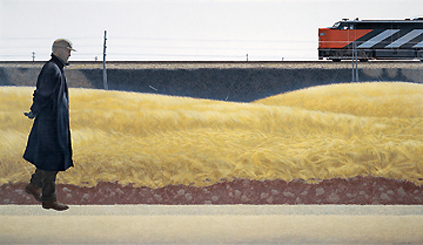
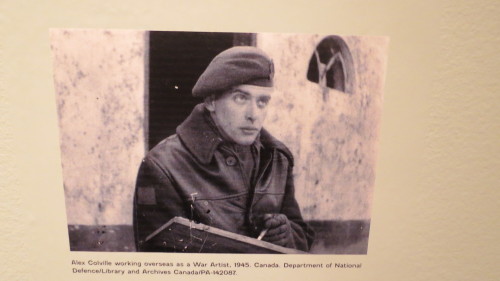
In 1945, Alex Colville, a young Canadian war artist from Amherst, Nova Scotia, was one of three painters admitted to the Bergen-Belsen concentration camp as it was being liberated. He would later become one of Canada’s most celebrated artists. In Alex Return, curator and writer Tom Smart suggests that, metaphorically and artistically, Colville has never stopped going back to the horrors that he witnessed in Germany. Designed to accompany a major exhibition of Colville’s recent paintings, prints, and drawings organized by the Art Gallery of Nova Scotia, Alex Return places Colville’s recent work in the broader context of the artist’s oeuvre. Beginning with his formation as an artist, Tom Smart suggests that the exacting naturalism and underlying sense of foreboding in Colville’s renderings of everyday life result, in part, from his experience of the Holocaust. Using recent paintings such as Embarkation 񢉊) and Dressing Room 񢉒), Smart traces the evolution of Colville’s contemporary work back to his earlier pieces, including the now famous Horse and Train 񢈢) and Ocean Limited 񢈪). In this insightful and provocative book, featuring over 40 colour reproductions, Smart demonstrates that Colville’s images are more than superbly crafted depictions of a somewhat mythical world. These complexly coded works command the disorder and chaos of trauma into order, coherence, and closure. Today, the world is disrupted once again by the atrocities of war, and Smart’s assessment of the wounds behind Colville’s unique works of art resonates with special potency. In a subliminal way, art lovers have always understood that Colville’s images are not benign, comforting representations of the real world. For the first time, in Alex Return, Tom Smart gets to the bottom of this understanding, revealing the pentimento of Colville’s astonishing and gripping vision.

144 pages, Hardcover

First published September 28, 2003

Loading...
Loading...

About the author

Tom Smart

44 books4 followers

Ratings & Reviews

What do you think?
Rate this book

Friends & Following

Create a free account to discover what your friends think of this book!

Community Reviews

5 stars
5 (33%)
4 stars
4 (26%)
3 stars
5 (33%)
2 stars
0 (0%)
1 star
1 (6%)
Displaying 1 - 2 of 2 reviews
Profile Image for Mir.
4,987 reviews5,337 followers
January 16, 2015
How much you'll like this book depends on how much you like Colville.
I generally find him fine but not too exciting. Certainly not as intriguing as the Neue Sachlichkeit artists, who greatly influenced his work.

I tend to prefer her his animals and seascapes over his geometric city and highway scenes or his human beings, although I do appreciate his use of negative space in landscape.


As for the text, the best portions were those which relied more heavily on Colville's own words, especially his accounts of his wartime experience.


I can't say I was impressed by the author's additions, some of which seem quite odd.

A dog sits in the back seat of a car, its sharp face giving it a kind of human vitality... Colville wants to reflect the sense that "dogs like to be in cars," even though at some level the dog in the womb-like Volkswagen Beetle is not a believable image... The woman turning to look at the dog suggests that the two are communicating and that the dog is a doppelganger, a double of a ghost or a living person, in this instance Colville himself. The dog shows no malice as it passively observes the woman.


What is not believable about this painting? Where does this doppelganger idea come from? Either I'm completely missing something or Mr. Smart has never interacted with a dog. And possible doesn't know how to parallel park.

I'll leave you with another favorite Colville subject: people near water.

Displaying 1 - 2 of 2 reviews