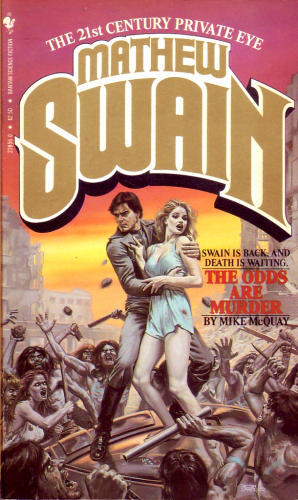
Swain wasn't betting on his future. He'd returned home, wasted and flat broke, to find the city ravaged by a deadly plague. But when an old friend got fried before his eyes, Swain was back in business. The stakes were life and death for millions, including Swain's long-lost love. Odds were he'd die catching the murderer--if the plague didn't kill him first!
Michael Dennis McQuay was an American science fiction writer. He wrote for several different series. His work in that field includes Mathew Swain, Ramon and Morgan, The Executioner, and SuperBolan. The Book of Justice series he wrote as Jack Arnett. He also wrote the second of the Isaac Asimov's Robot City novels. His non-series novel Memories was nominated for a Philip K. Dick Award for 1987.
McQuay taught creative writing at the University of Central Oklahoma for more than ten years, and died of a heart attack at the age of 45 in 1995.
It's been a few years since I've read this early 80s series, a hardboiled/proto-cyberpunk deal featuring tough guy-with-morals private eye Matthew Swain solving various crimes and mysteries in a semi-dystopian future city (and in the second entry, a huge settlement on the moon), but it's stuck with me. They're all a hell of a lot of fun, and this one, the finale of the series, has especially stayed with me, as it combines that future detective noir aesthetic that I loved in the previous books with a bit more of an apocalyptic edge to it.
A virus is loose, spreading fast and turning everyone into savage lunatics, and Swain must figure out how it connects to several high profile affluent types getting bumped off recently. It was funny that, even though this was written 40 years ago, author McQuay anticipated the whole "mask vs no mask" debate (Swain falls in the "screw masks" category). The plot gets super-convoluted at times -- these novels are dedicated to Raymond Chandler after all -- but I loved the relentless pace and feeling of impending doom with rampaging hordes of the infected and authorities methodically leveling various parts of the city to prevent the virus from spreading further.
Even though this is a four book series, they're all pretty much standalone, and can be read in any order, though there are callbacks to previous installments. I highly recommend it for those looking for some action-filled detective fiction with plenty of twists and a wise-ass protagonist, only set in a mostly lawless future with flying cars and even the occasional mutant. They're a blast.
Hopefully these and McQuay's other novels can be brought back into print in the near future. He's seemingly been totally forgotten.
(BTW that cover painting by Bob Larkin, which echoes some early and iconic editions of I Am Legend, is one of the all-time greats.)
The last chapter in the Mathew Swain saga wraps it up with a bang. Swain, down and really out, starts the tale in a bar (surprise!). After the trials and tribulations of the last installment, Swain got railroaded into a loony bin for months, lost his PI license and even had to sell his bullet. The city continues its decline, albeit at a more rapid pace as some sort of deadly plague spreads through the population. Yeah, there is a vaccine, but only the rich can afford it. Business as usual!
So, a guy walks up to Swain in the bar, calls his name. Turns out, the guy knew Swain from years back; part of a pack he used to run with before he joined the military. Well, the guy has a list with over a dozen names on it, including his, and most of the rest are dead. Coincidence? Nah. Someone is killing them and making it look like accidents. Five minutes later, his old friend is dead, murdered in a vis station at the bar. One name really stands out on the list, however: an old flame of Swains...
This series is so over the top and pulpy-- my kind of tale! These were some of the first things published by McQuay and good stuff. RIP McQuay and thanks for the stories. 4 dark stars!
Unfortunately the last of McQuay’s Swain series and probably my least favorite. Opened all right but kind of dragged and then finished in a not so fantastic fashion; however, I’d still give it an above average grade amongst the four and McQuay’s books have been much better than most of his peers from the same time.