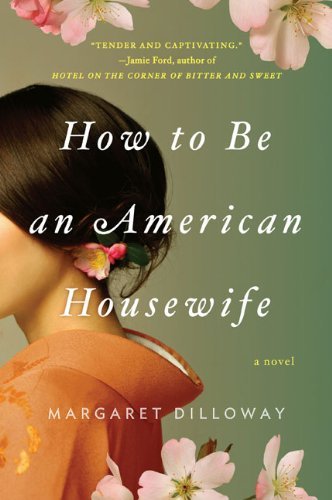
A lively and surprising novel about a Japanese woman with a closely guarded secret, the American daughter who strives to live up to her mother's standards, and the rejuvenating power of forgiveness.
How to Be an American Housewife is a novel about mothers and daughters, and the pull of tradition. It tells the story of Shoko, a Japanese woman who married an American GI, and her grown daughter, Sue, a divorced mother whose life as an American housewife hasn't been what she'd expected. When illness prevents Shoko from traveling to Japan, she asks Sue to go in her place. The trip reveals family secrets that change their lives in dramatic and unforeseen ways. Offering an entertaining glimpse into American and Japanese family lives and their potent aspirations, this is a warm and engaging novel full of unexpected insight.
Margaret started writing stories in kindergarten. Ever since then, she's used writing to understand the world and entertain people.
She loves improv, attempting complicated baking recipes, hiking, and dollhouse miniatures.
Awards: -MOMOTARO: XANDER AND THE LOST ISLAND OF MONSTERS: Winner of the American Library Association's Asian/Pacific American Librarian Honor Award -THE CARE AND HANDLING OF ROSES WITH THORNS. American Library Association's Literary Tastes Award for Best Women's Fiction
The story of a Japanese woman who marries an American GI at the end of WWII and leaves her country to live in America. She has the blessing of her parents but her brother disowns her for a "Shaming secret" in the past. She settles in the U.S. and struggles to raise her two children and fit in as an "American." The second part of the book focuses on her daughter and granddaughter's return to Japan to seek forgiveness from their Uncle on their mother's behalf....a pretty moving family story.
No. This is not how you write a realistic, moving or compelling book.
This was a fast read, and faster still once I decided to plow through it and get it over with. It lacked anything truly thought-provoking or original and the pidgin dialogue used by Shoko, the main character, was irritating and silly - the woman lived in the United States for over 50 years in a community of Caucasians with no other Japanese people around, she would not have this much broken English. I actually have an aunt from Japan who knew not a lick of English and didn't even speak this way after 3-4 years. C'mon. And the author supposedly wrote this based on her mother? I don't buy it. And even if I did, it hindered her storytelling. It reduced Shoko to a caricature.
And Charlie, the navy husband, the Mormon, the kind hearted giant, the old fashioned father, the acceptor of a son that was not his -- there was so much there to work with that could've been great but he was so underdeveloped he was practically a literary fetus fluttering around in the background of this book. 50 years of marriage: tell us the gory details. Tell us about the early years, tell us how much of an outcast this freckle face red-haired Mormon was in his community with a non-English speaking Japanese wife living amongst people whose fathers were killed in the very war Charlie was in.
Am I the only one seeing what a juicy, complex and amazing book this could have been? Look at those ingredients. It could have been awesome.
But it wasn't. It was mediocre and polite.
This entire review has been hidden because of spoilers.
In places sweet, playful and bittersweet...lacked something to make it more compelling and alive. I doubt Shoko's English was as bad as it was... and very unlikely seeing how young she was when she arrived and how immersed she was in America. Charlie seemed one dimensional, and so did Mike and Helena.
This is really a chic-lit book with a soul embedded in realism. Entertaining and well written. A feel-good, heart-warming experience while getting to know a beautiful spirit.
Everyone has a life-changing experience, including Shoko's husband, Charlie, and her son, Mike, when Shoko lands in ICU and must undergo a heart operation. From that moment on, nothing can be taken for granted anymore and forgiveness becomes the most important goal for Shoko.
Three women, a mother(Shoko), her daughter(Sue) and granddaughter(Helen) go through a spiritual renaissance when Shoko's heart starts acting up and they have to spend more time together. Single-mother, Sue, and daughter, Helen, travel to Japan to visit Shoko's family and experience the places her mother has told her about. Sue finally connects with her own mother in more ways than one and finally grows up by taking her responsibilities more seriously. She suddenly understands her mother and her upbringing better.
The story is fast moving. Tips on how to be a good American, or as the title indicates, how to be an american housewife, is thrown in at the end of each chapter. It is often funny as well as informative.
Aspects of the American attack on Japan during WWII is highlighted in the book, with America being subtlety pointed out as the bad villain, especially after Hiroshima and Nagasaki. For a novice it might distort the history, since the barbaric cruelties of Japan towards their Asian neighbors, as well as their POWs, are not discussed at all. Dare we mention Pearl Harbor here as well? However, if that kind of distortion does not trouble you too much, plenty of pink vinyl jackets, as well as hair dyed purple at the tips are more important, you might enjoy this light-read. After all, it is a story about forgiveness and the assimilation of two polar opposite cultures, with love.
This book describes the life of a Japanese woman who married an American man and moved to San Francisco. She describes not only the cultural changes she had to adapt to, but also the racial discrimination against her, especially in her mixed marriage.
Shoko shares her memories of her country and her family with her nuclear American family who do not know Japan and have never visited it before Shoko's heart operation. The tale also spotlights the generational adjustments of immigrants very well. It is indeed a novel about mothers and daughters with a light way of criticizing the American lifestyle. Shoko believes all things Japanese are the best and all things American are less good. Her daughter Sue, being a second generation immigrant, does not agree. Helen, the granddaughter, the full American citizen with 25% genetic ties with Japan, has a long learning curve ahead of her to reconnect with her grandmother's Japanese heritage.
From the negative reviews this has received, my expectations were pretty low; however I actually did like it very much throughout. But then I am partial anyway to most of the authors who turn out these Asian culture treasures (Amy Tan, Lisa See, Gail Tsukiyami, etc.). Before I joined GR and my reading list expanded like the waistbands of the Japanese who come here and eat our American food, these authors made up about 75% of what I read. I don't know how I missed Margaret Dilloway, but I will definitely read more of her. Next up is one I have, Sisters of Heart and Snow
I enjoyed spending time with Shoko and her family, both in Japan and the U.S. When the book begins, Shoko is living in Nagasaki, Japan with her parents, brother and sister. She comes of age during World War II and experiences the bombing of her city. As a young adult, she works in a hotel where she has an illicit romance with a Japanese man of a lower caste and also meets a young American G.I. He is destined to become her husband. Shoko then emigrates with him to the U.S. and starts a family.
This is her engaging story of what it is like to be a Japanese woman living in a very different culture. Shoko grows to understand English, but her speech is self described as pidgin English. She is determined to be a good wife and mother and like all of us, has her challenges. One heavy challenge is struggling with heart disease, thought to be caused by radiation exposure due to the bombing in Japan.
This is a multi-layered story which gave me a lot to think about. In the author's notes, Dilloway wrote that her mother was Japanese and her father was American. Shoko's speech was modeled upon her mother's way of talking.
This was the oldest book on my TBR (6/18/2012). I really liked it and flew through. Haven't done that in a while.
I forgot to miss that joyful little girl until she was already grown up and gone.
The person I used to be could have made only one choice; the grown-up Shoko might have made a different one. That was how life was. You only figured out the right thing after you were old.
In Japan, if you want to have more, you eat it all. If you are done, leave a little food on your plate.
To my other, the number four was bad. "Mean death. Or two. Bad manner. One or three or five." Flowers had to be arranged in a trio. "It for balance. Sun, Eath, sky. "
Burial = shocking since being cremated purifies the spirit and gets it ready for the afterlife.
But she must keep her figure to keep her dignity. Small portions. Avoid potatoes.
Americans feel guilt rather than shame. (haji)
Only the shell is old.
If bored/discontented, give your house a thorough cleaning. Get rid of everything you have no need for. Make your American house as uncluttered as a Japanese house. There is no better cure for the doldrums.
I'm surprised at all the four and five star ratings this book got. It just wasn't a very strong story, and the dark secret that the main character Shoko is hiding from her children is not very novel. I know that Dilloway's own mother was a first-generation Japanese immigrant, but I had a hard time buying the dialogue as spoken by Shoko. Fifty years in the U.S., having raised children who speak perfect English and she still speaks in broken pidgin English? I grew up around the first-generation grandparents of my peers, and none of them spoke as poorly as Shoko.
Thankfully, Shoko's inner dialogue is written normally, and we get insight into a very complicated woman. Switching to her daughter Sue's story halfway through gives us a little more understanding of how difficult their lives are. (Although this is territory that Amy Tan covered a long time ago.) Another reviewer pointed out how weak the character of Charlie is, and I have to agree. Beyond being a decent guy, we never learn what drew him to Shoko and what keeps the two of them together for so many years.
Still this a well-paced novel, and held my interest. But in the end I have to say it was "just okay".
If you're looking for a good summer read, this is the book for you!
It's the story of a Japanese woman who marries an American GI and strives to be a good American housewife. She encounters struggles with the family she left in Japan and the family she creates in the United States. The first half of the book is told in the voice of the woman, Shoko, and the second half in the voice of her daughter Sue. How many mother-daughter relationships do you know that have no issues? Well, their relationship is no different!
A good summer read wouldn't be complete without some family secrets thrown in, and this one has a couple of them. I recommend doing the audiobook version of the book if you can to get the accents and the voices, which I don't always enjoy from an audiobook, but this one I did.
Give it a read! This would also be a great movie!
Find this book and other titles within our catalog.
This book could have been so much better, but it just fell flat and made me lose interest earlier on. I plowed through it hoping that it would get better, but it never did. The 12 year old daughter of Sue's was truly irritating - she didn't appeared to be like any other 12 year olds I've ever encountered. Also, Shoko, Sue's Japanese mother, in her 50 years of living in America, still spoke such stereo-typical English, was unrealistic. She never picked up using verbs or adverbs in her sentences? My own mother, who came here from Taiwan over 40 years ago, picked up verb usage within the first few years. Here is a sample of her mother's speech, "no. I need talk. I fine. Look me." This can be really annoying after awhile. I cannot believe none of the editors ever picked up on this.
With that said, there were a few realistic, tender moments. For instance, I like the baseball scene at the end of the book. I liked the character, Charlie. I liked the character, Mike. Perhaps their characters were built on what others said about them, and were not exaggerated.
This book is really lacking in moral standards. Just over halfway through I gave up reading it.
It also doesn't have much credibility. For example, one character is a Mormon. The author mentions this character drinking tea in Japan, even though it is a well known fact that Mormons don't drink tea. Then the author focuses on the fact that caffeine is forbidden in his house. Caffeine is considered far less offensive than tea in Mormon culture. This is where the book loses credibility. The author also makes assumptions about Mormon views on marital intimacy that are very inaccurate. Having been raised as a Mormon, I know Mormon culture. But I don't know much about Japanese culture and I was hoping this book would shed some light on the subject. However, considering the flawed information included about Shoko's Mormon husband and Mormon culture in general, how can I rely on the implications the author makes about Japanese culture?
fiction American GI marries a Japanese girl. He gives her a book "How to Be and American Housewife" to help her with life in American.
I liked how each chapter started with a little quote from this book. "Forgiveness is a skill that, like cleanliness, should be learned early and practiced often..."
Non-fiction "the American Way of Housekeeping." " Written in Japanese and English. It told how to keep house the American way in order not to offend Western sensibilities."
I went into reading this book with very mixed feelings. On one hand, I really wanted to read about what it would have been like for a Japanese wife one generation earlier than my generation in the United States written by somebody, like Margaret Dilloway, who had first hand knowledge (through her mother.)
On the other hand, I cringe alot at books that address certain stereotypes without providing the detailed depth of knowledge about a situation.
And in some ways, I think this book is both successful and not-so-successful at addressing certain stereotypes about Japan and the Japanese filtered through American-colored glasses.
Each chapter of the book starts out with a chapter from a fictional book with advice about "how to be an American housewife" written supposedly by Japanese women married to Americans. The advice I think rightly reflects the mores of those times, with advice about making sure your children speak only English and to not question the husband to closely about where he goes after work.
And one of the main characters, Shoko (a Japanese girl who left her own country post-WWII and married an American GI) is a living version of this advice. She labors an entire day to make spaghetti sauce, she pampers her son (as it says to do in the book, going with the Japanese way over the American) and tries to make sure her daughter is never embarassed over her potluck casseroles.
And this is one place where the book suceeds. We get the stereotypical "be a demure housewife" advice one would expect from a Japanese-written book of that time, but we get Shoko trying her hardest to fulfill that advice while silently rebelling at the same time, and failing to make friends with the Americans around her.
The book does a great job of showing both Shoko's constant nagging to her daughter, Sue, from both sides of the equation: Sue's feelings of failure and Shoko's loving concern for her daughter.
It is the other parts of the book that don't suceed as well for me. Both Shoko's memories of her life before marrying her husband and then afterwards when her daughter, Sue, travels to Japan to make peace with Shoko's estranged brother.
Sue and her daughter travel to Japan for the first time. And while many of their observations about southern Japan resonated with the ways I experienced Japan for the first time, what it didn't get into were the juicy layers of emotional difficulty, of being an outsider in a culture where that is a very different thing than in the US.
Sue meets up with her gay cousin, another missed opportunity of exploring outsiderness, stays at his house with him (whoa there, hard for me to believe a gay japanese man would just blithely invite his never-before-seen cousin over to his house where it would be impossible to ignore his husband!) and then travels to see her uncle who has for all of Sue's life repudiated and ignored Shoko because of her marriage choices.
And the uncle, Taro, caves, just like that. Again, another missed opportunity for juciy emotional conflict and for Sue to experience what it means to be half-Japanese and not know Japanese culture or language well enough. Missed. Everything works out like a fairy tale.
I felt that the story missed out on many opportunities to give detailed layers to the Japanese-American experience that would help explore the difficulties faced by people of mixed heritage in making a place for themselves in either culture.
However, I realize this is an dissatisfaction based on rather personal reasons, including my own situation as a parent of Japanese-American children. For many Americans without "first-hand" knowledge, I believe the parts about how Shoko struggled to fit in US society would be an eye opener about some less desirable aspects of US culture.
This Book's Food Designation Rating: Niku jagga (Japanese meat and potato stew cooked with miso but based on Western stews) for the different viewpoints of Japanese in America, but that doesn't quite go all the way into the juicy, spicy bits of outsiderness that a full blown Japanese curry would.
It's odd to read two books in a row that feature How To pamphlets and assimilation. This may be the only time in my life when that happens, don't you think? The first book was the disappointing Mr Rosenblum Dreams In English and the second was How To Be An American Housewife by Margaret Dilloway. Second time's the charm apparently since Housewife was heavenly.
Housewife is the story of a young Japanese bride who comes to America with her GI husband. Shoko comes of age during WWII and because of that, the atom bombs, her culture and her family's finances she must forgo her ambitions of a college education in favor of helping to put her brother Taro through school. At the suggestion of her Father, Shoko marries an American Naval officer. As a result of the marriage Shoko not only loses her homeland but her brother as well. Taro's bitter prejudices will not allow them to stay in contact. There is some happiness in Shoko's and Charlie's marriage but there are troubles for Shoko. She must face racism and loneliness. These are not things that the bible of her life, the pamphlet Charlie gave her, How To Be An American Housewife, can resolve for her.
Decades later, Shoko is done raising her children and has decided to return to Japan for a visit. She would like to try to reconnect with the brother she hasn't had any contact with in 40 years. Serious illness prevents her from going but she is able to convince her daughter Suiko – or Sue-- to go in her place. Sue's own experience as an American housewife has not been successful. She is divorced and raising her daughter Helena alone. Helena is the only positive touch point between the two women. Sue's own experiences with racism and loneliness (A military family, they moved every few years.) and her resentment of her Mother's treatment of her verses her brother have left her disgruntled and cynical.
The novel has two narrators: Shoko and Sue. Shoko's voice and story is the dominate one and also the more interesting of the two. Her chapters all begin with advice from the How To pamphlet. Some of the advice is funny and some horrifyingly depressing in it's straightforward honesty about the prejudices the wives can expect and have to accept. Even with all her hardships and loss, Shoko's life comes across as exotic. Sue's story is harder to soften towards because it is contemporary and not as uncommon. However both women are carefully drawn and fully realized characters--as are the other characters in the book.
Dilloway is a first time novelist and has used her own Mother's life as a starting point for How To Be An American Housewife. Her creation of such strong, individual voices is impressive. As is her ability to take the story back and forth and time and from narrator to narrator without losing any momentum in the storyline. This book was captivating.
There are a few similarities between Housewife and The Joy Luck Club by Amy Tan. You can see that from just reading this small review with abreviated plot information. Mothers and daughters, Asia and America, daughters fulfulling their Mothers destiny, etc. Do not think that Housewife is even remotely a copy of Joy. The two books have many differences. House did make me want to re-read Joy which I have not read since it's initial publication so that's another good thing about Housewife.
And. Talk about a great reading group choice? Racism, mothers and daughters, assimilation, war, forgiveness, Japanese culture, American culture, marriage, biracial children---if I go on I'll be exhausted. Buy it, read it then discuss.
P.S. The cover? Gorgeous and so similar to some other novels from the same publisher, Penguin, that I have adored recently: The Piano Teacher and Girl In Translation. The turned away or cut off head is popular on covers. It creates an identity but doesn't identify.
I liked a lot of this book, but I only gave it two stars for two important reasons. One is that it had two stock characters that I dislike: the wise-beyond-her-years, confident child of a bewildered, shy single mother and the long-suffering, tolerant gay uncle/cousin/friend. Why do these two show up in so many books? The precocious twelve-year-old daughter somehow guided her mother through a foreign country, showed her PC acceptance of the gay uncle, and somehow convinced her great-uncle to forget the grudge he held against her grandmother for five decades. The last is the least believable, as she was downright rude to the great-uncle and bewildered mom did not object to this behavior. Later, Mom's response to daughter's question of why she never took her to church is that mom didn't know daughter wanted her to. (Right, because good parents let twelve-year-olds decide everything. Hmmm, is that how daughter got so confident, by raising herself? Nah, I don't buy that either.) The gay character was unnecessary, but shows up in nearly every book written in the last few years. The other major problem with the book is that everything wraps up nicely at the end. The grandmother and great-uncle are reunited after the daughter and granddaughter visit great-uncle for all of a day and a half. The single mom finds out that her mother is proud of her, despite being criticized by her her whole life. Even the weird, older brother of single mom is suddenly able to hold a job. Life just doesn't work like that. This book could have been so much better.
This entire review has been hidden because of spoilers.
I read many books now from the perspective of the writing: is it good, are characters well developed, is the plot well executed, is the pace slow or fast? Reading How to Be an American Housewife from this place was very insightful, as I think it had a lot of potential to be a much better novel.
The pacing is fast, and while I am a fan of writing that moves along at a good clip, there were many opportunities where I wish Dilloway had slowed down to set the scene more vividly. This book could easily have exceeded 350 pages had there been more time spent developing characters or describing the setting(s). As it stands many of the characters, especially the men, are caricatures.
The pidgin English dialogue from the mother contrasted with her inner dialogue was a slight distraction, and I'd be curious to hear why the author made that decision.
In short, it's an interesting plot and characters in need of slower pacing. Since this was her first novel, I'm guessing much was learned during this process and the next one is more fleshed out.
I really enjoyed this book. I recommended it for my book club - it seemed like the perfect summer book club book. It definitely delivered. I found it so easy to read, and I really enjoyed the characters and the stories of the main characters, Shoko and Sue. The book was interspersed with excerpts from a how-to guide created for WWII Japanese brides in America. I found those excerpts so interesting and eye-opening. This was a book that was enjoyable, emotional, and yet light and easy to read. Four stars.
I was really eager to read this book, even requested it from the public library. I jumped right into it, and continued to be eager to read it, right through to the end...but not without wincing several times, rolling my eyes and turning down pages so I would be able to go back and find the things that bugged me. It's difficult to not criticize flaws in a book when everyone else seems to rave about it and I can't believe the issues I have with it weren't glaring to every reader!
For starters, it's just not really well written. Several times, action was lost because the writing was so disjointed. This further served to break up any emotion or drama in the action that Dilloway, I would hope, was trying to build up. At one point, Helena went from tears to lying on the floor playing with a 3 year-old and speaking nonchalantly about all the emotion that just occurred minutes before...in the space of a quarter of a page. These are things that jarred my reading so much that I had to go back and read the page again to make sure I knew what was going on. There were so many classic mistakes of the sort that I learned not to do in basic college creative writing classes...that I can't even begin to list them.
In addition, the sections of the book set in Japan were almost laughable, from the language to the culture. In the first half of the book, we suffer through the broken English of Shoko as she leaves out prepositions and misuses verbs...even after she's supposedly been living in the U.S. for 40 years. Yet, when Suiko gets to Japan, everybody there speaks English flawlessly! She apologized for her bad Japanese but then went on to converse with everyone in Japan...in that perfect English! When Suiko and Helena finally get to their uncle's house, he comes in speaking Japanese, yes, but it is the highly formal Japanese that is taught in textbooks, not what is actually spoken...and he was speaking to his daughter! Closer to the end, they all say goodbye and opt not to say, "Sayonara" but instead, "Dewa mata." I have never heard anyone say "dewa mata." "Mata ne" is the informal way of saying goodbye or see you later. I'm not sure it's necessarily a regional form, either, as my own sensei is from Kyushu, where the book is set, and she, of course, says, "Mata ne" to me at the end of a lesson. Also, everybody was always wearing kimono around the house...I lived in rural Japan for nearly 2 years and I never saw anyone wearing such a thing around the house. It's jeans and t-shirts, just like in America! In general, I found the culture bits a little disappointing. They seemed as if they were pasted into the surface of the story, much like the characters and not at all like Amy Tan or Lisa See, to whose books this one has been compared. The narrative and culture is not nearly as rich or detailed as in those novels. The characters were simple and their actions and emotions predictable and shallow.
All that said, I actually enjoyed the story. I loved reading about a culture with which I'm familiar. I related to the issues between Shoko, the mother and Suiko, her daughter, and between Suiko and Helena. I love how Suiko found herself in Japan and I was interested in the historical aspects of it. This review has been more of a pick-apart-the-book review instead of touting the good parts of the novel. I'd say the good story cancels out the flaws so if you're interested in the book, it is worth reading!
This book was underwhelming and lacking...substance.
A friend passed the book along to me because she knew my affinity for Japanese and American relations before and after WWII. This book seemed so promising and the initial reviews I saw were overwhelmingly positive. But I must say having forced myself to finish the book, I only like two things: the cover (thanks Penguin) and the snippets from the fictitious book How to Be an American Housewife which appear at the start of each chapter. It is only here where the voice and tone remain constant, where, ironically, cultural differences are explained without being heavy handed.
The read is simple; the prose is simple. I had a difficult time connecting with any of the characters for the main reason that their personalities were never constant, but rather their actions often contradicted what the author told us two chapters previously. In general, I feel there's a great deal more of telling than showing for the whole novel. I also had a difficult time with the shift of narrators. Having spent such a great length of the novel with Shoko as a child and young women, I had a very difficult time switching allegiance to her daughter Suiko, who just materializes as a young mother blessed with an amazing daughter (trope). She's meant to go off and confront her Uncle Taro on her mother's behalf. As the reader, we're clearly meant to side with Shoko and Suiko and find Taro villainous and unreasonable (in case we didn't get this point, it's thrown in that he's excommunicated his gay nephew as well).
The story builds towards this confrontation between western, modern niece and staunch, traditional uncle. And the conflict never comes. Taro just rolls over. He doesn't even try to expose his sister's betrayal (the real reason he's ceased speaking to her; not the fact that she's married an american). The reader knows what it is; we've know the whole book. But Sue doesn't learn it here, when it could have been effectively used to test Suiko's relationship with her mother; to make the daughter fight and support her overbearing mother. To be blunt, there is no conflict. And therefor there's no climax.
The novel ends...unbelievingly. Forever changed by her week in Japan meeting second cousins and further relations, Suiko decides to up and move to Japan and teach. To teach what is anybody's guess. That author herself didn't think it important enough to tell us.
I think, I would have much preferred the story the title wants to tell: A woman being handed a guide book and trying to follow it to a tee. I think this is ultimately the story Dilloway wanted to tell to honor her mother. Shoko's "betrayal/secrete" doesn't come off as authentic, but cliche. I wasn't surpirsed that's for sure, nor was I impressed by its resolution.
This novel tells the story of Shoko, a Japanese woman who marries an American GI following World War II and returns with him to the United States to live, carrying a shameful secret with her. I really enjoyed the first half of the book, which is narrated by Shoko and tells of her early life in Japan and her subsequent move to the States and her struggle to acclimate and adjust to a new (and not entirely friendly) land. The second half of the book is narrated by Sue, Shoko's adult daughter, and tells of Sue's trip to Japan with her own teenage daughter, Helena, after her mother falls ill. The trip gives Sue new insight into her mother and renewed focus for her own life. The second half of the book didn't ring as true to me, and things seemed to wrap up much too quickly and happily at the end. That being said, I still found it to be a quick and enjoyable read with interesting historical details and important themes explored about culture, immigration, assimilation, and family relationships.
I thought this book was superb in layout, design, and of course, the somewhat based on true life story. Margaret Dilloway is the daughter of a Japanese woman who married a GI during WWII and emigrated to America. Some of the stories are true, and some are fiction, but the book over all is a tribute to her mother whose radiation weakened heart had problems that caused her death by the time the author was 20.
The story is split into two parts: The Mother, " I had always been a disobedient girl"; and The Daughter, "I had always been an obedient girl." The only reason I didn't give this book five stars is because Dilloway appears to have had an easier time writing about her mother than about the fictional character based on herself. The book is great overall, but the first half is a little stronger than the second.
I don't know if this was done on purpose, but I think the cover really speaks to the plight of women who leave their home countries to become American wives. Stereotypes without a face trying to ride the line between blending in and keeping a sense of self.
A young Japanese girl living not far from Nagasaki during the bombing at the end of WWII later marries an Irish-American stationed in Japan. Not out of love but because this is her best choice, the person her father chose for her from a stack of photos.
This novel includes wonderful quotes, advice from the fictitious book How to be an American Housewife. But it is really a story about family, secrets, assimilation and alienation, about forgiveness.
I love reading about cultures other than my own and about my culture seen from another's viewpoint. This book has both. It also has foibles common to all humans, people doing the wrong thing when they think it is the right thing. And people doing the right thing when the wrong would have been acceptable. All in all, this is a lovely story, beautifully descriptive, and well worth reading. Thank you to Tara for recommending it.
I have always frowned upon American G.I.'s marrying foreign women and bringing them back. Too many of those women seduce or coerce or manipulate their way over here. There are some cases tho, in which the G.I. has his eyes wide open.. so even tho, I don't think these people are marrying for the right reasons (love), whatever floats their boat.. However, my bias did not get in the way of my enjoying this story. I was able to see and understand the other side of the bargain, in this case, Shoko's.
Very rarely does a book so profoundly sit with me. More than once while reading this book I could actually see my Grandma doing these exact things. It was so eye opening to read about the struggles she felt after coming to the states. Tears were shed but because of the memories it evoked in me. Beautifully written, I loved how both mother and daughter got parts of the book.
This is a very kind book with a good ending. It something we not often meet in life and in fiction, too! I gulped it in less than two days not only due to the clear and simple style of writing, truthful dialogue and observations of life, but for I could clearly try on the shoes of being an immigrant in America, something I always felt is not as easy as it may seem to be. "When you marry and integrate with Americans, it is only natural not to have friends. Most American women will dislike you. Perhaps looking for other Japanese women will be possible, but probably not. Expect to be alone much of the time. Children help relieve this melancholy." I smiled, though sadly, when I read how Shoko, a prototype of thousands of female immigrants, stayed strong: "I kept my head high and said, “Hello!” I had practiced my l sounds in the mirror before I ever left Japan. It didn’t matter whether people said hello back or not. I was holding up my end. What they did was their own business."
Shoko, the first narrator we meet, married an American to lead a better life. She vowed that she will have what she once had as a child - benefits of luxury and easy life - when she realized that for an Asian woman in the 1950-es the only way to the top was marriage: "I understood then that my skills in school or in sports would not make my life come about in the way I wished. I took my bows at that recital, vowing I would learn what I needed and make the best marriage possible."
She had no other way but sacrifice her first true love, but, 70 years old and waiting for a heart operation, she admits: "When I thought of Ronin today, it wasn’t with heartache. It was with fondness. Nothing could have been different in the circumstances I was in. The person I used to be could have made only one choice; the grown-up Shoko might have made a different one. That was how life was. You only figured out the right thing after you were old."
The theme of accepting life the way it is yet never giving up the search for happiness runs through the book, and Suiko, Shoko's daughter, takes the advice from her Mom and changes her life: " “I love Daddy,” Mom said quietly. “Not then. I do now. Love can grow.” She touched my head. “No time in this life think ‘What if?’ Just got do. Okay?" The manual on how to be an American Housewife, a lovely fictional account of all sorts of advice for female immigrants, concludes: "If this book teaches you one thing, let it teach you this. Do not protest against life’s strains, but let them unfold and carry you through wherever they may."
The quote above is a lovely summary of the book I just finished. Shoko left Japan for it was the only way to get a better life that she knew about and to prevent joining the "untouchable" cast, something that would cause her family to cast her off forever: yet, her life was not easy, and underlined with deep, never seizing worry of what to do if her husband leaves her. And she never saw her parents again, living life in isolation of being a "stranger" and a foreigner; next to "untouchable" as a Japanese wife with a heavy accent in the 1950-es America... The book is engaging in its honesty and the loneliness of time that is running out. But no matter how fast it runs it is never too late to learn what it is that you want and do it: "“If you wait for happiness to find you, you may be waiting a long time." says Dad to Suiko. It is never late to find your family and the right place in the World.
And no matter how far you run, Fate will bring you and your offspring where you are meant to be. So... you might as well relax, enjoy life and count your blessings!
I have deep admiration for both Shoko and especially for her husband Charlie. Both characters are largely based on Margaret Dilloway's parents, and it seems that mixed marriages do work, even though differently than the same-culture ones. And mother-daughter relationship... oh, these seem to be largely the same everywhere. We admire our Mothers and deep inside our hearts always strive to be the best for them, to make them proud, to make us worthy of every second of their lives. And good mothers show you that yes, you ARE MY NUMBER ONE, and I am proud of you every second of my life. This goes both ways and is never, never too late to communicate!!!!
Three hundred pages later: I don't know what I was expecting.
This book has a HUGE build-up towards the daughter (Suiko) of the first protagonist to possibly be rejected from her mission. The mother character (Shoko) keeps repeating fear that her brother would turn away Suiko at the door while she, herself, is on her sickbed, unable to go. Throughout the book, we're shown many flashbacks about how the brother character (Taro) was so spiteful towards Americans during World War II, specifically picking derogatory terms for the group even when the Americans won the war, going as far as hate his beloved sister because she married one of them - to their father's urging.
I think I was quite disappointed because it was a perfect opportunity for a real climax and the chance was ruined by the pacing.
The problem I have is that the book is riddled with a lot of flashbacks and no balance in the present progression of the story we have: where Suiko goes to Japan to search out for Taro. Yes, the flashbacks do give background on the characters ; however, I feel a good portion could have been taken out and replaced with a mention rather than a full-blown description of events.
Though, mind you, I'm looking at this from a fictional book perspective. Most of How to Be an American Housewife is fictional, as said by the author on the backflap of the copy I had (or how I interpreted it right, I hope). It could have been better with more balanced pacing instead of being bogged down by all these flashbacks that had no heavy bearing on the current plot.
Again, the tension being brought up also didn't fit what happened. It was like building up the excitement for someone you've been waiting and saving months to purchase. You've waited a whole period for this thing to happen... but then when you actually get it, it kind of let you down in many areas. It wasn't bad, but it wasn't to your expectations and dreams. [To be explained in below spoiler:]
I don't think it helped matters that Suiko was on the same boat with Taro when it came to her relationship with Shoko. We also had this build-up that Suiko and Shoko weren't on the best of terms due to stuff with Suiko's ex-husband; but, that also got resolved in such a short span of time that it was a bit disorientating.
How to Be an American Housewife was not exactly a bad book; it just disappointed me in a lot of areas that it overrode the points I did like, such as my interest of Japanese culture. Take it what you will, I suppose. This was sort of based off of the author's mother's life and a maid's book that existed in real life (not called How to Be an American Housewife, as quoted in the novel) that was supposed to help Japanese women assimilate into American culture. It also can provide insight into the Japanese view of the bombings and WWII but it's not the main focus of the plot; regardless, Asian interest is Asian interest, so I read it with a grain of salt.
I started Margaret Dilloway’s How To Be An American Housewife just before bed last week, distracted by my busy day and unable to calm my worried mind enough to sleep. From the opening sentence, I was surprised at how quickly I sunk into this beautiful, lyrical story — and how enchanted with Dilloway’s world I became. I didn’t put the book down again until 2 a.m. — and only when my eyes were literally shutting.
In this novel centering around identity, growth, healing and motherhood, our protagonists are Shoko and Suiko, or “Sue.” The Japanese wife of a former American GI, Shoko has become American through assimilation. She chose to marry Charlie, a shy redheaded military man, and left her native Japan after the bombings of Nagasaki and Hiroshima left her culture, land and family devastated. Sue is Shoko and Charlie’s divorced American daughter, a lovely woman with a 12-year-old daughter, Helena, who understands her mother little and their Japanese heritage even less.
Now aging and facing serious surgery, Shoko is looking back at the life she left in the Japanese countryside — and the family that disowned her when she married an American. Taro, Shoko’s brother, was particularly venomous and couldn’t — or wouldn’t — see the way out Shoko was forced to take. After her father chose her future husband out of a photo line-up of American suitors, Shoko said goodbye to her native country . . . and hello to a world even more foreign than the frightening one she abandoned. But toward the end of her life, did Shoko make the right choices? Could she have changed things for herself, for Charlie, for their son Mike — or for Sue?
From the novel’s first words to its rapid conclusion, I was enchanted with everything about Dilloway’s story. In the cover blurb, author Jamie Ford calls the story “tender and captivating” — a description I second whole-heartedly. I can think of little I disliked about Housewife, except that, for me, it ended far too soon.
Alternating between Shoko’s memories of her early life and teenage years across the Pacific and the present in California, Dilloway seamlessly moves us from time to the next. Shoko herself tells us her story, providing background and details in flawless language. We know that Shoko has faced discrimination in forms: especially after she arrived in the U.S. We know, too, that her English language skills are limited and her accent hard to understand. But as a narrator, Shoko is intelligent, witty, deft; she’s wonderful. The details Dilloway shares strike the impeccably perfect balance between telling and showing.
Oh, there’s so much to discuss in this fabulous book: the nature of Charlie and Shoko’s marriage; Mike’s difficulties and the nature of his reticence; the Japanese caste system that forced Shoko to shy away from a man she once loved; the effects of the atomic bombs on Japanese society, and the way the war changed everything. But I don’t want to give away the story or overshare, because I went into this novel mostly blind — and I loved that. What appealed to me most, from reading a description on Goodreads, was the cover. I’m obsessed with cherry blossoms — or sakura – and usually savor stories of immigrants and foreign cultures.
This novel was exquisite — one of the finest I’ve read this year — and I highly, highly recommend it to lovers of literary fiction, historical fiction and plain ol’ fine storytelling.
Read my (shockingly longer!) full review at write meg!
Being a fourth generation Japanese American, I am always drawn to novels that share the immigrant experience and reveal the experiences of the assimilation process. In this book How to Be an American Housewife, the author shares a tender tale about a Japanese immigrant woman named Shoko who marries an American GI shortly after WWII and emigrates to the United States. Much of the story is revealed through Shoko’s relationship with her own daughter Sue, and the story juxtaposes between their differing points of view and the contrasting issues they face. Sue desires to ‘find herself’ and to truly evolve into her full potential, while Shoko attempts to make peace with the past and find some resolution. The story is a captivating read, and I enjoyed the references to many Japanese cultural terms (such as ‘takai’ for expensive, Jan Ken Po (which is a childhood game that I played), natto (a slimy delicacy of fermented soy beans which the people from Niigata love- the province my ancestors are from), and sukiyaki (a traditional meat and vegetable dish commonly served in Japan) that were incorporated into the book. I thought that many of these references were accurate and appropriate to the story. However, I did think that there were a few cultural inaccuracies presented in the novel. When Shoko comes to the United States and raises her daughter in the American lifestyle, she finds dissatisfaction with her daughter Sue’s outcome in a science fair project. Shoko goes up to the teacher, Mr. Moynahan, to chastise him for not telling them about how to do this project. Because the teacher in Japan was one of the most revered members of the community in Shoko’s time, it would have been highly inappropriate for a Japanese woman to speak to a teacher in such an abrupt and pointed way, especially in public. That encounter to me was very shocking and out of character to the refinement of Japanese culture. The author also presented the phrase ‘tokidoki’ as meaning ‘fate steps in sometimes.’ To the best of my knowledge, tokidoki is simply translated as ‘now and then,’ without any connotation toward one’s fate. When I Googled the term, I was unable to find a meaning to the term which complimented the author’s intention. As I studied the Japanese American experience, I found frequent use of the term ‘shikata ga nai’ which is translated as ‘it cannot be helped.’ This term was frequently used by immigrants as they encountered difficulties and obstacles in life. Perhaps the author meant ‘shikata ga nai’, instead of ‘tokidoki.’ In spite of these minor cultural inaccuracies, this was a lovely mother-daughter story which seemed to depict cultural, as well as generational differences, as a mother and daughter attempt to establish communication and to understand each other.