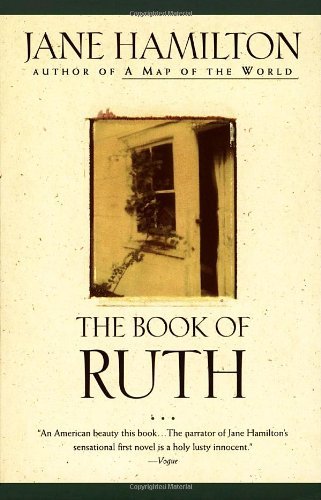
Winner of the 1989 PEN/Hemingway Foundation Award for best first novel, this exquisite book confronts real-life issues of alienation and violence from which the author creates a stunning testament to the human capacity for mercy, compassion and love.
I am really surprised by all of the negative reviews of this book. I think it is so strange that the characters are discounted as "white trash", their story thus, uninteresting or too dreary. While the story is by no means a happy one it is highly engrossing and worth telling. Hamilton's narrator Ruth is by turns despairing and joyful of life and Hamilton's writing manages to be lyrical and poetic, blunt and simple at the same time. I personally like to connect with other people, to imagine what it would be like to live in their skin, to know what forces shaped them into being who they are. This includes "white trash". The story is very realistic and you come away feeling like you have read truths, if not about fictional characters then real people somewhere out there who are experiencing very similar lives. If you are the type of person who is only happy reading stories that end happily-ever-after then steer clear of this book. But if you are like me and can also find beauty and meaning in even the most tragic tales then I highly recommend it.
This is one of my all-time favorite books. It's a book that changes one's perspective on people and walking a mile in other's shoes before judging. Did your school have one or two or maybe more kids that were just "off" -- easy targets for bullies and even kids who usually seemed nice? In this book the main character's name isn't even mentioned until the end because she's someone who is constantly minimized ... or even worse, unnoticed.
Is that terrible? Does that make me a bad feminist?
In Country? Hated it. All these poor white trash stories about kids growin' up harder n' poorer than those other kids over there, wearing ugly clothes, and having lots of scrap metal in the yard...
...yeah I just can't deal.
Because these stories never GO anywhere. It just sounds like a lot of whining through the front, middle, and back of life.
As if whining was courage. As if living poor every day was compelling courage.
Look. Being poor is rough. I've been poor. It sucked.
But a story has to DO something. It can't be day after day, year after year of going from being a confused and misunderstood backwoods girl with some small un-nurtured bit of promise to a confused backwoods teen with slightly less promise, to a ridiculous backwoods woman who is no smarter, no more interesting, and no more relavant than anyone else living in a valley made of dirt.
Look: populations need stories. John Steinbeck, for crissakes, wrote these people. Wrote them well, too.
But this? This plodding journey through an embarrassingly hideous life?
John Kennedy Toole did it in The Neon Bible. He was 16 when he wrote that, and even his sad naif protagonist had a few meaningful and well-turned revelations to make it all worthwhile.
But I got halfway through the story when I realized it wasn't GOING anywhere. The protagonist was just going to get more and more tedious. Less and less interesting. More and more annoying. Good lord was her voice annoying.
Yes, yes, very well-done. The writer's replicated the annoying voice to a T. Y'know there's ways to make that voice less grating without robbing it of authenticity.
What authenticity anyway? Is the girl supposed to be a half-wit? Or is she really sort of normal but painfully shy and socially awkward because of her place in society?
Sadly, I cannot tell. Because I think I'm supposed to sympathize with her, but in looking at her all I can think is "Yeah, I'd call her a half-wit too, dammit. Then I'd slap her."
And, Lord, if one more person in the story offers up a half-wit grin as a means to express innocent and misplaced pleasure I'm going to smack that grin right off their face. Author! A new device! Please!
people complain about ruth being "white trash," but i think they are missing the whole point - putting yourself in a world not your own. i grew to adore ruth as i experienced her small-town world. i found her ability to daydream and fantasize intelligent and mesmerizing. people also complain about the ending - let me just say that while it is harsh, it is an eye opening juxtaposition between hum-drum and madness.
This book is quite sad but has an amazing voice. The protagonist, Ruth, was never encouraged to do much with her life and has always been told she was not quite that bright. However, she has some incredible insights into human nature and her story is very barebones. Hamilton writes Ruth in such a way that her thoughts about the world are those that many of us have but never reveal because of social custom. Ruth's ideas are often right on and her "alleged" stupidity allows her to state things in an incredibly honest manner. A very clever narrative.
This is Jane Hamilton's first novel and it is a whopper. It's the story of a small-town girl and her struggles with growing up with a mother who's lost any compassion or sweetness and a brother she can't relate to. This girl, Ruth, despite an intelligence that she's unaware of and so is everyone else, ends up marrying a dangerous, drug-riddled fellow. Throughout the story, which lags at times in Ruth's simple cadence, there are bits of foreshadowing of some life-changing, terrible day. So you keep reading through 300 pages and the book's nearly finished and then it's there, and you're suprised and shocked and saddened even though you knew this terrible day was coming. It doesn't exactly sneak up on you, this moment, but it does kind of knock you out.
Hamilton, as with later books including A Map of The World, is good at writing about terrible things, trials of the soul. A drowned child in that case. I won't spoil this one for you.
It's worth a read because it takes you into a life you'd probably never experience or imagine, and the language is beautiful.
The book just lost me, despite the picturesque, but dark dragging and dragging and dragging and dragging and dragging prose. No oomph. No spirit.
The first third of the book had me excited. The next third had me counting the pages. The last third was just more of the monotonous same. How long should we wait before the paint will dry on this wall of misery?
So Ruth was born in misery, which means Ruth will die in misery. The end. Just like that. And the pity party will remain in full swing, because she wants it to.
Not for me. Maybe Erskine Caldwell spoiled me as a reader. There's sadly no comparison. Between the beginning and end some masterful prose got wasted.
I gave this book four stars, but I can't say I actually enjoyed it. I turned the pages out of a compulsive voyeurism, the way one might stick one's ear against the wall to eavesdrop on the dysfunctional family next door. It's not that you enjoy hearing the domestic violence break out--the screams, the profanity, the smashing of hurled glassware. You just can't bring yourself to turn away, let alone turn up your own radio to drown it out. Shhh. Quiet! They're at it again!
I agree with some of the other commentators here that none of the characters was particularly likable. Not even Ruth herself, whom I would have respected if she didn't have such appalling taste in men. I found myself pleading with her. "He's bad news, Ruth! He's a loser! You can do better!
She didn't listen. They never do.
What most impressed me about the book was the voice of the narrator. The author pulled off an exceedingly difficult trick: she wrote from the first person perspective of a character far less educated than she herself is, and yet it was both a) totally believable and b) not a painful literary abortion.
She pulled this off so smoothly that it's almost unnoticeable. It's so easy to believe that you are hearing the story directly from this poor uneducated young woman, without reflecting on the fact that she managed to write a book, something most privileged college-educated upper middle class academics will never accomplish in spite of their misplaced belief that they could do so easily.
If you are looking for something entertaining and uplifting, I'm afraid I couldn't recommend this, because if you don't find it depressing and disturbing, I think there is something seriously wrong with you. But as far as a lesson on the craft of storytelling, you could easily teach an entire course around it. Hamilton is a masterful craftswoman and I learned a lot from reading it, but I didn't exactly enjoy the experience. Then again, I didn't enjoy quite a lot of classes I've taken in my life, and I didn't learn as much in most of them.
I'll never forget when I first saw this book. It was being carried in the arm of a woman who had had an affair with my second husband during the year 1993 when my daughter was only a year old. She was a woman I alternately despised and pitied, a neurotic mess who thrived on breaking up marriages and making women miserable, to prove something to herself, that she was some kind of Superstar in the sack or something. We just happened to be in the same bookstore, a few years after the affair had ended in Portland, Oregon, and as she passed in front of me, I saw the book pressed into her arm as she was preparing to purchase it. Instantly I was curious because of the odd title, referencing the biblical story. What was it that she found interesting about such a book? So, after I slipped away, I can't recall if we saw each other, I later purchased the book and read it.
It occurred some time later that it was one of the books that Oprah Winfrey promotes in her "Book Club" and as such had become extremely popular as a result. I found the storyline to be something you might find in any city, anywhere in America, a saga of regular people, or even what some would term White Trash. What I love about Jane Hamilton and "The Book of Ruth" is how she can make something ugly seem beautiful. She writes about Ruth and her boyfriend who then marries her, Rudy, in such uncompromising ways. She spares nothing, but the reader is left knowing who matters in the story. Yes, Rudy is tragic and he ends up destroying himself, in a way, but this story is about survival and its about how Ruth survives and is helped by another woman who tells her at one point, "Do you know how smart you are?" I loved that part. This poor girl, working class, who thinks she is nothing survives this horrible event and then goes onto what the reader hopes are bigger and better things.
The book is about compassion and survival. And it comes highly recommended.
Book of Ruth is Jane Hamilton's first novel. Just reading the first lines again grants me the profound pleasure of stumbling on beauty and hard-earned wisdom (about losing one's naivete, or maybe innocence) in the lingua franca of rural Wisconsin.
"What it begins with, I know finally, is the kernel of meanness in people's hearts. I don't know exactly how or why it gets inside us; that's one of the mysteries I haven't solved yet. I always tried to close my eyes and believe that angels, invisible in their gossamer dresses, were keeping their loving vigil. I learned, slowly, that if you don't look at the world with perfect vision, you're bound to get yourself cooked."
This book was an early Oprah choice, but it stands out from the crowd because of its lyricism and awkward, bawdy truthfulness. It was published in 1988 and was influential in helping to make room for a certain kind of passionate female voice and underprivileged-girl-lost coming-of-age story in the mainstream publishing world. Personally, I have read it so many times I can practically recite parts of it out loud. Great book.
The New York Times Book Review said, "Ms. Hamilton gives Ruth a humble dignity and allows her hope--- but it's not a heavenly hope. It's a common one, caked with mud and held with gritted teeth. And it's probably the only kind that's worth reading about."
This is the story of a white trash girl named Ruth, her white trash mother and her white trash boyfriend/husband with bad teeth. It was very difficult to make it through this book because I didn't like any of the characters--they were stagnant and annoying throughout. Ruth had great potential but never realized any of it. A bad story was made even worse when about 4/5 of the way through, there was suddenly a horrific and bloody scene that took about 4 pages of graphic descriptions. I was caught completely off-guard because the rest of the book had been so boring. I guess I had kept reading thinking that something had to happen eventually to make the book worthwhile, but what finally did happen was awful. I would have been OK with it all if Ruth had changed for the better or pulled herself together because of the event, but she chose to stay ignorant. I know this is a popular author and book, but I really did not enjoy it at all.
I should have known better. I really should have. First, it was an Oprah book club pick, and second, it won some Hemingway writing award. I always find Oprah's picks terribly dark and I despise Hemingway. Sorry to all the Hemingway fans out there. BUT, on the back cover a review said the book was very "Dickensonian" and another said it had quirky off-beat characters in the vein of Anne Tyler--two authors that I happen to love, so I gave it whirl.
Ugh, ugh, ugh. I loathe ignorance. And the characters that fill this book are just so ignorant, and spiteful, and trashy, that I--well, it nearly turned my stomach at times.
Jane Hamilton can write, I give her that, but the material of this particular novel? I can't see that it adds anything worthwhile to the world. I really can't.
After all last month in the company of, how can I put this delicately, white trash (with the insupportable Harry “Rabbit” Angstrom) I got my hands on this, another American Family tragedy. As much as I loathe Norman Rockwell portraits, inversely I adore AmFamTs. Andre Dubus III, Joyce Carol Oates, Philip Roth…they are ALWAYS welcomed in my bookshelf. This, a “first novel,” seems like a breeze to read since its protagonist is, according to those that surround her, “slow.” Theme & form are the same, & maybe that is too much of a cop out. Lazy writing, just because the main character is slow, make the associations stark, and interesting more often than not. I’ve read stuff like this before (She’s Come Undone, The Patron St. of Liars, White Oleander… more…)
The ending seems a long way coming. The mystery of why the narrative is even told takes a while to simmer, finally boiling over in a scene that is 10% Raymond Carver’s “Popular Mechanics,” 20% Peter Jackson's "Heavenly Creatures" & 70% John Carpenter’s “Halloween.” So: good enough.
I admit that I purchased this book on a whim as I liked the title. The reviews also looked good and I could see that it was the winner of the Pen/Ernest Hemingway Foundation Award. I also thought that perhaps it was a modern day version of Ruth from the bible, which, in my opinion, is one of the most beautiful Books there. However, that soon proved not to be the case.
Initially I thought the book was rather good. It had a rather humorous, odd and yet self-effacing way about it. However, after a while I just couldn't take this in at all; characters such as May, Matt, Ruby, etc. soon became very annoying.
I then skim read looking for something that I had perhaps missed in the book (as obviously so many people had liked it), and then sailed on to the end as quickly as I could. Unfortunately, I couldn't send it up into my Kindle "cloud" as I had purchased the paperback.
I personally found this rather non-linear book was all over the place. My poor just brain couldn't handle it unfortunately.
I'm looking at the cover now. I liked the cover photograph by Barry Marcus, and the cover design by Kathy Kikkert. So that's a blessing, of sorts.
We were assigned this book as part of a writing course, with the intention that the instructor would have us read a few chapters per week, for us to discuss the author's use of craft. Our first discussion opened with the group unanimously loathing the book so much that it was never brought up again. I read it to the end to see if things got better - they did not, a tedious downer to the final sentence.
Jane Hamilton’s The Book of Ruth is a novel that tells of a family who endures the emotional toll of poverty, family dysfunction, and small-town isolation. It is a story of Ruth Dahl who through her endurance of poverty holds onto hope through tragedy. Ruth is a young woman who grows up in rural Illinois. Her mother is a bitter, domineering woman. Ruth grows up being told she’s slow, unworthy, and she will always be nothing. When Ruth marries a charming, troubled, cruel man, she only sees that love will free her. The story tells how Ruth’s life continues to erode. Until there is no more. The novel is soft and sad. Edges are hard as Ruth grows through the difficulties of life. Novel is character driven, with a strong female. It isn’t uplifting and happy, but one of life through multi-generational poverty and a desire to escape without knowing how.
Hands down probably one of the most disturbing books I have ever read in my life. At the unexpected climax of the novel, I got physically sick reading the description and almost fainted. Fun. But that's one of the reasons this book is so special; Ms. Hamilton does not even hesitate in her honesty.
The characters in this novel are unforgettable. I would like Jane Hamilton to write six more books as sequels: Book of May, Book of Ruby, Book of Justy, Book of Aunt Sid, Book of Matt, Book of Daisy, you name it. Any of them would be just as fascinating, disturbing, dark, and honest as Book of Ruth.
Ruth is one of the most tragic characters I have ever read about. Her connections with nature and beautiful, complex metaphors show off her observation skills, and it's devastating to realize that she had just as much intellectual potential as her brother, except she didn't receive the right nurture and education. She is naive, and the reader sees everything through her eyes. I loved Ruby because Ruth loved Ruby, I pitied May because Ruth pitied May. There are so many interesting aspects to all the characters I feel the need to read the book again, as soon as I know I can stomach the ending.
I finally finished this book which has been on my "could-not-finish" shelf for ages. What can I say... it is a lyrical book with beautiful prose, but the subject matter is extremely depressing and it never lifts itself up. It's like Hamilton has never heard the term "comic relief". I loved Jane Hamilton's "A Map of the World" and "A Short History of a Prince", but this book made me weary of Hamilton's metaphor-a-minute writing and her continuous dwelling on everything ugly about people. Everyone says that this book has a hopeful ending; well, that's not saying much considering that there is no where else to go at the end of this book except up.
This book was a huge dissapointment. The reader is forced to listen to the story of a woman who leads an unhappy and meaningless life. Throughout the eventless book you keep waiting for something to occur to make reason of the narrator's purpose in life, but instead find out that she is simply a pathetic and unhappy person. In the last few pages a huge twist occurs, but it is simply too late to indulge the reader, and is to much to take into too short of an amount of time. The only thing stopping me from giving this book a one is that the book was well written.
Dit is echt een donker boek. Ruth vertelt haar levensverhaal. Ze woont in een klein dorpje in de staat Illinois, met haar moeder May, haar vader Elmer en haar broer Matt. Ze heeft geen gelukkig leven. Ze zijn nogal arm, en Ruth krijgt niet veel kansen in haar leven. Haar broer Matt echter, die een wiskundig genie is, wordt door iedereen geholpen om vooruit te komen in het leven. Er zijn veel spanningen in het gezin, mede doordat met steeds gebrek lijdt. Ruth krijgt totaal geen opleiding, wordt op school steeds in de laagste klassen gezet etc. Ze is niet dom, maar heeft totaal geen educatie gehad. Als Ruth 8 is, verlaat Elmer het gezin, en moeten May en de kinderen het alleen zien te redden. Als na een tijd Matt de kans krijgt om aan een universiteit te gaan studeren met een beurs, blijven alleen May en Ruth achter in Honey Creek. Eigenlijk is het enige leuke in Ruth's leven het contact met haar tante Sid, met wie ze regelmatig correspondeert. Ruth ontmoet Ruby, een nietsnut van een jonge kerel, die al heel wat op zijn kerfstok heeft en te lui is om te werken. Maar Ruth is blind voor zijn tekortkomingen. Na enkele maanden verkering trouwen ze, en omdat ze weinig middelen van bestaan hebben, blijven ze bij May inwonen. Ruth en May werken in een stomerij. Tussen May en Ruby botert het totaal niet. Als Ruth zwanger wordt, betert de situatie een beetje, maar als Justy geboren is, wordt het eigenlijk alleen maar erger. May eist het kind helemaal voor zich op, en vooral Ruby krijgt nauwelijks de kans om iets met zijn zoon te doen, May scheldt hem herhaaldellijk uit dat hij niet in staat is om voor een kind te zorgen of het te onderhouden. Enkele jaren kabbelt het leventje van deze personen zo verder, tot er een dramatische uitbarsting volgt....
Het boek leest vlot, is simpel geschreven, eigenlijjk net zoals een dagboek van Ruth er zou kunnen uitzien. Ruth kan scherp de karakters van de mensen in haar omgeving beschrijven, waaruit blijkt dat ze niet dom is. Ik vind dit eigenlijk op een prachtige manier weergegeven. Toch kan ik het boek maar 3 sterren geven, vooral omdat het nogal traag loopt, en er weinig spanning in zit, tot op het einde. Alhoewel dat het verhaal wel realistisch maakt natuurlijk, het leven van mensen die in zo'n situatie zitten is meestal niet spannend, maar ontzettend saai.
I absolutely loved the story that main character Ruth tells about her pathetic family in rural Illinois, I can't believe this was the author Jane Hamilton's first novel, it's brilliant and made me laugh and gasp in horror too. Ruth's mother May had a hard life - her first husband and love of her life was killed at war, her brilliant son Matt never returned her love, her second husband abandoned her, she's alienated her entire family, and as far as she's concerned her daughter Ruth can't do anything right. Ruth grows up trying and failing to please her mother; and settles on Ruby, the first man to pay her the slightest attention. Ruby, like everybody else in this book, is damaged; also he can't keep a job or his clarity, even after they have their baby Justin. Ruth and Ruby together are completely headed towards catastrophe but she tells the story with such love and conviction it's never difficult to read at any point... eventually it all comes to a shocking head, and then she just continues on telling it until I'm sad the book ends.
The Book of Ruth, by Jane Hamilton, is the story of a girl growing up on the Illinois-Wisconsin border, born into a world that simply doesn’t love her. It is a study on the culture of the American boonies, on the failed education system, and of a flawed family, as Ruth struggles for hope. It raises the question- how does one prevail over ignorance, when ignorance is the only world to know, when it is an essential part of one’s identity?
In the beginning of the book, when Ruth is a young girl, we see a flame, a fire, as her thirst for knowledge and passion for life cause rebellion against her mother, May, who stands over her children, determined to keep them on a leash in the dark. The reader is not given many gifts in this dark, disturbing book, nothing much to cling on to as Ruth’s life turns from childhood passion to a numbness as a teenager, and then utter blindness and pain as an adult, but there are two significant characters that the author inserted into the book, to indicate that there is a lucid message behind all of the chaos and confusion that Ruth undertakes. These characters are her Aunt Sid- a choir director living in a university town in southern Illinois- and Ruth’s brother, Matthew, who somehow makes it out of the small, suffocating town, to become a successful scientist at an ivy league school, estranging himself from his family- “‘It is always strange, going home, facing people and a place with which I have nothing in common. I won’t bore you with the difficulties of my childhood, but to be honest my main preoccupation was trying to figure out who was worse, my mother or my sister’” (318).
In this book, it is so easy to get swept up into the world of Ruth, her violent marriage, her failed goals and dreams, her depression and repression, and not see anything else outside of it. That is where the true meaning of this book comes in. Despite its unusual format- it is not often that I read books where the situation gets continually worse for the main character, never better- I felt I learned a tremendous amount from this book, about the way that ignorance is bred, and the way that some people hurt themselves for their entire lives. The two self-aware characters in this book, Matthew and Aunt Sid, act as a reminder to the reader- be thankful for your life. These are small characters, remember, compared to the vast struggle of Ruth and her mother, but are the sliver of light. The fact that it is only a sliver is another tool the author uses here to create palpable emotion and draw the reader head-first into a world many wouldn’t dare choose to travel to, to make the reader crave for that light, and become aware of their own craving.
This book was a journey through the life of Ruth Grey. There is a beginning, middle and an end of the book, but not her life. Almost, but not quite.
The journey allows us to see Ruth's family and her situation through her words. Who the people were, what happened to them, what happened to her - all are detailed and told in her own words. How she felt and what she thought comes through clearly and is beautifully written, even when she was not quite truthful to others. She idolized her Aunt Sid and although she wrote letters to her, starting in 3rd grade, she never told her the truth. Her truth was too painful to put into words.
Much of Ruth's painful journey through life with her mother brother and later, her husband was very sad, but some of it was very moving and funny. I loved how she described nature and things around her. Many times it was very quirky and unexpected.
She described her Aunt Marion as having "soft brown eyes almost as tender as a dead mouse's in a trap..."
Her mother was hard. She felt that she had a hard life and she was hard on her children, especially Ruth. She verbally abused Ruth and had seemed to have no love or use for her.
Ruth was teased and bullied in school her whole life, but she was not dumb or retarted as they all said and thought. She was very sensitive and kept her mouth shut, except to her special friend and neighbor, Mrs. Finch. Mrs. Finch was blind and Ruth used to go to her house every afternoon to load the tapes for the audio books that she listened to. Ruth listened too and the books and Mrs. Finch saved her from being completely isolated and uneducated. The books and her letters from her Aunt Sid kept her grounded and interested in learning although she seldom let on and was always in remedial classes in school.
After high school, Ruth went to work at the Fit 'N Trim Dry Cleaners and later was married and had a baby. What I really liked, was that Ruby had a reason for telling her story. She very carefully guided the reader along to make us aware of what she called warning signs. She felt that what happened to her should not have to happen again, so she wanted everyone to know.
I am glad she wrote her story and I am especially glad that I decided to read it.
Didn't really care for this book, but didn't hate it either. Not sure that I would recommend it. One of the reviewers of this book called it "a sly and wistful ... human comedy" and another said the "small-town characters are ... appealingly offbeat and brushed with grace" but I wonder if those reviewers read the same book that I did. I found the novel dispiriting, depressing, and rather boring. Perhaps if this was part of a series, and we could also hear others' stories (May's and Matt's and Ruby's and Justy's) in their own voices, I would like it better. Alone, it feels like there is not enough to explain Ruth's feelings, her background, and why she would put up with the things she did, instead of doing something to change them.
Oprah's Book Club! Hemingway award winner! Should be fantastic, right?
Well, it is very well written. Certainly it is a very in depth story of the life of a woman growing up poor in the rural midwest in the 60s and 70s. The characters are very well fleshed out for better and (mostly) worst and the main character does a fine job herself at connecting the dots from one generation to another and seeing how their lives were all intertwined. For that quality of the writing and character development I can rate this highly.
But, my god is this one hell of a depressing tale! You want to like Ruth - to root for her - but at every opportunity to redeem herself or to gain some clarity or to show that is NOT turning into her dreadful mother - she disappoints. Yet the picture you are given into her own mind is one of someone who wants to believe she is smart and wise and has the courage to be someone different. And then she isn't. The tragic ending is quite inevitable. It's only a manner of when and how. Her reaction to it all is again, a huge missed opportunity. In the end I was far more curious how her friend Daisy and her brother Matt's tales continued. I gave up on Ruth entirely and no longer cared.
It was well-written and psychologically astute. Painfully insightful about the characters and human nature. However, I usually gloss over 'challenging' books in favor of fluff. My life and work are challenging enough. By the end of the day, I'm ready to sit down with a book and let my mind roam while talking animals adventure with irreverent wizards.
The only time I end up tackling thoughtful modern literature is when I'm sick in bed; too sick to make it to the public library, with the kind of sinus congestion that makes reading downloaded books on my iphone unworkable. Then I turn to the stack of books on my nightstand that have been so moving that my friends and relatives have felt compelled to give me copies.
I lay, feverish and read these devastating critiques of human nature.
Sometimes I wonder if friends give me these books because they were so disturbed by the content that they needed to share the burden and thus diminish it.
It was a good book, well written. The plot and characters well executed. I will think about it for a long time. Now will someone pass me the tissues, the Nyquill, and something less dark and challenging?
I loved this book! It is written in a very unsophisticated tone, as compared to "A Map of the World." It is a wonderful book about a girl who makes her way in the world, completely unsupported by her family, with the exception of an aunt who lives out of town. The small town in which the main character lives is very nostalgic to many of us who were raised in similar places. The main character grows to become what she hates the most, her mother. The ending is as dramatic as they come, with an episode that no one sees coming!!!
Gritty. But so is life. I ponder if I'd have handled my life any better if born into that setting. Probably not. We, who are born into a life of privilege and high functioning, assume that those who aren't somehow "deserved" it and can climb out if they wanted to. A quote I heard haunts me, "He was born on third base but thought he hit a triple." May I extend more kindness and grace to the Ruths I meet.
My mother-in-law read this on Oprah's suggestion, then she asked me to read it so we could discuss it. We both hated it. There is no way the reader can accept the self-consciously literary narrator as Ruth, who tells us repeatedly how stupid and illiterate she is. Likewise I found Hamilton's attempts to empathize with her characters both shallow and condescending. The only reason I finished this book was to discover what horrible thing had happened, as was referred to on the first page...the answer wasn't worth it. Hamilton has used every literary device at her disposal, and she is clearly a skilled writer. Unfortunately, her dislike or disrespect for her characters distances the reader, and the literary skill is wasted.
To my subconscious: We do not need to read this book again. Once was enough. I don't know why you decided to pull me toward it for a second go-round, but it stops here. Pick something nice next time.
Thanks ever so, Cara
To my memory: Exactly how did we manage to forget ever having read a book with such a grisly ending, for the entire book right up to the page before said grisly ending? Try to do better next time.
Most sincerely.
This entire review has been hidden because of spoilers.