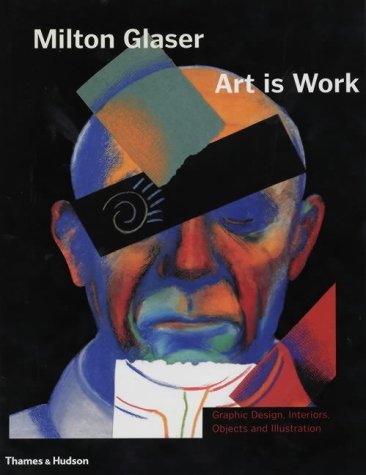
The best of Milton Glaser's prodigious output since 1974 is contained in this study of one of the world's most influential graphic designers. He leads readers through the development of his ideas, reacquaints them with central design principles, and shows how technology can provide opportunities.
Milton Glaser was a celebrated American graphic designer and artist, whose notable designs include the "I ❤ NY" logo, the psychedelic Bob Dylan poster, and the logos for DC Comics and Brooklyn Brewery. Born in the Bronx in 1929, he was educated at Cooper Union. In 1954, together with Seymour Chwast, Reynold Ruffins and Edward Sorel, he co-founded Push Pin Studios, which became a guiding reference in the world of graphic design. In 1968 he co-founded New York magazine with Clay Felker. Glaser had one-man-shows at the Museum of Modern Art and the Georges Pompidou Center. He was selected for the lifetime achievement award of the Cooper Hewitt National Design Museum (2004) and the Fulbright Association (2011), and in 2009 he was the first graphic designer to receive the National Medal of the Arts award. Glaser died in June of 2020, of a stroke.
If Milton Glaser’s most recent volume, Drawing is Thinking, is the private man, with his uncaptioned and hence often mysterious images, then Art is Work is the public Glaser, with plenty of commentary on his posters, paintings, drawings, flyers, publications, three-dimensional art, and even restaurant designs.
Many of Glaser’s greatest hits are here, including “I 'Heart' New York,” a visual slogan so ubiquitous that we have to stop for a moment to realize that it was consciously conceived and designed.
The book opens with a wonderful visual essay of Glaser’s struggles – and ultimate success, of course – in designing a poster for the School of Visual Arts in New York around the theme of “new” emerging from the “old.” We also see enticing posters for The Julliard School and other arts institutes and projects.
The variety of Glaser’s imagery and imagination for his clients is astounding: fallen angels, the landscape of Tuscany, artists from Duke Ellington and Gerry Garcia to Claude Monet, animals wild and domestic, Russian peasants and Italian Renaissance noblemen, restaurant furnishings – and always the consummate handling of typography.
As in his other books, Glaser offers a stalwart defense of the value of drawing: “We draw because it enables us to see. The act of drawing is perhaps the only time you pay attention to what is in front of you.”
Glaser’s work obliterates any meaningful distinction between “high” and “low” art, between commercial art and the fine arts. Is there any real difference, for example, between a record company commissioning the iconic “rainbow” profile drawing of Bob Dylan, and the Medici family or Renaissance Pope ordering up a wall fresco? If executed by a great artist, of course, the answer is no.