Jump to ratings and reviews
Rate this book

Robert Ardrey's Nature of Man #1

African Genesis: A Personal Investigation Into the Animal Origins and nature of Man

Rate this book
“Not in innocence, and not in Asia, was mankind born.” So opens Robert Ardrey's earthshaking 1961 classic African Genesis, his first professional foray into the scientific realm.

In 1955 Ardrey travelled to Africa to examine the collection of the then-obscure paleontologist Raymond Dart. He saw, culled from a cave occupied by early humans, a collection of antelope jawbones perfect for sawing, and antelope forelegs perfect for clubbing. He saw the skull of a juvenile proto-human, apparently bashed in. A growing body of evidence suggested that man had evolved on the African continent from carnivorous, predatory stock, who had also, long before man, achieved the use of weapons.

An acclaimed dramatist, Ardrey's interest in the African discoveries sprang less from purely scientific grounds than from the radical new light they cast on the eternal question: Why do we behave as we do? Are we naturally inclined towards war and weapons? From 1955 to 1961, Ardrey commuted between the museums and libraries and laboratories of the North, and the games reserves and fossil beds of Africa trying to answer that question.

The result was African Genesis. In a sweeping work that encompasses the evolutionary roots of nationalism and patriotism, private property and social order, hierarchy and status-seeking, and even conscience, Ardrey tells a story of man never before heard, and redefines what exactly it means to be human.

384 pages, Hardcover

First published January 1, 1961

54 people are currently reading
1017 people want to read

About the author

Robert Ardrey

76 books40 followers
Robert Ardrey was born in the South Side of Chicago in 1908. He attended the University of Chicago to study biology, but became the writing protegé of Thornton Wilder. He graduated in the midst of the Great Depression and supported himself with odd jobs while he wrote under Wilder's watchful eye. His first play, Star Spangled, opened on Broadway in 1935.

He continued to have plays produced on Broadway. His most famous, Thunder Rock, became a sensation in wartime London, and is now regarded as an international classic. Ardrey's plays caught the attention of MGM executive Samuel Goldwyn; in 1938 Ardrey moved to Hollywood, where he would become MGM's highest paid writer. He is credited with over a dozen films, including The Three Musketeers (1948, with Gene Kelly), The Wonderful Country (1959, with Robert Mitchum), and Khartoum (1966, directed by Basil Dearden, starring Charlton Heston and Laurence Olivier) for which he was nominated for the Academy Award for Best Screenplay.

In the 1950s, increasingly disenchanted with Hollywood, Ardrey travelled to Africa to write a series of articles. This trip renewed his interest in human origins, and he returned to his academic training in the sciences. In 1956 he moved with his wife and two sons to Geneva, and spent the next five years travelling and researching in Eastern and Southern Africa, conducting research for what would become his first scientific work, African Genesis (1961).

African Genesis and Ardrey's subsequent books were massively popular and deeply controversial. They overturned core assumptions of the social sciences and led to a revolution in thinking about human nature. Fundamentally Ardrey argued that human behavior was not entirely socially determined, rather evolutionarily inherited instincts help determine behavior and format large-scale social phenomena. Subsequent science has largely vindicated his hypotheses.

Robert Ardrey is the winner of a Guggenheim Fellowship and the inaugural Sidney Howard Memorial Award, is a Fellow of the Royal Society of Literature, and received an Academy Award Nomination for best screenplay for his film Khartoum. Time magazine named African Genesis the most notable book of the 1960s.

For more see: https://en.wikipedia.org/wiki/Robert_...

Ratings & Reviews

What do you think?
Rate this book

Friends & Following

Create a free account to discover what your friends think of this book!

Community Reviews

5 stars
129 (38%)
4 stars
110 (33%)
3 stars
74 (22%)
2 stars
10 (3%)
1 star
9 (2%)
Displaying 1 - 30 of 39 reviews
Profile Image for David.
Author 1 book71 followers
September 6, 2025
"African Genesis” by Robert Ardrey was a book being passed around the teacher's lounge in Jeddah, Saudi Arabia, where I was instructing Saudi soldiers in 1967. I bought a copy for myself in Istanbul on my way to Athens a few months later. I read it on the train from Turkey to Athens by way of Thessaloniki and finished it on the plane flying back to New York.

Ardrey raised my suspicions when I learned that he was primarily a dramatist and screen writer; but his science writing was so good that I let that slide and took him seriously. Ardrey and Genesis led me to ethologists Konrad Lorenz and his study of causes of aggression and imprinting; Niko Tinbergen—hawk vs. goose theory; Desmond Morris—adaptive behavior, and later on Richard Dawkins—gene-centered view of evolution. And even later Jared Diamond in an oblique way and now Juval Noah Harari. It’s interesting to note that several of these scientists and researchers were either amateur or professional ornithologists, or drawn to the subject at one time or another, or to some form of speculative fiction. In my undeveloped idea of science, I looked upon such compelling speculations as suspect and untrustworthy, and indeed, true scientists have posed such doubts on the work of these authors.

As with Sigmund Freud, some of whose works I read and who made me feel that I understood him and who is now often largely debunked by academics in their respective fields, changed my life. I don’t know if Freud cared much about birds, but many literary writers embraced Freud, and again influenced my life in many ways. What I’m leading up to here is that these kind of “speculative” writers can be thought of as Indian scouts who creep up to peer over a rise in the plain to see what possibilities lie ahead and come back to us with their idea of a plan of attack or a plan of avoidance. I believe these pioneers in fields like ethology are good for generalists like myself to study.

When I first read Genesis, I had no idea that within a few short years I would be ensconced in Africa with my bride very near a portion of the Great Rift Valley near the Zambezi where it is postulated that Man really began.
Profile Image for Edward Simpon.
3 reviews1 follower
January 16, 2014
This book changed my life for good. It answered many questions of life and why the world is the way it is,questions that no one else that I know of could. Although it is a fairly old book and that new scientific updates clarify a few aspects that at the time was speculative. I found this didn't affect my supreme enjoyment of, the best relevant to everything on this planet literature to come and grace the world.

Almost by sheer luck, while I was perusing a messy second hand bookshops natural science section, I waded through the unorganised piles of dusty old books(to the shop keepers amusement haha), lo and behold I found this priceless Gem at the very back of the piles. For $5 dollars this book has been the investment I have ever made. I'm so pleased to have stumbled upon this book. Period.

Even if the main educating/enlightening thesis of the book is disagreeable to some, it is a veritable goldmine of fascinating zoological, palaeoanthropology, evolutionary and historical facts. Yes I believe in the mantra, "nullius in verba", so I've done a lot of researching into what's in contained within this informative book that confirms, in essence that Roberts investigation and result(African Genesis) was, not in the least instance in vain assuredly definitely NOT for naught.

I found that after the first chapter that, I literally couldn't unengross myself and got by without a couple nights sleep until I completed reading it.

I wish I could have met this detective of the Natural World in person so I could shake his hand, for Robert Ardrey has revealed to me, clarity through obscurity.


Profile Image for Quo.
343 reviews
March 2, 2024
There are perhaps few books that can be said to represent a life-changing experience but for me African Genesis: A Personal Investigation into the Animal Origins & Nature of Man represents such a work. The best way to consider Ardrey's book is not to regard it as a scholarly work of man's prehistoric roots but as a very personal voyage by a gifted writer who intersected with the men & women who were at the forefront of these discoveries. Robert Ardrey, a former screenwriter & playwright, acts as someone who collates & dramatizes the characters who brought the world to a more complete understanding to our prehistoric origins.


Much in the way that Charles Darwin, a man without any specific scientific training fashioned his notes & observations from the long journey on the HMS Beagle into a definitive book on evolution, Ardrey took a giant leap, propelled largely by curiosity while living in East Africa but also hearkening back to a famous biology teacher at the University of Chicago, W.C. Allee, someone who served as an inspiration.

Beyond that, Robert Ardrey was mentored in the craft of writing by Thornton Wilder while at the Univ. of Chicago, someone who encouraged him to write for the stage. Many years after leaving his Chicago home, New York, where several of his plays were produced & Hollywood, where he was a screen writer, nominated for an Academy Award for the film Khartoum, Ardrey found his way to Africa and transformed himself & in so-doing, served as a kind of evangelist for folks like Louis & Mary Leakey in Kenya and Raymond Dart in S. Africa.

African Genesis is so very many things in one but one of the key elements I'd forgotten about is the autobiographical nature of the work, almost playfully inserting footnotes about the author's own life, while at the same time functioning as an imaginative screen writer in creating a tableaux of primate development with very colorful, evocative language.

For example, the author compares the "genetic lottery" each of us is beset with to a hand of poker. And Ardrey uses the American musical West Side Story as a method of demonstrating man's territorial nature, going as far back as "Australopithecus Africanus" in the Pleistocene era, 3 million years ago, a continuing human quest for territory with early primate origins. Here are a few samples of Ardrey's commentary:
Not in innocence & not in Asia was mankind born. We are a fraction of the animal world & to its subtle ways our hearts are yet pledged. We are children of Cain. And were it not so, then for humanity there would be no hope. We are born of risen apes, not fallen angels, and the apes were armed killers besides.

And so what should we wonder at? Our murders & massacres & missiles & our irreconcilable regiments? Or our treaties whatever they may be worth; our symphonies however seldom they may be played; our peaceful acres, however frequently they may be converted into battlefields; our dreams however rarely they may be accomplished. The miracle of man is not how far he has sunk but how magnificently he has risen. We are known among the stars by our poems, not by our corpses.
Among Robert Ardrey's many captivating assertions are these: the paradox that our predatory animal origin represents for mankind its last best hope; there are parallel lines of evidence that bipedalism leads to tool use, which leads to weaponry & the inevitable "Cain & Abel moment"; human intelligence is no sideshow but the main event, with the mind free & the creature of no single instinct, capable of discovering a truth or creating a lie; that territory is much more a defining element than sexuality in animal life (he establishes a homestead before gaining a mate); that man is neither unique nor central nor necessarily here to stay; there is an amity-enmity code of any animal society: mercy, devotion & sacrifice for the social partner but suspicion, antagonism & unending hostility for the territorial neighbor.


Beyond these assertions, Ardrey contends that "in the hieroglyph of human emergence certain symbols must stand for all to read: change is the elixir of human circumstance & acceptance of challenge is the way of our kind. We are bad-weather animals, disaster's fairest children. For the soundest of evolutionary reasons, man appears at his best when times are worst."

Of course in the many years since Robert Ardrey wrote African Genesis further research has changed the way we view our prehistoric development and many later researchers have refined the manner in which we view primate behavior, among them Donald Johanson, also with a Univ. of Chicago background.

I first read Robert Ardrey's African Genesis in Africa just after it was published & found it a most remarkable book, in part because much of the research into early man's roots had been done in Kenya where I was living but also in South Africa & Ethiopia, a country where I'd also spent time.

But more than that, the book served as a pathway to so many other important books by authors such as Raymond Dart (with whom Ardrey spent considerable time in S. Africa), Sonia Cole (The Prehistory of East Africa), Eliot Howard (Territory in Bird Life), Konrad Lorenz, Phillip Tobias, & Eugene Marais (Soul of the White Ant & My Friends the Baboons), all works of considerable interest that represented stepping stones to a further understanding about the African sphere of man's evolutionary passage.


In a curious sort of way, the book has been with me ever since but only recently did I establish time to reread African Genesis. Yes, much has happened in the world of research on the early archeological roots of mankind as well as competing explanations regarding the behavior of early primates. At some point, unable to locate my paperback edition from my time in Africa, I wrote away for a used hardcover edition, which when it arrived bore the inscription of William L. Shirer, the illustrious journalist & author of Rise & Fall of the Third Reich & other well-regarded books.

Later, based on a comment regarding African Genesis that I'd made at this site, I was contacted by Jonathan Ardrey, the author's grandson who very cordially introduced himself & proceeded to send me copies in a newly bound paperback format of all of Robert Ardrey's books, apparently long out-of-print. My apology for taking so very long to deal with a review of African Genesis Jonathan.

African Genesis is most certainly a book for a limited audience but I recommend it to those with an interest in primate ethology, human prehistory & African paleo-anthropology. More than that, Ardrey's book represents a quest-tale of a sort that is both formidable & quite unusual in its scope. Alas, some of the comments of reviewers at this site betray an almost utter absence of familiarity with the book but I was quite moved by the positive review by Edward Simpon.

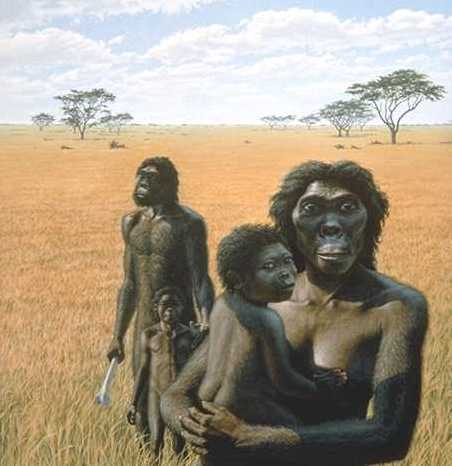
*There are many expressive drawings inserted within African Genesis, done by Berdine Ardrey, the author's wife, at a time when they lived in South Africa, where both are now buried. Given Robert Ardrey's extreme sensitivity to Africa & man's origins there, Ardrey's place on the continent represented a kind of homecoming. **1st Image within review=Robert Ardrey; 2nd=artist's rendering of Australopithecus; 3rd=Thailand postage stamps portraying Australopithecus/primate evolution.
Profile Image for Katie-Ellen Hazeldine.
32 reviews3 followers
January 7, 2015
I am currently re-reading this grand, passionate, minutely observed book; an inspiration and an education in its own right, about the nature of the animal, Man, and his place in the natural order.

Published in 1961, it is perhaps not completely up to date in every detail, eg, an observation made about the hunting nature of Man suggests Ardrey had not observed chimpanzees group-hunting live prey, where we've since had the benefit of film to show us that chimpanzees do hunt in teams for meat, and how. Zoology has carried on apace, and added to his findings, but this is a book still far ahead of mainstream educational provision. It is a profound book, and its message stands.

Ardrey's many references to the tragic naturalist Eugene Marais point to further reading with profound implications for psychology and philosophy. By Eugene Marais, The Soul Of The White Ant. Available to read online: http://www.soilandhealth.org
Profile Image for Larry.
14 reviews
April 10, 2012
This new theory of human evolution opened me to better understanding of my emotional makeup, human behaviors in general, history and focused my attention on our animal nature.

When I had read Hobbs, I began to understand the artificiality that civilization requires. "African Genesis" took me a step further.

LB 2012
Profile Image for J.D. Steens.
Author 3 books32 followers
March 1, 2016
I re-read this book (1961 edition) because a PBS special referred to Ardrey’s opening line, “not in innocence, and not in Asia, was mankind born,”* as particularly significant in understanding human origins (he wrote his book just prior to the renewed interest in our biological origins, and before the work of Jane Goodall and others on ape behavior). Ardrey confronts and counters a Western, romantic view that human nature is benign and that it is only external factors (e.g., society, per Rousseau; or means of production, per Marx) that create our nasty history. Ardrey also refreshes Darwin’s speculation that our beginnings were in Africa, and not in Asia or in Europe as had been largely argued. **

These twin themes are intertwined. Ardrey focuses on two early hominid lines. Initially, both lived in the African forests. Due to climatic changes, these forests dwindled in size, forcing one of the lines (Australopithecus africanus) to take to the open savannah. This in turn forced the development of bipedalism that freed the hands for “tool” use (a euphemism for weapons) and the evolution of a mental capacity directed toward weapon-tool development and use, and toward communication and cooperation within hunting bands. These developments allowed this last ape line that preceded humans to survive by wits alone (a non-specialized capacity to solve survival problems by intelligence and social cooperation). This ape line operated under a single commandment: “Kill, eat meat, or die.” This “not-yet-man” was a predator, with an instinct to kill and “a genetic affinity for the weapon.” While “Abel” stayed in the forest, Ardrey writes that “Cain” emerged on the savannah as a primate carnivore. The irony is that while this ape line was exiled from its forested habitat, this in turn forced the evolution of an ape line that gave rise to the human line that dominates today, which stands in contrast to the arboreal ape, the forest specialist, who survived but is now is regarded as “an evolutionary failure.”

Ardrey argues that a territorial instinct was central to the success of the exiled ape line. Territory, presumably, defined hunting areas that were essential for survival. Territory defines one’s group from non-group competitors, giving rise to our dual nature (love our friends, hate our neighbors). Order was essential for the group’s success in accessing food and defending territory and order was achieved to mute the competition for relative benefits (sexual mates, access to food, etc.). The pecking order was based on fear. It was about “who I fear, and who must fear me.”***

Territory, status, society were the keys to order. Ardrey calls them “the instincts of order.” They function as super structures. They function like Schopenhauer’s will. They underlie all we do. Such is their power that reason is powerless to counter their operation. The “romantic” view about our being in control is a fallacy. It’s an illusion that does not see that conscience “organizes hatred.” It only expresses our deepest primate instincts and cloaks them with the voice of God or the pretensions of reason.

Ardrey thus takes us to the bottom and then gives us a ray of hope. The instinct for order may be our salvation for we see the destruction that comes with our killing (animals, and competitors for territory) imperative. That, in a tamer form, was Hobbes’ observation as well. Ardrey sees reason as our only hope. This is not the reason that advances ourselves at the expense of the other, but the reason, through civilization and its laws, that advance the interests of the whole. Ardrey’s irony is “that our predatory animal origin represents for mankind its last best hope.”

*The line is repeated on page 353.
**Ardrey writes that "anything coming from below the equator has always, to the northern nose, borne the suspicious odour of someone hailing from the wrong side of the tracks.”
***There was no death in pre-Cambrian time Ardrey argues. Life simply divided itself. As there was no mortality, there was no fear. There was only “undifferentiated” and “immortal slime.” With sexual reproduction came individuality and death, and with death, fear. “With the advent of death,” Ardrey writes, "paradoxically, came all that we think of as life.”
Profile Image for Doug H.
286 reviews
December 2, 2015
A gripping, mind-expanding read. Fascinating and poetic writing.

“We were born of risen apes, not fallen angels, and the apes were armed killers besides. And so what shall we wonder at? Our murders and massacres and missiles, and our irreconcilable regiments? Or our treaties whatever they may be worth; our symphonies however seldom they may be played; our peaceful acres, however frequently they may be converted into battlefields; our dreams however rarely they may be accomplished. The miracle of man is not how far he has sunk but how magnificently he has risen. We are known among the stars by our poems, not our corpses.”
32 reviews3 followers
October 30, 2009
A wonderful blend of ethology, zoology, anthropology, and sociology, Ardrey is among the first to publicly argue that Man originates from Africa. He also has less than noble things to say about our dubious origins, which run contrary to the common Rousseauian ideal about humanity. Namely, that we came from bloodthirsty, murderous apes.
Profile Image for Kerem.
414 reviews16 followers
April 27, 2020
This is a fascinating book with plenty of knowledge and interesting theories on the evolution of humans. Though the book is almost 60 years old and science has clarified various components of the book for the better or worse, it still carries weight in this day. Human aggression and use of weapons is one of the main themes throughout the book, and Ardrey certainly has a passion to argue for the so-called Killer Ape Theory of Raymond Dart, which claims that man evolved from now extinct apes that were capable of using basic weapons such as bones (the theory is neither proven nor disproven by science yet, but Ardrey at least disproves the then popular hyena alibi thoroughly.) There are many other interesting parts on a number of subjects, from territory to hierarchy, not only focused on humans but also a range of animals from jackdaws and lions to baboons and termites. Ardrey is also not shy being harshly critical of dogmas in science and hoe hard they're broken (the history of science is full of them!) Ardrey's writing style is also very enjoyable to read.
Profile Image for Lisa.
236 reviews3 followers
November 7, 2007
The story of our animal origins including our aggressive nature. Somewhat outdated, since it was written in the 60s, but still interesting even if everything he says is not entirely correct anymore (due to new evidence).
Profile Image for Steven Peterson.
Author 19 books324 followers
May 6, 2010
This is the earliest of the works by Robert Ardrey that "caught on" in terms of his exploration of human nature as a result of the evolutionary process. A bit simplistic (but he was not a scientist after all), he explores the origin of human ancestors and the role of violence in the evolutionary history of the species.
5 reviews1 follower
September 14, 2009
African Genesis by Robert Ardrey is an early book on human genesis. It claims the genesis for Mankind is in Africa and not in Asia. The author contends that humans have a violent streak which extends to this day. Robert Ardrey uses much material from Raymond Dart.
Profile Image for Chicory Poetry.
25 reviews1 follower
February 8, 2013
I discovered this book in my first year of college because I haunted the town library from boredom in a god forsaken town...

I digress .. tangent ...

I enjoyed this book & read it often for years. It now sits proudly on my bookshelf in the den ..

Profile Image for Curtiss.
717 reviews51 followers
December 17, 2017
A tour-de-force discussion of the origins of mankind, told as a personal journey of discovery by former playwright and Hollywood screenwriter ("Khartoum"), Robert Ardrey. In addition to his keen insight, and wide-ranging interests, Ardrey's sardonic sense of humor is on full display, in his descriptions of the territorial and mating habits of Howler monkeys and English Jackdaws, as well as his own reminiscences of his early years in a Chicago "church-study group", whose rowdy basement meetings and initiation rites helped prepare him for the rigors of anthropology in the field with Drs. Louis Leakey and Charles Dart.
Profile Image for John Triptych.
Author 59 books78 followers
April 8, 2018
This is a profound revelation. If you ever wondered how people are capable of mass murder, extremism, racism, sadism and all that, then you must read this.

When this book first came out it changed the general consensus on human origins completely- prior to it most anthropologists believed in the concept of early man as a noble savage, but this book completely blew that illusion out of the water. Some parts of it are dated, but it gives you the proper insight on what drives people today since we havent changed much- that killer instinct is inside us all. Warfare, greed, and aggression is part of our genetic makeup, and we need to accept that in order to move forward.
Profile Image for Paula Guisard.
10 reviews1 follower
November 25, 2016
O que mais me incomodou não foi tanto o fato do livro ser da década de 60 e, portanto, estar bastante defasado, mas sim o total desprezo por uma metodologia minimamente confiável. Pelo menos na primeira metade inteira do livro, Ardrey escolhe os dados que mais lhe apetecem para defender uma ideia que ele já sabia que queria provar... e com isso, tudo o que eu poderia ter aprendido na segunda metade deixou de me passar qualquer confiança.
Profile Image for Xavier Patiño.
207 reviews68 followers
did-not-finish
March 5, 2020
I really wanted to like this book however I am going to have to call it quits after almost 100 pages.

I found the writing to be verbose and I had trouble following his line of thought. There were some nuggets of interesting information about animal behavior but it wasn't enough to keep my head from bobbing up and down in sleepiness and boredom.
Profile Image for Doigt.
55 reviews1 follower
September 11, 2007
Your tiny ape brain can't handle evolution, so take drugs...that will help.
Profile Image for Chris Gager.
2,062 reviews88 followers
November 15, 2011
I think I read this and most if not all of Ardrey's pop anthropology writings. He was also a prominent screenwriter. Date read is a guess.
Profile Image for Julio The Fox.
1,713 reviews117 followers
October 11, 2023
Once upon a time, this was the most controversial book in the world, and influential. AFRICAN GENESIS left its footprints on everyone from Stanley Kubrick, who incorporated Robert Ardrey's findings on the bloody origins of man into 2001: A SPACE ODYSSEY, along with far-right political groups that welcomed the notion of how violence is an innate part of human nature. Are we all natural-born killers? If Ardrey is right Hobbes was right with his view of life as "nasty, brutish and short"; humans are wicked brutes and the violence they practice can only be tamed, never eradicated. Religion, politics, and education are all failed attempts to turn humans into what they are not---peaceful creatures living in harmony. A dark analysis to be sure, and not wholly convincing, yet guaranteed to start arguments right now.
Profile Image for Alayne.
2,441 reviews7 followers
September 23, 2018
Well what can I say about this book? First published in 1958, this impression in 1971, its facts were extremely out of date. Its prose was very "high-falutin" to the point of being distracting from the points the author was making. However, it was very interesting in terms of being a historical document of the discoveries in Africa of australopithecus, and the point (that he made over and over again in 400 pages) that humans, descended from apes, were and still are users of weapons rather than tools. I found it quite a fascinating book, if overlong.
Profile Image for Grant.
Author 2 books14 followers
September 15, 2020
Ardrey's writing style takes a lot of getting used to; I found it to be overly florid much of the time. What could have been said in simpler ways, he chooses to say in a florid, roundabout stylization. And yet, this is mostly forgiven when one encounters some remarkable passages, including the beautiful prologue and epilogue. And, ultimately, the book's assertions just make a lot of sense, however difficult it may be for people (particularly religious ones) to accept.
Profile Image for Gili.
305 reviews
October 24, 2022
ספר שנכתב ב-1961
רחב יריעה, לטעמי יותר מדי
מתחיל מזאולוגיה ועד לפלאנטולוגיה ולאנתרופולגיה.
אין ספק שבעת פרסומו היה חדשני ומהפכני ואפשר להבין שהצית את הדימיון של האנשים והפך לרב-מכר
מובן שיש בו דברים שהם לא ממש מעודכנים או אולי אפילו נסתרו.
יש בו מסקנות נכונות וכמה שלפחות נכונות בחלקן
לא כל כך אהבתי את הסגנון התיאטרלי במקצת של המחבר שהוא מחזאי במקור.
70 reviews2 followers
June 22, 2023
At its most gripping moments Ardrey leads you through a series of conclusions that feel instinctually true, like he's articulating something that you feel in your bones as much as in your brain. Spectacular prose helps too.
Profile Image for Toons.
142 reviews3 followers
December 19, 2022
Really enjoyable, despite it's age. Man ancestors were violent, man's pursuit of weapons has been in perpetual step with our evolution.
Profile Image for Michael J.  Somers.
Author 3 books
January 17, 2023
Read it a long time ago and much has changed in our knowledge but it was a very inspirational book.
Profile Image for Alex Lippincott.
16 reviews1 follower
March 21, 2024
Very very interesting book due to it being so contemporary for things that are nowadays accepted as fact. Written very well too
Profile Image for Lester Fisher.
Author 3 books20 followers
December 10, 2021
Now this book has inhabited my mind to this very day. Ardrey asks a simple question: did the human brain cause the evolution of our bellicose nature, or did our innately warlike nature cause the evolution of the human brain. But the unfortunate corollary is whether the the human brain will evolve to control out bellicose genes, or will societies be perpetually doomed to devolve into war and conflict? The evidence is not strong for the former, but at least we have not had another world war since I was born in 1947, although conflicts continues to rage around the world.
Profile Image for J. Dolan.
Author 2 books32 followers
January 12, 2017
I read AG over 30 years ago, but plan on picking it up again soon. Aside from Mr. Ardrey's entertaining prose, it's always good to be reminded of where our dysfunctional species came from. And how little we've evolved (just turn on the TV news) from that sad, sorry beginning.
Though recent research into that beginning and its immediate aftermath has cast doubt on some of Ardrey's assertions, his basic argument has held up well, namely that our kind was forged in the unforgiving environment of the Pliocene, and that in order to stave off its extinction one of the tactics Mother Nature employed was to imbue our progenitors with a harshness akin to that drought-plagued era. To cite but one example, we had to learn to kill (and eat meat) or starve.
And boy, did we learn! Nor for reasons Ardrey also mentions was our bloodlust confined to animals. Witness not only the history books but, again, today's news. Unfortunately, though we may by some miracle have avoided slaughtering each other out of relevance, in her blind zeal not to lose us, Nature also saddled our beleaguered line with a sexual appetite second to few. So that overpopulation and its attendant catastrophes may be our undoing yet.
One can only hope we're not THAT dysfunctional-- but after reading AG, I for one wouldn't bet on it.
Displaying 1 - 30 of 39 reviews

Can't find what you're looking for?

Get help and learn more about the design.