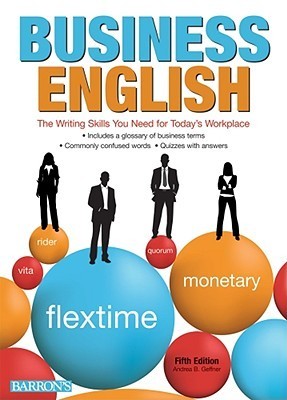
This updated edition provides clear, concise instruction on every form of business writing, from traditional business letters, reports, and memos to e-mail and other electronic communications. The author emphasizes that effective business English begins with mastering grammar and sentence structure, and presents a brush-up review of grammar and correct English usage. She also advises on achieving an appropriate business style that conveys the writer's message succinctly without resorting to stilted, overly formal language or meaningless jargon. She follows up with good examples of model business letters, résumés, employment letters, interoffice memos, news releases, and business reports. Additional features include exercises with answers and a glossary of business terms.
Business English is a part of English for specific purposes and can be considered a specialism within English language learning and teaching, or a variant of international English. At least that is how Wikipedia defines Business English, and while I don’t disagree with the definition, it does not quite capture the spirit of the word. You see, Business English, is the English that you need to work, plan, or do business in English. It will help you land a job, get a promotion, and stand out from colleagues. You need to know when to be formal – a business plan; when to talk in sports metaphors – negotiating a deal; and when to KISS – Keep It Simple, Simplify. Keeping Business English simple and concise is hard work. Many writers of various sorts, make a good living helping to do just this. Authors write about it. One such author is Andrea B. Geffner, and I recently revisited the sixth edition of, The Writing Skills You Need for Today’s Workplace. It is a good start if you understand Business English – orally, and in writing. But that is not enough. Yes, you can get bogged down in such useful information as, “Every verb has five principal parts. These are the infinitive, the present tense, the past tense, and the two participles.” But the beauty and dread of English is that rules do not get in the way of the communication. English adapts to the environment. That makes understanding the context of the language and the culture of your situation fundamental to getting your Business English right. Here is a model verb example from Geffner’s book:
• Infinitive to go • Present tense go • Past tense went • Present participle going • Past participle gone
The book is full of excellent exercises, examples, and explanations. Most people will conclude that Business English Is too Hard! As one teacher explained: “What prevents students from making progress with their English and Business English is EXCUSES.” Excuses like:
• I'm too old. • I'm too young. • I don't have enough time. • I don't have enough money. • I live in a non-English speaking country. • I don't have anyone to talk to in English. • I'm not good at learning languages. • English is too hard.
The truth is that all the above excuses are valid. The reality is that a lot of people who speak and, in some cases, work in English and in the business arena are not fluent in Business English.
“How is that possible?” you might ask.
To be fluent in Business English you need to understand the terms and concepts used in Marketing, Economics, Finance, Management, Accounting, and IT (Computers). You would need to understand some of the jargon as well.
How is that possible?
• Listen • Read • Practice • Learn
You might also consider getting a coach. I know smart and multilingual lawyers, that need help with Business English. They may be familiar with the words, but not the concepts. That can be deadly. Of the over 1.5 billion people in the world that speak English, over a billion speak it as a second language.
Many want to speak it for business purposes. It is a step learning curve. Here are some general tips to help:
This book does an excellent job of giving you a comprehensive overview of uses of Business English. It would make an excellent reference to keep on to the serious student. However, the book does not delve into the ‘why’ of why you would want to learn Business English. There are answers to the quizzes at the end of the book and that helps to keep you on track – but no cheating. Then again is learning cheating? There are lots of little things that we just say in English that actually have rules and how and why we say them in the way that we do. Overall a very good overview and an excellent resource
Lino Matteo
Noted below is the chapter of the book, with its topic and some of my observations.