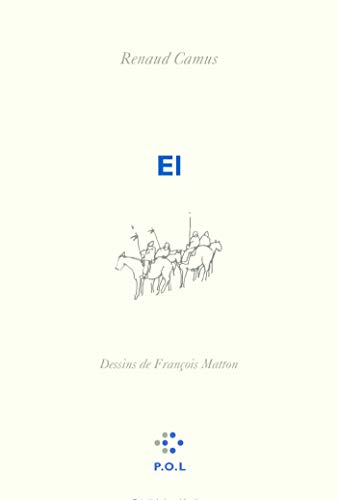
El est un texte écrit par Renaud Camus il y a 20 ans. Le manuscrit égaré puis retrouvé récemment a été écrit pour être accompagné de dessins, réalisés par François Matton. Dédié à El, mis pour Elisabeth, ce livre est un hommage rendu à une femme devenue personnage. Autour d'elle s'organisent les fragments d'une histoire ajourée, comme griffonés sur une nappe en papier. Chaque page comprend quelques lignes de texte placées sous une vignette ou une fenêtre. Chaque vignette n'est pas l'illustration du texte qu'on lit, mais l'écho retardé ou anticipateur de ce qui est dit, en décalage. Un peu comme le carré que dessine l'aruspice avec sa canne en désignant le ciel pour interpréter ce qui le traverse. "Ceux qui savent lire, le font tout haut, mais chacun propose son interprétation". El publié conjointement au Journal 1991, est aussi une manière d'autobiographie, une histoire donc. On pencherait pour un souvenir de vacances. La situation idéale serait celle d'une île grecque. Trois personnages isolés dans le désert des possibles, étrangers, dépossédés, un triangle réduit à un diminutif et deux initiales. Une femme et deux hommes on le comprend, des rencontres alléatoires à peine évoquées déjà évanouies au profit d'une nouvelle image faisant de la vie ce répertoire d'images et du lecteur ce regardeur.
Renaud Camus, writer, painter, photographer, was born in 1946. As a young man, Camus' ideas and writings were strongly influenced by his association with Roland Barthes, Louis Aragon, Marguerite Duras, and the Warholian circles. He is now the author of more than one hundred and sixty works, published for the most part by P.O.L, Fayard and now by "Editions du Château": annual volumes of diaries, novels, essays, elegies, eglogues, dictionaries, anthologies, writings on art, political writings, literary travel guides...
His works are marked by the question of meaning. It includes avant-garde texts, the "Eclogues", conceived as a response to the aporias of the Nouveau Roman, and "Burn Boats", an immense hypertext in perpetual growth. The political work is organized around the monumental "Du Sens" (P.O.L., 2002), "Le Petit Remplacement" (Chez l'auteur, 2017) and "Le Grand Remplacement" (Chez l'auteur, 5th edition, 2019).
Cultural animator of the Château de Plieux for a decade (exhibitions Jean-Paul Marcheschi, Eugène Leroy, Miro, Jannis Kounellis, Josef Albers, etc.), Renaud Camus is also the author of abstract paintings ("YHWH", "Alephs", "Enjambements") and figurative, as well as photographic albums ("The Day nor the Hour").
To fight against the industrialization of man and the massacre of landscapes, against a pan-economism that treats men as Undifferentiated Human Matter, and against the change of people and the violence it implies, the author founded the party of In-nocence (2002) and, with Karim Ouchikh, the National Council of the European Resistance (2017)