

What do you think?
Addison-Wesley Object Technology Series
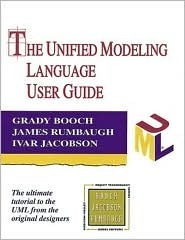
The Unified Modeling Language User Guide
The "Unified Modeling Language User Guide" is the first of two UML works written by the creators of UML. This book will introduce the core 80% of UML, approaching it in a layered fashion and providing numerous examples of its application. The title is suitable for developers unfamiliar with UML or with modeling in general.
482 pages, Hardcover
First published September 30, 1998
About the author
Grady Booch
36 books67 followersGrady Booch is an American software engineer, best known for developing the Unified Modeling Language (UML) with Ivar Jacobson and James Rumbaugh. He is recognized internationally for his innovative work in software architecture, software engineering, and collaborative development environments.
Ratings & Reviews
Friends & Following
Create a free account to discover what your friends think of this book!
Community Reviews
Displaying 1 - 7 of 7 reviews

January 29, 2012
UML is just about the driest of all dry topics, even for technical people. It shouldn't really be a surprise that this isn't a real page-turner.
I picked up this book because it was recommended in another book on design patterns and I wanted a deeper understanding of UML. It is a good reference and I'd recommend as such it to anyone who needs to add more formality to a software design process. I particularly like the fact that the author focuses on providing the appropriate level of detail (not too much, not too little) where other UML books seem to treat UML as the Universal Answer To All Design Problems.
The book is very structured and almost all the chapters have the same sub-sections, which would make it more useful as a reference tool. On the other hand there are a couple of chapters (on state machines and state diagrams) which are almost the same and I have to wonder why there are two different chapters.
Overall, I'd say this is a useful reference, but I'll not recommend anyone read it straight through.
I picked up this book because it was recommended in another book on design patterns and I wanted a deeper understanding of UML. It is a good reference and I'd recommend as such it to anyone who needs to add more formality to a software design process. I particularly like the fact that the author focuses on providing the appropriate level of detail (not too much, not too little) where other UML books seem to treat UML as the Universal Answer To All Design Problems.
The book is very structured and almost all the chapters have the same sub-sections, which would make it more useful as a reference tool. On the other hand there are a couple of chapters (on state machines and state diagrams) which are almost the same and I have to wonder why there are two different chapters.
Overall, I'd say this is a useful reference, but I'll not recommend anyone read it straight through.
July 7, 2011
yes i am satisfy

April 3, 2026
The approach of the book feels a bit outdated. It mostly provides “recipes” for everything, assuming readers will look up the details and variations when needed. Still, it does remind us why modeling matters: you wouldn’t build a house for your family without detailed planning. A model is simply a simplification of reality, focusing on one aspect at a time. We build models so we can better understand the system we’re developing.
For my own use, I treat this book as a reference. I can review the core concepts, see what suits my needs, and look up the specifics when necessary. Regardless of its age, I appreciate the effort that went into writing it.
The book organizes UML into three main kinds of building blocks:
- Things: structural things, behavioral things, grouping things, and annotational things
- Relationships: dependency, association, generalization, realization
- Diagrams: class, object, use case, sequence, collaboration, statechart, activity, component, and deployment diagrams
This structure is still useful today, even if the tooling and practices around UML have evolved.
For my own use, I treat this book as a reference. I can review the core concepts, see what suits my needs, and look up the specifics when necessary. Regardless of its age, I appreciate the effort that went into writing it.
The book organizes UML into three main kinds of building blocks:
- Things: structural things, behavioral things, grouping things, and annotational things
- Relationships: dependency, association, generalization, realization
- Diagrams: class, object, use case, sequence, collaboration, statechart, activity, component, and deployment diagrams
This structure is still useful today, even if the tooling and practices around UML have evolved.
Want to Read
February 9, 2022best

September 28, 2013
1er volet de la trilogie UML. Cet ouvrage de bonne facture (couverture rigide, impression bicolore !) présente les différents concepts d'UML, ainsi que les diagrammes associés. Les éléments les plus importants de la notations (tels que les classes) sont partagés en 2 chapitres : Notions de bases et concepts avancés. Lecture agréable, aussi bien par le style que grâce au partitionnement en de nombreux chapitres de taille raisonnable. Ce n'est pas un manuel d'initiation destiné aux néophytes en modélisation. Pour ceux ci, le livre pourra paraître trop complexe du fait de son exhaustivité, dans ce cas un ouvrage tel que celui de Pierre-Alain Muller sera plus approprié.

March 28, 2010
Nice book on UML
April 16, 2010
No es bueno este libro para "aprender" UML. No está muy explicado. Pero es muy bueno como soporte para el trabajo diario :P. Aclarar dudas concretas.
Displaying 1 - 7 of 7 reviews