Jump to ratings and reviews
Rate this book

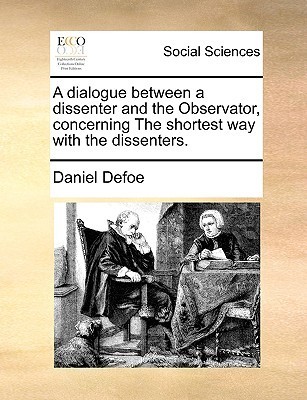
A Dialogue Between a Dissenter and the Observator, Concerning the Shortest Way with the Dissenters.

Rate this book
The 18th century was a wealth of knowledge, exploration and rapidly growing technology and expanding record-keeping made possible by advances in the printing press. In its determination to preserve the century of revolution, Gale initiated a revolution of its digitization of epic proportions to preserve these invaluable works in the largest archive of its kind. Now for the first time these high-quality digital copies of original 18th century manuscripts are available in print, making them highly accessible to libraries, undergraduate students, and independent scholars.Delve into what it was like to live during the eighteenth century by reading the first-hand accounts of everyday people, including city dwellers and farmers, businessmen and bankers, artisans and merchants, artists and their patrons, politicians and their constituents. Original texts make the American, French, and Industrial revolutions vividly contemporary.++++The below data was compiled from various identification fields in the bibliographic record of this title. This data is provided as an additional tool in helping to insure edition ++++Harvard University Houghton LibraryT032970Anonymous. By Daniel Defoe. Observator = John Tutchin, to whom the pamphlet is sometimes printed in the year, 1703. 30p.; 4

36 pages, Paperback

First published June 10, 2010

7 people want to read

About the author

Daniel Defoe

5,649 books1,985 followers
Daniel Defoe was an English novelist, journalist, merchant, pamphleteer and spy. He is most famous for his novel Robinson Crusoe, published in 1719, which is claimed to be second only to the Bible in its number of translations. He has been seen as one of the earliest proponents of the English novel, and helped to popularise the form in Britain with others such as Aphra Behn and Samuel Richardson. Defoe wrote many political tracts, was often in trouble with the authorities, and spent a period in prison. Intellectuals and political leaders paid attention to his fresh ideas and sometimes consulted him.
Defoe was a prolific and versatile writer, producing more than three hundred works—books, pamphlets, and journals—on diverse topics, including politics, crime, religion, marriage, psychology and the supernatural. He was also a pioneer of business journalism and economic journalism.

Ratings & Reviews

What do you think?
Rate this book

Friends & Following

Create a free account to discover what your friends think of this book!

Community Reviews

5 stars
0 (0%)
4 stars
0 (0%)
3 stars
2 (100%)
2 stars
0 (0%)
1 star
0 (0%)
Displaying 1 of 1 review
Profile Image for Keith.
931 reviews12 followers
October 12, 2025
“Alas, the Church of England! What with Popery on one hand, and Schismatics on the other, how has She been crucified between two thieves. NOW, LET US CRUCIFY THE THIEVES! Let her foundations be established upon the destruction of her enemies!”

Is this a horrifying example of intolerance or a work of satire? Daniel Defoe’s The Shortest Way with the Dissenters is included in volume 27 of The Harvard Classics. Originally published anonymously in 1702, it was composed during a time of hostility in England against Protestants who dissented from the Church of England. Defoe wrote it in the style of Tory publications of the era, apparently calling for bloody oppression against Dissenters. Harvard Classics editor Charles W. Eliot noted that the piece “brought down on” the author “the wrath of the Tories,” leading to his imprisonment for seditious libel, and causing Defoe to be hailed for a time “as a popular hero.”

According to Black (2006), Defoe intended the pamphlet to be a work of satire, and the Tories recognized his mockery of them. Eliot, on the other hand, includes it and “The Education of Women” in the Harvard Classics as examples of Defoe “writing vigorously and sincerely” before selling out his political principles to the English government. Whatever the author’s intentions, The Shortest Way with the Dissenters is a bold piece of writing.


*******************************************************************************************

[Image: Cover of the Delphi Classics’ The Harvard Classics]

Citations:
Black, J. L. (2006). The Broadview Anthology of British Literature. Broadview Press.

Defoe, D. (2018). The shortest Way with the dissenters. In C. W. Eliot (Ed.), The Harvard classics (eBook). Delphi Classics. https://www.delphiclassics.com/shop/t... (Original work published 1702)

Title: The Shortest Way with the Dissenters; Or, Proposals for the Establishment of the Church
Author(s): Daniel Defoe (circa 1660-1731)
Year: 1702
Series: The Harvard Classics (1909): Volume 27 - Delphi Complete Harvard Classics and Shelf of Fiction
Genre: Nonfiction - Pamphlet: Politics, Religious Criticism, Satire (possibly)
Date(s) read: 10/10/25
Book 210 in 2025
*******************************************************************************************
Displaying 1 of 1 review

Can't find what you're looking for?

Get help and learn more about the design.