

What do you think?
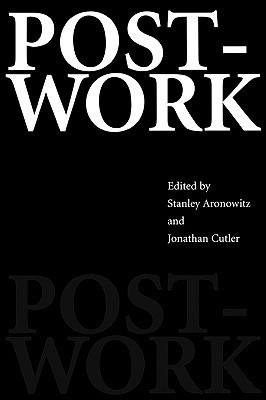
Post-Work: The Wages of Cybernation
In Post-Work , Stanley Aronowitz and Jonathan Cutler have collected essays from a variety of scholars to discuss the dreary future of work. The introduction, The Post-Work Manifesto, , provides the framework for a radical reappraisal of work and suggests an alternative organization of labor. The provocative essays that follow focus on specific issues that are key to our reconceptualization of the notion and practice of work, with coverage of the fight for shorter hours, the relationship between school and work, and the role of welfare, among others.
Armed with an interdisciplinary approach, Post-Work looks beyond the rancorous debates around welfare politics and lays out the real sources of anxiety in the modern workplace. The result is an offering of hope for the future--an alternative path for a cybernation, where the possibility of less work for a better standard of living is possible.
Armed with an interdisciplinary approach, Post-Work looks beyond the rancorous debates around welfare politics and lays out the real sources of anxiety in the modern workplace. The result is an offering of hope for the future--an alternative path for a cybernation, where the possibility of less work for a better standard of living is possible.
290 pages, Paperback
First published November 6, 1997
About the author
Stanley Aronowitz
81 books22 followersStanley Aronowitz (1933–2021) was a professor of sociology, cultural studies, and urban education at the CUNY Graduate Center. He was also a veteran political activist and cultural critic, an advocate for organized labor and a member of the interim consultative committee of the International Organization for a Participatory Society.
In 2012, Aronowitz was awarded the Center for Study of Working Class Life's Lifetime Achievement Award at Stony Brook University.
In 2012, Aronowitz was awarded the Center for Study of Working Class Life's Lifetime Achievement Award at Stony Brook University.
Ratings & Reviews
Friends & Following
Create a free account to discover what your friends think of this book!
Community Reviews
Displaying 1 - 1 of 1 review

May 12, 2026
Follow/Subscribe: YouTube, Patreon, Instagram
Feelings about the book:
- Interesting that there has been talk to increase the retirement age to 70 many decades ago. Which goes to show how crazy life has been for a while now.
- Plus, the conversation around UBI is so old at this point. It's a shame the history is buried.
Premise/Plot:
- A collection of essays from mostly academics, examining how automation, computerisation, and technological change have affected our current system.
- The essays range from looking at historical moments involving UBI, to tenured professorship being one of the last good jobs left.
Themes:
- Labour union struggles, capitalism, leisure time, guaranteed basic income, welfare and more.
Pros:
- Some of the essays in this book perfectly articulate how certain proposals (like UBI) actually had a chance to come to fruition.
- Personal stories in essays that are in non-fiction anthologies don’t usually sit well with me. But there were two in here that I liked. They were towards the end of the book and they go over what life was and is really like in their profession. All whilst touching on themes of professional autonomy, work/life balance, their personal lives and how it relates to the wider world.
Cons:
- Outdated in some aspects, which is to be expected. But I find myself reading older books that hold up better.
- The writing for most of the book was dry and unengaging, not even intellectually even though this book is filled with essays around important subjects.
- Pretty much silent on how the ordinary person could navigate their current and future predicaments.
Quotes:
‘The bottom is falling out and with it our sense of wellbeing.’
‘It has become increasingly difficult to find the time just to reflect, to write, to feel – to change.’
‘Even many professionals are forced to work as “consultants.” Translation: a new form of part-time work with no benefits and job security has emerged.’
‘During the 1920s, progressive intellectuals and social reformers advocated for a “leisure ethic” that pushed for free time as an alternative to work. This ethic pushed for the benefits of capitalism to be reaped by workers as the enlargement of free time, not by capitalists as profit.’
‘What has been called utopian in the past is now a practical necessity.’
‘By 1968, 13,00 economists at almost 150 institutions around the United States had signed a petition urging Congress to adopt a “national system of income guarantees and supplements.”’
‘For the demonisation of “underclass” groups may have become so customary in American life that, indeed, psychological resistance will be stirred at the very notion of that stigma’s removal.’
‘As Rawls tells us (1971), a right to liberty is not worth much if one does not have access to the resources which allows one to exercise this right.’
Feelings about the book:
- Interesting that there has been talk to increase the retirement age to 70 many decades ago. Which goes to show how crazy life has been for a while now.
- Plus, the conversation around UBI is so old at this point. It's a shame the history is buried.
Premise/Plot:
- A collection of essays from mostly academics, examining how automation, computerisation, and technological change have affected our current system.
- The essays range from looking at historical moments involving UBI, to tenured professorship being one of the last good jobs left.
Themes:
- Labour union struggles, capitalism, leisure time, guaranteed basic income, welfare and more.
Pros:
- Some of the essays in this book perfectly articulate how certain proposals (like UBI) actually had a chance to come to fruition.
- Personal stories in essays that are in non-fiction anthologies don’t usually sit well with me. But there were two in here that I liked. They were towards the end of the book and they go over what life was and is really like in their profession. All whilst touching on themes of professional autonomy, work/life balance, their personal lives and how it relates to the wider world.
Cons:
- Outdated in some aspects, which is to be expected. But I find myself reading older books that hold up better.
- The writing for most of the book was dry and unengaging, not even intellectually even though this book is filled with essays around important subjects.
- Pretty much silent on how the ordinary person could navigate their current and future predicaments.
Quotes:
‘The bottom is falling out and with it our sense of wellbeing.’
‘It has become increasingly difficult to find the time just to reflect, to write, to feel – to change.’
‘Even many professionals are forced to work as “consultants.” Translation: a new form of part-time work with no benefits and job security has emerged.’
‘During the 1920s, progressive intellectuals and social reformers advocated for a “leisure ethic” that pushed for free time as an alternative to work. This ethic pushed for the benefits of capitalism to be reaped by workers as the enlargement of free time, not by capitalists as profit.’
‘What has been called utopian in the past is now a practical necessity.’
‘By 1968, 13,00 economists at almost 150 institutions around the United States had signed a petition urging Congress to adopt a “national system of income guarantees and supplements.”’
‘For the demonisation of “underclass” groups may have become so customary in American life that, indeed, psychological resistance will be stirred at the very notion of that stigma’s removal.’
‘As Rawls tells us (1971), a right to liberty is not worth much if one does not have access to the resources which allows one to exercise this right.’
Displaying 1 - 1 of 1 review