Responde rá ¿Cuál es el animal más veloz del mundo? ¿El guepardo, dijiste? Si así fue, tienes razón… en parte. El guepardo, o chita, puede alcanzar velocidades de 70 mph (millas por hora) pero ¿sabías que hay una especie de ave que puede volar más rápido que un auto de carreras? ¿Y sabes que esa ave tampoco es el animal más rápido que existe? Esta mirada a los doce finalistas entre las especies más rápidas de la naturaleza examina cuáles son los más rápidos en la tierra, el aire y el mar. Esta historia será de mucho agrado para los niños que toman exámenes estandarizados porque... ¡no todos encajamos en el mismo molde! English Quick, name the world’s fastest animal! Did you say cheetah? If so, you’re right – sort of. Sure, the cheetah can reach speeds over 70 miles per hour (mph); but did you know that there is a species of bird that can fly faster than a race car? Did you know that that’s not even the fastest animal there is? This “dashing dozen” of nature’s speediest species examines the fastest on land, air, and sea. This story will resonate with children taking standardized tests…one size does not fit all!
Brian Rock is a children’s author and former school teacher who lives in Chesterfield, VA with his wife, daughter and of course, his many imaginary friends.
He has enjoyed writing stories since he was old enough to hold a no. 2 pencil. Although he was once put out of class for writing too many stories, he went on to receive a master’s degree in Creative Writing and Children’s Literature from Hollins University. Along the way, Brian has performed as a stand-up comic, worked as a “McCountant,” and written award winning country songs for his band Family Reunion. He also contributes to the Richmond Children's Writers blog.
We listened to this as one of Audible's free offerings. Some books succeed well in a verbal format only but I think this is the sort of book that really needs accompanying illustrations as this is more of a non-fiction book and I feel illustrations would really help children better understand the animal being discussed. That said, the poems are evocative and I appreciated that the poems move through different times of day and night in a forested wetland and covers a variety of animals (birds, mammals, insects) but every poem focuses on predator-pray and I would have enjoyed more variety than just one animal trying to (or succeeding at) capturing another. Some of the poems might be a bit intense for sensitive youngsters --- or, then again, the words might go right over their heads ("mandible snares" makes me shudder, but my four-year-old wanted to listen to this book about ten times, so I guess he wasn't phased!)
North Carolina is my home and it is also home to many of the critters that populate the wetlands. You see, we have lots of water and lots of wetlands in North Carolina. So this book is particularly appropriate for a child growing up in North Carolina. If he or she has the opportunity to venture into the wetland areas of our lovely state, they might be privileged to see some of these creatures first hand in their own habitat. What a grand opportunity.
The wetlands are important for our entire global ecological system. So knowledge about them and the habits of the wild inhabitants is particularly important as well.
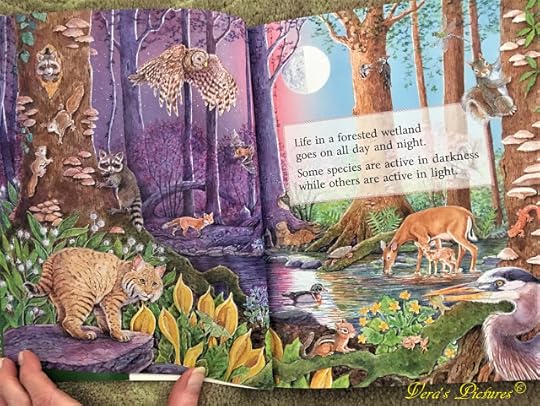
This book is written in a lovely cadenced poetic prose that was a delight to read. The illustrations while rich with browns and greens of the natural elements is also awash with splashes of beautiful colors depicting night fall or sun rise, etc.
It's sunrise in the wetland. An owl flies to the ground. Though its wings are flapping, they do not make a sound.
The barred owl wades in water, and looks for prey to eat. It spots a tasty crayfish and grabs it with its feet. DISCLOSURE: I received a complimentary copy to facilitate a review. Opinions are solely mine and are given without compensation.
A Day in a Forested Wetland by Kevin Kurtz with illustrations by Sherry Neidigh takes readers on a twenty-four-hour journey through a riparian forest rich with wildlife.
Green darners rise with the sun to hunt flies while snapping turtles wait to ambush prey. Sunset brings forth bats, frogs, flying squirrels, and a bobcat family. The cadence of the rhyming text is appealing and readily accessible for readers. The narrative is packed with fascinating information about the diverse inhabitants of this ecosystem – from Caddisflies armoring themselves with rocks to barred owls hunting crayfish.
The illustrations enrich the text and are drawn in the natural palette of the environment with colorful patches of color to highlight special moments.
As with other books by Arbordale, this story contains a Creative Minds section that includes factual information to provide points of discussion for parents and lesson options for teachers. Keystone Species: Beaver discusses the important ways in which the beaver supports the forested wetland habitat. Beaver Sam Forested Wetland Sequencing offers a step-by-step look at the way in which this environment changes over time. Wetlands compares the four types of wetlands: Forested Wetland, Marsh, Bog, and Fen. Find the Animal challenges readers to correctly match names and descriptions with the animals pictured in an image of the forested wetland.
Recommended for home and school libraries. Great addition to STEM studies.
Kids can spend a day in this forested wetland and see just what goes on and meet the many different species that make their home there. Following the same format as his other A Day in...series, Kurtz rhyming text begins with sunrise in the wetland and goes through a 24 hour cycle, introducing a multitude of species active at different parts of the day and night. There are a few drawbacks to this book. One is that the rhyme doesn't work in two places (my kids didn't notice this) and it feels forced, and two, there are some words that need to be defined in the context of the creature being talked about (we made a list of those words and looked them up later, then went back to the page where they were found). However, Neidigh's illustrations are beautifully detailed, yet with a simplicity that will help young readers work out some of the definition omissions. A wise teacher can do much with this book, as I found out using it with my kids. There is some very useful back matter with activities for kids to do, all of which can be photocopied and used in classrooms. There is a longer focus on the beaver, a page covering the different kinds of wetlands, and a search and find picture where kids have to match the animal with its name and what it does. My kids were particularly taken with this and it actually generated lots of talk about the animals.
Handsome illustrations rely on details and soft colors to highlight the topic and accompany the engaging text that teaches readers about a forested wetland. They have the chance to learn about the various species that live in that particular habitat as well as making note of the importance of keystone species such as beavers that can make changes in the places they live. As the back matter indicates, some of the changes that cause last long after the beavers have moved on to another home. As is typical for the publisher of books such as this one, there are four additional activity pages that allow students to learn even more about the forested wetland and apply some of their newly-acquired knowledge.
On Audible this is only 4 minutes long, but it is enjoyable rhyme and very visual. In the forested wetland there are many interesting animals, birds and insects to learn about, and in this story about 15 of them are mentioned, some in wonderful detail.
I love love love the artwork of this. It took a second for me to get the rhyme , but it worked. The artwork is so lovely it is a shame the covered it up with the text.
Very informative! I was also impressed with this publisher arbordalepublishing.com. They have great actives on their website that relate to the book and pages in the back of the book for teaching! I would love to give this a 4.25 stars but with the text covering the great artwork, I just can't go that high