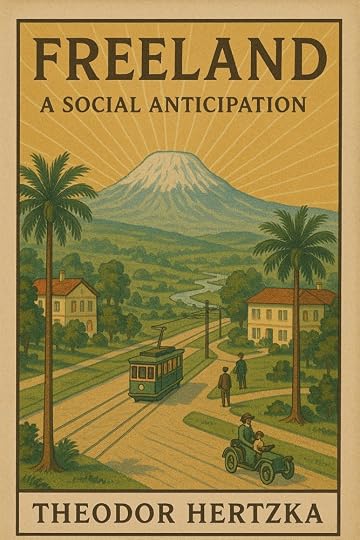
Theodor Freiland. Ein soziales Zukunftsbild Duncker und Humblot, Leipzig 1890. Hier nach der vierten Auflage, Dresden, E. Pierson Verlag, 1890. Neuausgabe. Herausgegeben von Karl-Maria Guth. Berlin 2017. Umschlaggestaltung von Thomas Schultz-Overhage unter Verwendung des Porträt von Theodor Hertzka aus der zehnten Auflage von Freiland, 1896.. Gesetzt aus der Minion Pro, 11 pt.
This is a utopian fiction written by an economist and based on the idea of all private property remaining private but anything used for making money becoming public and usable by anyone. Also all profits are divided among the workers fairly evenly, effectively every person is self-employed. Not being an economist i can't say where the flaws in the premise are.
Still though there is a fair amount of extra things thrown in to keep it interesting. It starts off with a new nation being founded in africa and there is an amazing amount of detail regarding the travel through africa and the various countries and peoples encountered.
There's some romance thrown in, a bit of a war, it also jumps 20 years into the future so there are minor elements of sci-fi and it finishs off with a big parliamentary debate. Which is just as exciting as it sounds, but i also found it fairly interesting especially a theory about overpopulation which i hadn't thought of before. Anyway, the various voices and view points in this coupled with the level of detail made it quite good despite its length.
Oh, one thing i found odd was the sexism. This new society gives women equal voting rights, they can work in any profession and they receive a stipend which keeps them financially independent even when married, so far so good. Then the author states that any woman who does a job other than nurse or teacher is socially frowned upon. The fact the author is sexist is not surprising given the time in which this was written, but it is odd that he could maintain his sexism even while creating an equal society under the law.
However the one major indefensible flaw in the story is its smugness, literally nothing goes wrong in the entire book, everything is far too easy, although that is not unexpected as this is essentially an advertising campaign.
So this is a long, economics based, utopian, philosophical, documentary kind of book. In fact fans of non-fiction might enjoy it more than others. Maybe i was just in the right kind of mood or something but i still liked it.
Edit: My chatgpts' cover is better than any others i've seen
Review: For what it intended to be, the book fails. It's intended to be a spur to the establishment of a specifically described and justified post-capitalist utopia. While for some years it had followers, that was long ago.
As a narrative, it is preachy and dull, with many characters acting as mere foils for a propagandist exposition. While I read it in translation, I doubt that the language was much more enjoyable--to non-converts--in the original German.
This particular edition, which would appear to be a print-to-order, suffers from the frequent omission of spaces and punctuation at points where one phrase ends and another begins. This adds to the reader's burdens, particularly when the resultant concatenations accidentally spell a word and thus create extra confusion.
Beyond a review: The book has value as a window to a study on the author's times. Some areas of interest--expressed by me here as open questions in the manner of post-scripted talking points--are:
--The assumptions about Africa, specifically the Kenyan highlands, were thought by the author to be just and reasonable. What does this tell a reader about European imperialism and its apologists?
--The male author thought he was describing the emancipation of women, yet the idealized economic and social roles he held out for them were quite circumscribed. To what extent did he move ahead of typical contemporaneous male opinion, and when did men--to the extent they have--move beyond his limited vision to something more acceptable to women?
--One economic assumption was that a society could do without interest, providing capital funding through trade-focused associations with the facilitating mediation of a central bank--in my opinion, a form of barter. Would a centrist economist today hold this as relatively inefficient and how would they demonstrate why this would be so?
--Do the trade-focused associations bear any relation to the kind of corporatism advocated in Italia (Italy) and that later became a supporting element in fascism (and that has also been said to be important to the founding policies of the Partido Revolucionario Institucional of México)?
nice argument, but I've already depicted your system as barbarous and my system as a militarily dominant engine of Georgist revolution in central Africa