Joseph Mallord William Turner, or as we now know him, J.M.W. Turner, was born in April 1775 in Covent Garden, London. His father was a wig-maker and barber, and John had little formal education. Surprisingly enough John showed himself at a very young age to be a talented artist, and by the age of 13 he was selling drawings in his father’s shop. The “Royal Academy of Arts” admitted him a year later, and the following year he was given the chance to display his work in the Royal Academy Exhibition.
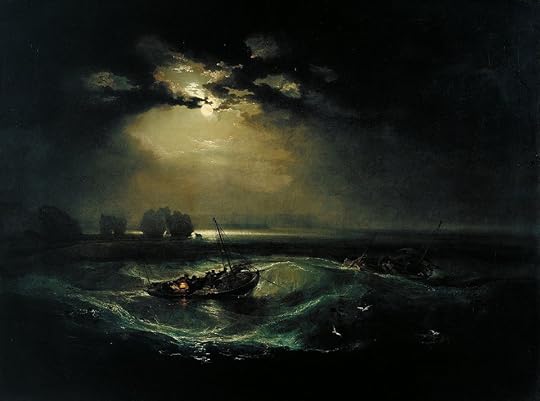
At this time his art was solidly traditional, and conformed to the Royal Academy’s strict stipulations for “high art”. The themes must be from history, classical literature or the Scriptures, and the style and treatment must be that of the Old Masters. J.M.W. Turner painted plenty of scenes of this type, but he also painted non-historical subjects such as ships and storms, avalanches, scenes on the river Thames and views of country houses. The Royal Academy accepted this, because they were painted in the style of the Old Masters, and very forcefully. Take this painting for instance, the first oil painting of his to be exhibited at the R.A., in 1796:
“Fishermen at Sea”
It very cleverly looks forward – and back. There are two light sources, one warm and one cold, and already with this one painting we can see a life-time preoccupation with light and colour. Other 18th century painters such as Joseph Wright of Derby, Joseph Vernet, and Philip James de Loutherbourg had established an interest in night scenes and contrasted light sources, and this treatment of naval scenes, interiors and landscapes had thus become considered respectable. An entire sub-genre called “moonscapes” had become popular.
J.M.W. Turner was to keep this interest in the special effects of light, allied with those of climate and the weather, throughout his life. He was to be termed the “father of modern art” and even the “father of Impressionism” by John Ruskin, but this is true only in one sense. The Impressionists observed light and colour effects, and tried to bring their paintings close to what they actually saw, whereas Turner’s aims were always expressive, rather than naturalistic.
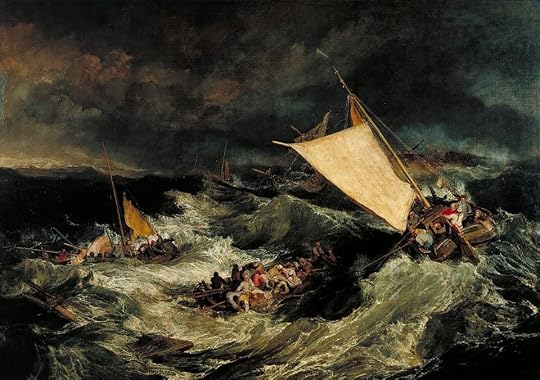
By 1799 he had been elected as an Associate of the Royal Academy, and by 1802 he was a full member. He painted classical subjects, scenes from Italy, and a series of large painting of Biblical subjects. But some of his work he kept hidden from the Royal Academy - or at least he preferred to exhibit it in his own gallery. One such work is this:
“The Shipwreck”
The vigour of this painting shows how Turner was gradually beginning to change the face of marine paintings. The small figures look like they do in Dutch Masters, but the sea is dynamic, swirling about as if it has a life of its own. He correctly assessed what was wanted by the Royal Academy, and produced “Aeneas and the Sibyl”, “Apollo and Daphne” and so on to conform, but his own painting was moving in a very different direction.
With his success at the Royal Academy, Turner furthered his exploration into the British landscape under varying conditions of light and atmosphere, side by side with the large dramatic canvases which were required. He painted scenes of the Thames and various pastoral scenes, but his interest clearly was always in the way the seasons and weather conditions affected his subject. He painted a beautifully delicate observation of hard ground touched by frost in Yorkshire:
“Frosty Morning”
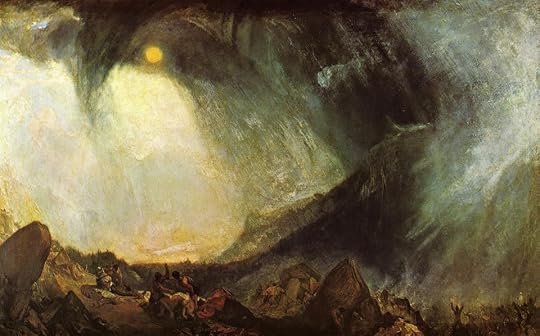
yet also within the same year, this contrasting piece of high drama:
“Snow Storm: Hannibal and his Army Crossing the Alps”
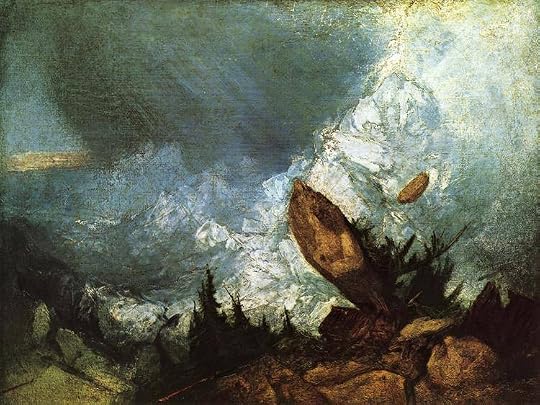
The foreground here is typical of the Old Masters, with Turner illuminating the figures, but the background is a maelstrom of light and colour. It is obvious where Turner’s interest lay. This too, was produced in the same few years:
“The Fall of an Avalanche in the Grisons”
Such paintings were from life. Turner would sketch the event, to work up to an oil painting later.
I viewed many of these large reproductions of his shipwrecks, stormy seas, catastrophic events of Nature, and then looked up from where I was sitting. There was the sea, a calm sheet of silk with just a few ripples, under a cloudless blue sky. It was a strange contrast, and brought home to me that the sea in Turner’s eye could turn savage in a moment. It had an animalistic, primal force. The paintings jolted me out of my comfort zone. I needed to look up sometimes, to gain tranquility.
Turner experimented with the use of colour, and painted on mahogany board when he wanted to use warm tones. On canvas, he was heavily criticised for using a white ground (base) for his oil paintings. He began to be heavily influenced by the principles of Goethe in his “Treatise on Colour”. Turner deliberately chose blues, blue-greens and purples to show what Goethe described as “restless, susceptible, anxious impressions”, and reds, yellows and greens to show “gaiety, warmth and happiness”. It has to be said that there is little of the latter, however. Turner often accompanied his more positive pictures with verses about the “fleetingness of hope”, and as his life went on, became more and more deeply pessimistic.
Turner’s paintings became more abstract, and the title would sometimes belie the treatment. It may be of a country house, but the building would be far less important than the climate and weather. Sometimes it would seem to be an afterthought; a mere few lines sketched on the horizon. Turner did paint buildings, and on his visit to Italy carefully studied the works of Canaletto, and produced his own studies of them, using his inimitable style. But these do not tend to be the paintings for which we remember him.
“Rain, Steam and Speed” and “Ulysses Deriding Polyphemus”, although both exhibited at the Royal Academy, now both hang in the “National Gallery”, so are not in this book. Both of these show a startling new interest in the strength and brightness of colour. His loose brushwork and vibrant colour palette shocked his contemporaries. Sadly the Roman paintings, sent by sea, did not reach London in time for the 1829 exhibition, but if they had, we may never have had these masterpieces. “Ulysses Deriding Polyphemus” was worked up from one of the sketches he made in Rome.
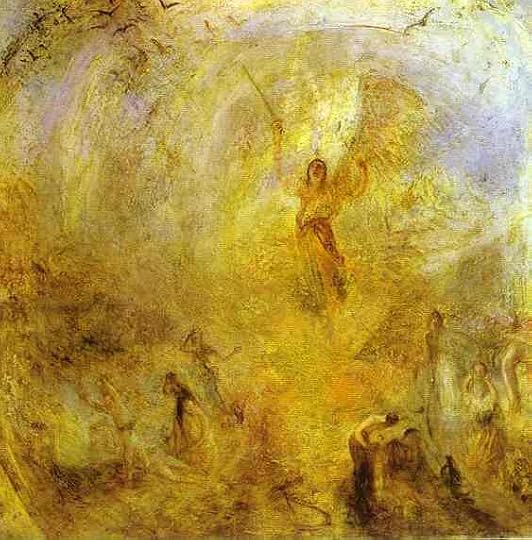
J.M.W. Turner continued to exhibit at the Royal Academy until 1850, the year before he died. The final few paintings seem to be rather congested, with increasingly hot colours. However this one:
“The Angel Standing in the Sun”
seems to be almost a deliberate farewell. It is a scene from the “Book of Revelation”, and in a way sums up his achievement, over the 55 years represented here, as a painter of light; light seen as the sum of colour.
The author of this book, Martin Butlin, is a leading authority on J.M.W. Turner, and has co-written the definitive catalogue of his work, as well as co-organising the historic bi-centenary exhibition of Turner’s work. He used to be the Keeper of the British Collection at the Tate Gallery. He has written a 16 page essay to accompany these reproductions. The focus is narrow, and his style rather flat. He restricts himself to a brief analysis, with little about Turner’s life or history. I have included a little extra here, as well as my own viewpoints, to try to put this in context. However Martin Butlin does include a list of books for further reading, and a list of plates.
The plates are superb, which explains my 4 star rating. The oversize book is printed in landscape format, on heavy glossy Art paper, and the colours are true, having been checked by the Tate Gallery.
The book contains reproductions of over half of J.M.W. Turner’s known work in oils, which are on public view at the “Clore Gallery”, part of the “Tate Gallery” in London. In an extraordinary act of generosity, Turner bequeathed them to the nation. Another interesting aspect which demonstrates his key place in art history is the “Turner Prize”. This is a well-known annual prize for British visual artists, based upon a showing of their work that they have staged in the preceding year. The winners are often highly controversial, and often associated with conceptual art. The prize was named after Joseph Mallord William Turner, because although much of his work is traditionalist, his work was controversial during his lifetime. His new approach to landscape painting changed the course of art history, as many of the Turner Prize winners aspire to do.
Turner’s bequest had been the subject of much controversy in itself. Originally he had stated that all his picture should be hung in a separate gallery in Twickenham, South West London, as part of a charity called “Turner’s Gift” for “Poor and Decayed Male Artists”. However he then changed his mind, and decided that all his “finished pictures” should go to the National Gallery, provided that they were hung in separate rooms, added to the existing gallery.
He had no legitimate children, but this will incensed his relations, who contested it. There were many delays, and recriminations. It is quite likely that this was in Charles Dickens’s mind when he wrote his magnificent novel, “Bleak House”, which so evocatively described the devastation caused by a long-running legal case, which came about because someone wrote several conflicting wills. The timing is significant. Joseph Mallord William Turner died in December 1851, and Charles Dickens first published “Bleak House” as a serial between March 1852 and September 1853.
Eventually, to avoid more delays in the Court of Chancery, a settlement was reached. The relations got the money which was intended for the poor, and the “National Gallery” received not only the “finished pictures,” but also all the oil paintings, water colours, drawings and sketches which had remained in Turner’s possession.
The “Tate Gallery” was opened in 1847 as an offshoot of the National Gallery, and is home to the largest collection of works by Turner in the world. In 1987, the “Clore Gallery” was opened as a separate wing. It has 300 oil paintings and many thousands of sketches and watercolours (including 300 sketchbooks). Although viewing these at the gallery gives us an insight into his methods, allowing us to track the development of his ideas and to document his travels around the UK and Europe, this huge heavy book only contains 92 of his oil paintings, and none of his drawings, watercolours and sketchbooks. Each one fills a page, and only a few are printed vertically, for which it is necessary to turn the book.
There is a room in the “Clore Gallery” dedicated to Turner’s British tours, from the Lake District to the West Country to Edinburgh, and another exploring his European travels, to Germany, Italy and France. Here three Turner views of Venice are displayed together, including “St. Benedetto, Looking Towards Fusina”, which often confuses people because there is no such church in the city. Not only that, but nothing seems to be in the right place. According to John Ruskin, the work is “without one single accurate detail”. It represents the perfect view of Venice that Turner wanted to exist:
“St. Benedetto, Looking Towards Fusina”
Another room displays the radical late works for which he is so loved: those luminous paintings of light and colour, where the subject seems to lose its definition, and dissolves, diffused through the blazing light and mists:
“Norham Castle, Sunrise”
Turner became the most celebrated painter in England. He trailblazed the methods the Impressionists would later use, and portrayed the development of the modern world unlike any other artist at the time. Yet all these works are on display, without charge, for all to see. If however you cannot get to London, and find the colour in computer images sometimes questionable, high quality art books such as this may well be a good second choice. All the images I have included are in the book, with better colours.
Sometimes we are left with intriguing questions. It is a well established fact that Turner had many pictures in his studios, which sometimes remained there for many years. When he produced a huge classical work, he would take one of his “half finished ones” and work on it to produce the finished painting. So with these later works we may ask ourselves, “Is it finished, or a work in progress?” Did Turner perhaps consider it to be too advanced for public display?
We will never know. What is clear is that in the mid-1840s, nobody else anywhere, was painting in this way. The term “Impressionist” was not used until 1873, after Claude Monet’s painting, “Impression: sunrise” and the first Impressionist exhibition was not until a year later. But looking at these late works we can see J.M.W. Turner’s phenomenal influence, both on the Impressionists, and on how we view art.