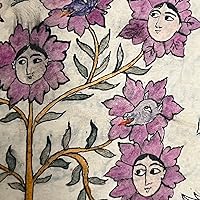
Encounter one of history’s greatest civilisations through miniatures. In Persian Miniatures, the story of the magnificent Persian Empire is told by way of an artistic tradition on a small but vibrant scale. This unique collection of colourful miniatures from Persia in a convenient portable size will make the perfect gift.
Vladimir Grigor’evich Lukonin, outstanding Russian scholar in the field of history and history of culture and arts of ancient Iran, from the earliest times until the end of the Sasanian period. He published and introduced to scholarship many artifacts of Iranian culture preserved at the Hermitage Museum, including the unique hoard of Iranian silver drachms of the 3rd century CE and some objects of early Sasanian toreutics. http://www.iranicaonline.org/articles...
وارد دنیایی از رنگ ها شدم ! نقاشی های مینیاتوری پارسی برای چند قرنی در دوران تیموری و صفویه مد بوده. مدارسی در شیراز و تبریز (مشهد و قزوین) برای آموزش این سبک از نقاشی دایر می شده. یکی از درخشان ترین دوره های هنر ایران بعد از اسلام دوره صفویه ست. اما یه تعدادی از این نقاشی های مینیاتوری، رنگ و بویی از ایران نداشت. و این طبیعیه که با حمله ی اعراب به ایران بخش گسترده ای از فرهنگ و افکار مردم رو برای سالیان سال تغییر داده که تا به امروز هم به چشم می بینیم... (به امید آزادی ایران خانم قشنگ)
Reading this book seemed to be the natural evolution of things, since I was a huge fan of miniatures for years now,especially those depicting gardens and fountains or even banquets. But I grew fonder of them after discovering that the letters scattered around were poetry verses (or simply the story that was depicted) I appreciated the artists challenging the perspectives, and drawing what they deemed essential to show. What is even more surprising is the dazzling precision with which every motif is drawn, the utmost care, admiring them inspired a sense of flow "also known colloquially as being in the zone, is the mental state of operation in which a person performing an activity is fully immersed in a feeling of energized focus, full involvement, and enjoyment in the process of the activity".
I had the chance to learn more about it, accidentally by reading "Benim Adım Kırmızı" by Orhan Pamuk - my review here - https://www.goodreads.com/review/show... However, reading this book was another experience of following the historical evolution of Persian miniatures, reaching its height by the 14th century in medieval Iran, and how every royalty tried to impose themselves through this form of art by bringing artists from al around the globe (Chinese scholars, Buddhist monks, Catholic monks, scholars of Mongol traditions). To put it in a caricatural way, it was with the same pride and zeal that a sultan could take in building the greatest library ever and garnish it with the rarest books, that he was to patronize the perfect miniature collections ( drawing, ornament, illumination, and poetry). The greatest chef d'oeuvre that was ever produced in this way was the Shah Nameh done in 8th century after hijra in Tabriz ( the book of kings)… Clearly there were different regional styles, but it all depended on the political stability of Persia. The crisis and decline of this art started by 1840, as a "result of the factory goods from European countries that poured into Iran"… There was however a revival of the art that emerged at the end of the 19th century that took Isfahan style of the 17th century its model.
Miniature painting – decorating with illustrations the pages of a hand-written book is one of the domains in which Persians excelled. It is owing to this art that many monuments have fortunately survived to this day. The portrait miniature as a genre had already established itself in the Sassanian period (224-651 AD), and developed, even flourished, in the 15th and 16th centuries, having a dominant influence on these traditions n Ottoman, Mughal miniatures in Turkey and India, respectively.
This book is a unique collection of colorful Persian miniatures from famous art galleries and museums, such as The British Museum, London; Topkapi Palace Museum, Istanbul; Musée des Arts Décoratifs, Paris; The Metropolitan Museum of Art, New York, etc.
The main drawback of the book is the incompatibility of the text and the illustrations in almost the book; the depicted miniatures does not relevant to the text. It becomes more bizarre and even confusing wherein many apart of the book sentence continuation of the next page does not follow the preceding ones. It tried to ignore it and just enjoying the illustrations.
My rating is just for the excellent beauty of the miniatures, not the book.
First of all, the authors of this book are Vladimir Loukonine/Lukonin and Anatoli Ivanov. Somehow Parkstone Press or their layout agency in Ho Chi Minh City (formerly known as Saigon), Vietnam, decided that it isn't worth putting their names on the cover.
This little book is on the one hand very rewarding and on the other hand terrible. It is a treasure because it contains a lot of illustrations in color and relatively good quality. Some of these Persian miniatures have rarely or never been published. Usually, whenever I open a book on Persian miniatures I expect to know at least half of the miniatures depicted. Here, fortunately, this is not the case. In this regard this book was a pleasant surprise.
However, text and illustrations are not well paired at all. Usually the text talks about a completely different illustration than the one that is depicted. Also, the text is usually cut off in the middle of a sentence and so it is difficult to follow the argument if there is a completely unconnected but interesting illustration in-between, while also imagining the completely different illustration the text talks about (that however is never shown). Fortunately, there is not much of an exciting argument or much important information in the text, so it can more or less be ignored.
Only on the last 5-10 pages of the book the text actually talks about illustrations depicted. I really wonder why this was not the case before. If the miniatures depicted were not so interesting, this book would have to be called a catastrophe.
I’m giving it a 5 stars even though I got bored after 60 pages and did not resume reading. The paintings were fascinating and the history given about it was even more fascinating. I stopped reading because it was not my cup of tea, but I will admit it is a good book. You’re in for a history/artistic ride if this is your cup of tea.
It's so great to have Hoopla back at the library! I had this book earmarked before Hoopla disappeared a year ago and found it was still there when Hoopla came back. I own a couple of vintage Persian miniatures on a necklace that my grandmother owned back in Iran, so this was really special for me.