Museum of Degenerates invites you to a delirious display of art by one of contemporary America’s most original and incendiary political cartoonists. Eli Valley’s extraordinary work is a scathing indictment of the entire American polity, with a particular focus on the issues of Israel and Judaism at a time when these have moved to the center of public debate and action.
In these pages, Valley tips a homburg to German expressionists such as George Grosz and Otto Dix who featured in “The Exhibition of Degenerate Art,” a 1937 Munich show that sought to ridicule the work of artists critical of Hitler’s fascist regime. In an aesthetic that is strikingly original, Valley also draws on early twentieth-century American Yiddish cartoons and the work of artists who created the helter-skelter exuberance of MAD comics in the 1950s.
Valley’s own art, accompanied here by extensive descriptions of its genesis and context, is a howl of protest against the political, cultural and media elites driving America into an authoritarian abyss. Here is anger, pure and hot, expressed in exquisite detail and, often, disturbingly funny.
New York based cartoonist, Eli Valley's work has appeared in a range of publications including The Nation, The New Republic, The Village Voice, The Forward and Gawker.
The Publisher Says: Museum of Degenerates invites you to a delirious display of art by one of contemporary America’s most original and incendiary political cartoonists. Eli Valley’s extraordinary work is a scathing indictment of the entire American polity, with a particular focus on the issues of Israel and Judaism at a time when these have moved to the center of public debate and action.
In these pages, Valley tips a homburg to German expressionists such as George Grosz and Otto Dix who featured in “The Exhibition of Degenerate Art,” a 1937 Munich show that sought to ridicule the work of artists critical of Hitler’s fascist regime. In an aesthetic that is strikingly original, Valley also draws on early twentieth-century American Yiddish cartoons and the work of artists who created the helter-skelter exuberance of MAD comics in the 1950s.
Valley’s own art, accompanied here by extensive descriptions of its genesis and context, is a howl of protest against the political, cultural and media elites driving America into an authoritarian abyss. Here is anger, pure and hot, expressed in exquisite detail and, often, disturbingly funny.
I RECEIVED A DRC FROM THE PUBLISHER VIA EDELWEISS+. THANK YOU.
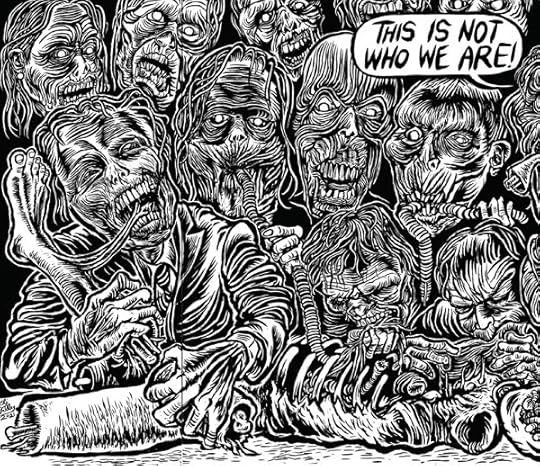
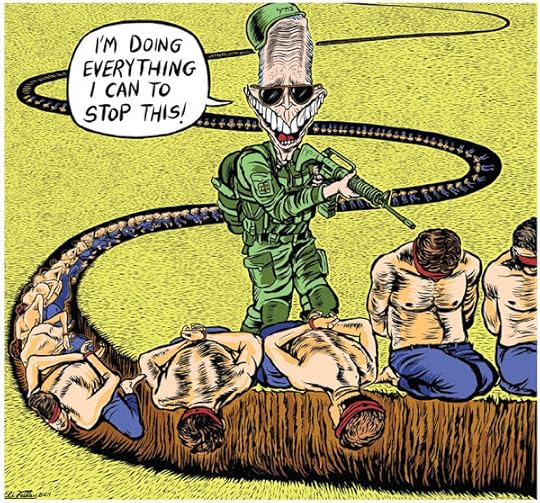
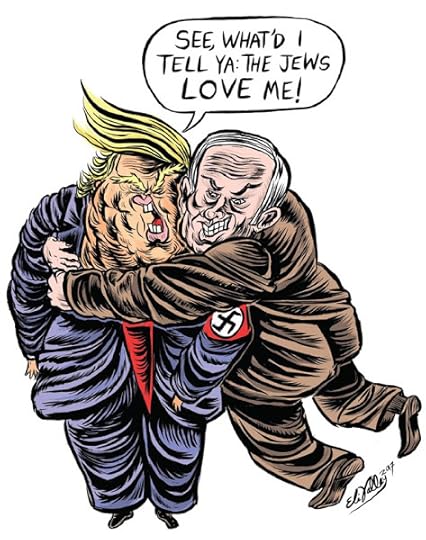
My Review: "Disturbingly funny" from the synopsis above is spot-on. This editorial artwork is disturbing. It can be funny. It disturbed me to find some of it funny. It was a funny kind of disturbing. I'm sure I can recombine those ideas in more apt ways, but I trust my point is made: Épater la bourgeoisie is the modus operandi of this artist. It feels...unsettling, "funny" or weird and certainly unnatural to laugh at the present moment rendered into highly stylized art. Funny. Sick-making. A moldy shar-pei corpse with a hatespeech ikon in and on it. Somehow it's still funny. Sorta. Like a zombie movie. Into the fire with you! These zombies don't want braaaiiinnns but roasted flesh. On every axis I am appalled and offended...less by the artwork than the accuracy of the commentary. Bibi showed his luuuv to the bankster-in-chief by accepting some Gaza deal that kept the dollars flowing. Never mind how ridiculously ineffective it was at justice, or even fairness. If the revolution needs a poster, let this be it.
I suspect most of y'all are thoroughly turned off by now, so I'll stop. The thing that Eli Valley does is the thing all editorial cartoonists strive to do: exaggerate the ghastly into absurdity. Shock the viewer into recognizing how demented and distorted the discourse he's skewering is. The text of the artist's thought processes and inspirations will make a reasonable person as mad...in all senses...as he is himself.
I'm positive offense is intended by Eli Valley; I'm positive offenseiveness is deployed with purpose, can't say "care" but intent and purpose make up for it. In times of horror, use the horror of the times to motivate the audience to make it stop.
This is not a test. The signal is repeating; the instructions are....
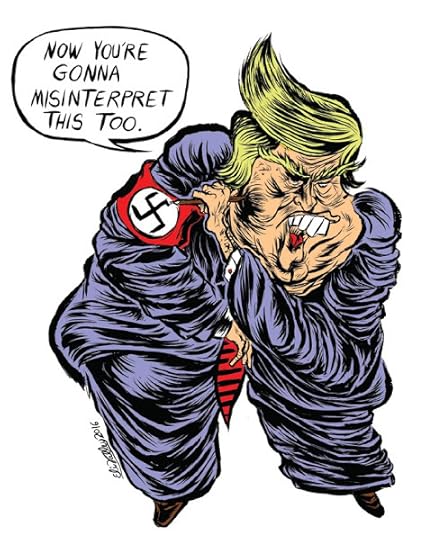
The phenomenal Eli Valley charts the wretched course of the last decade or so, his scabrous nib leaving us under no illusions as to how actual Nazis ended up in the White House, ably abetted by the abject cowardice of the Democrats.
You simply can't touch Eli Valley when it comes to searing, grotesquerie-as-mirror comics. I had to stop reading this collection in the mornings because they were fucking up my whole day. Free Palestine 🇵🇸
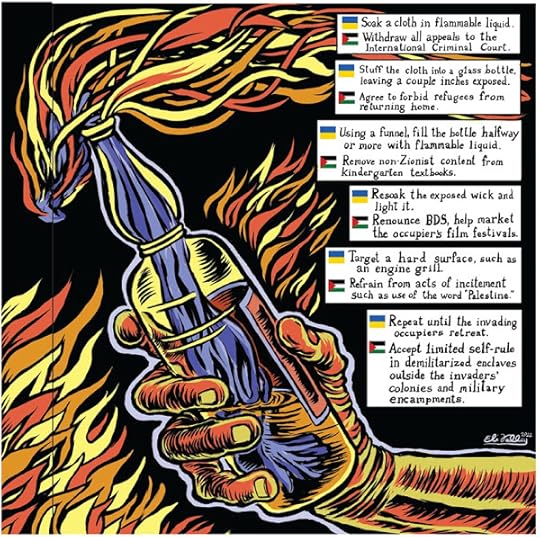
Museum of Degenerates was as shocking, grotesquely beautiful, and insightful as I thought it would be. I was familiar with Valley's art through his twitter account, particularly since he often posted art he had made during the current Israeli war on Gaza, attacking the hypocrisy and complacency of western media and the democratic establishment in a scathing manner that reflected the anger we felt collectively. This book covered and provided context to some of Valley's comics from 2016-2024, with the focus being more on the first Trump administration. But the topic of Israel/Palestine is ever-present throughout the book. I am more of a politics person than a comics person (I only started reading comics recently) so I really appreciated the connections Valley made between his art and his influences, both when discussing and referencing Yiddish art and comics, and especially the introduction on "degenerate" art and its connection to Fascism and Zionism. In this particular time, and after more than a year of the beginning of the war on Gaza, I understand the criticism some people have towards Jewish artists and political activists who center Jewishness (or themselves as individuals) in their discussion of Palestine, where the goal shifts from providing support and solidarity to Palestinians in their struggle against their oppressors, towards catering to perceived *possible* oppression towards jews (such as censoring certain expressions such as "from the river to the sea" and refusal to acknowledge that Israel was founded on ethnic cleansing, this can be seen in the recent narrative of artists such as Art Spiegelman whose recent input on this topic felt narcissistic and inappropriate). But Valley never falls into that. His defence of Judaism and Jewishness, and his appeal for saving it from the clutches of Zionism, never falls for the traps set up by bad faith actors: he demonstrates the clear connection and collaboration between Zionist ideology and western antisemitism as well as the clear links and similarities between the Jewish struggle in the 19th and 20th century against fascism and state oppression and that of all oppressed people in the world, particularly of Palestinians. I particularly loved his explanation of why he never falls for the "but does Israel have the right to exist" question (the precursor of "but do you condemn Hamas" bit) that is meant to shut down criticism of Israel. Particularly, I was very happy that he did not condemn Palestinian resistance and portrayed the hypocrisy of the west in his comic "How to resist" (which predates October 7th but in my opinion holds for that, but I don't want to put any words in his mouth that he did not directly state). Artistically, I find his style captivating and beautiful in the hideousness of the portrayals. I would tattoo one of the designs but understandably I would not want a drawing of a small dicked trump on my body. Overall this was a wonderful read and a great artistic experience, and I can't wait to read Diaspora Boy and to see more of Eli's art.
I was only recently introduced to the work of Eli Valley when he was interviewed by another cartoonist I follow, Dwayne Booth, AKA Mr. Fish, on his substack Independent Ink. Valley's most impressive works are black and white productions that mimic the style of a linocut. They are explicitly political in nature and in this book the author draws specifically upon his Jewish cultural heritage to critique right-wing Zionism. He writes: "Progressive American Jews saw what has been happening, we felt it in our bones, and we knew that if our historical experience is used only as blinders when similar similar horrors start befalling other communities, then our history is worthless."
But this book is not just a response to the current war crimes taking place in the occupied territories. Another prominent theme is the documentation of antisemitism, but not the faux antisemitism of the current political climate. A 2019 panel exposes Stephen Miller as freely courting and cavorting with actual Nazis, but when this concern was aired his defenders dismissed them by asking “how can a Jew be a Nazi?” This collection reminds us who the real antisemites are and that the current phenomenon was actually years in the making.
This material in this book dates back to work first published in 2005 and slowly develops a throughline in chronological order to more current events. It is powerful work, striking in its visual impact. Each panel is accompanied by text which offers historical context, lest we forget, so we might best understand what the author calls his "portraits of the American grotesque." And grotesque they are, all the more reason, perhaps, for the explanatory context (lest we come to imagine that Eli Valley is just a bitter man with an axe to grind).
I highly recommend this volume to those seeking an understanding of the history that brought us to our current circumstances, documentation of our present day horrors, and who wish to identify with others who are understandably and justifiably dismayed. Any lesser response is simply too degenerate to imagine. We simply must refuse to accept these live streamed atrocities as normal. Our species is better than that, or so we hoped.
I didn't read it when it came, though. It went on a pile. Because the only drawback with the book is its size, it is the same as his earlier "Diaspora Boy."
The thing is, the scale works because it lets you really see the art, which is what it is about.
Valley's left-wing, anti-zionist, faith-driven work does show a lot of anger, but if you've been paying attention, you have a lot of reasons to be angry.
This was interesting to read because it weaves the art with little essays, and it was fun to go back through and remember the context, bring up names from the past decade that I had almost forgotten, like Eve Fartlow or the things half-remembered, like the Kyle Rittenhouse saga.
The book seemed to have been put to bed before the election, so there was a bit of optimism. Alas, alas, that was not to be.
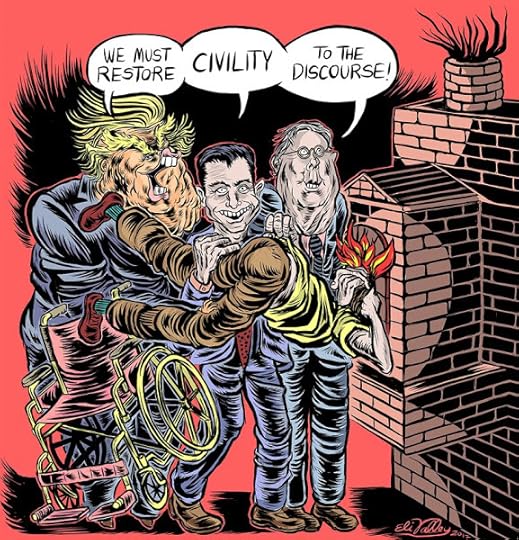
Goddamn. Good to see anyone else remembers every bullshit thing the dems did to sell us out since 2016. He even caught some stuff I missed or had forgotten.