

What do you think?

Nature Guide to the New Zealand Forest
New Zealand's native forests are rich and fascinating ecosystems, and the interactions between the various plants and animals are as interesting as the individuals themselves. This book is an ecological field guide.
In one volume, Nature Guide to the New Zealand Forest provides identification for a range of common plants (trees and shrubs, vines and epiphytes, ground plants, fungi, mosses and liverworts) and animals (birds, reptiles, insects and mammals). It also offers insights into the intriguing and vital interactions between them.
With a user-friendly, colour-coded layout – from the tallest trees to the forest floor – and stunning photographs for easy identification, this is a comprehensive and innovative guide to the wonders of the New Zealand forest.
In one volume, Nature Guide to the New Zealand Forest provides identification for a range of common plants (trees and shrubs, vines and epiphytes, ground plants, fungi, mosses and liverworts) and animals (birds, reptiles, insects and mammals). It also offers insights into the intriguing and vital interactions between them.
With a user-friendly, colour-coded layout – from the tallest trees to the forest floor – and stunning photographs for easy identification, this is a comprehensive and innovative guide to the wonders of the New Zealand forest.
- GenresNature
312 pages, Paperback
First published November 1, 2000
Ratings & Reviews
Friends & Following
Create a free account to discover what your friends think of this book!
Community Reviews
Displaying 1 - 1 of 1 review

May 3, 2026
The first time I went to New Zealand, I was followed for more than an hour through a forest outside Christchurch.
Not by a stalker, fortunately, but by a pair of fantails. I didn’t know what they were then – I just saw these little birds swooping up ahead of me, stopping on a branch, and tilting their heads to watch me go past. Then they’d flit through the leaves, over my head, between the trees, and stop again twenty metres further ahead. I kept thinking they’d get bored, or reach the edge of their territory, but they kept on going for almost the whole walk, staying beside me on the little path. My kids were enchanted.
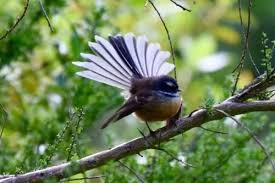
It’s really common behaviour for these birds, it turns out. Ornithologists say it’s because they can grab any insects or bugs disturbed by people walking. The thing is, it doesn’t feel like that when you see it. It feels like affection and interest.
There’s a kind of awe that builds up sometimes when you get to interact with animals outside, even common birds like fantails. The longer they followed us, the less we talked, and the more extraordinary it seemed. By the time they flitted off (perhaps deciding that I was not kicking up as many bugs as they hoped), I felt like we’d bonded for life. Surely, I thought, this must mean something. Perhaps they are a sign of some kind – a message of welcome from the land.
When I got back to my car, I looked them up on my phone. ‘Aha!’ I said, scanning Wikipedia. ‘In Māori mythology, the fantail is a symbol…oh.’
I tailed off while my wife stared at me. ‘A symbol of what?’
‘Er…a symbol of death from the gods.’
‘Those little fuckers!’
‘Ah, but wait, there’s something about Maui here – listen, kids, you’ll like this.’ They watched a lot of Moana in those days. ‘Here we are. When Māui attempted to achieve immortality by climbing through the goddess Hine-nui-te-pō, a group of fantails laughed at him as he entered her vagina.’ (‘Oh great,’ murmured my wife.) ‘The goddess awakened and crushed him to death with her obsidian vaginal teeth,’ I concluded, slightly quieter than I’d started. My children, to be fair to them, looked vaguely interested.
‘Well what do the Māori know,’ I said, putting my phone away.
No one talked much on the drive back.
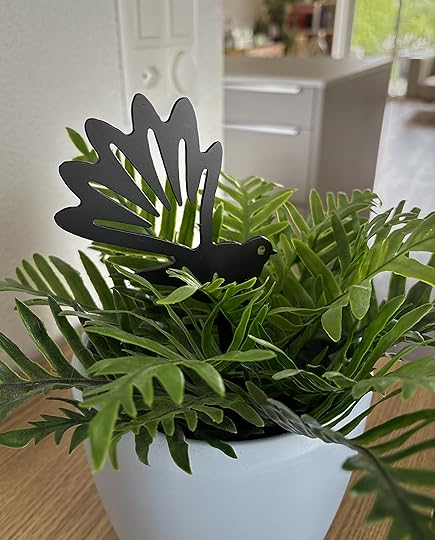
I have a little metal one in my plant-pot at home now. I don’t think the gods can object to that.
Not by a stalker, fortunately, but by a pair of fantails. I didn’t know what they were then – I just saw these little birds swooping up ahead of me, stopping on a branch, and tilting their heads to watch me go past. Then they’d flit through the leaves, over my head, between the trees, and stop again twenty metres further ahead. I kept thinking they’d get bored, or reach the edge of their territory, but they kept on going for almost the whole walk, staying beside me on the little path. My kids were enchanted.
It’s really common behaviour for these birds, it turns out. Ornithologists say it’s because they can grab any insects or bugs disturbed by people walking. The thing is, it doesn’t feel like that when you see it. It feels like affection and interest.
There’s a kind of awe that builds up sometimes when you get to interact with animals outside, even common birds like fantails. The longer they followed us, the less we talked, and the more extraordinary it seemed. By the time they flitted off (perhaps deciding that I was not kicking up as many bugs as they hoped), I felt like we’d bonded for life. Surely, I thought, this must mean something. Perhaps they are a sign of some kind – a message of welcome from the land.
When I got back to my car, I looked them up on my phone. ‘Aha!’ I said, scanning Wikipedia. ‘In Māori mythology, the fantail is a symbol…oh.’
I tailed off while my wife stared at me. ‘A symbol of what?’
‘Er…a symbol of death from the gods.’
‘Those little fuckers!’
‘Ah, but wait, there’s something about Maui here – listen, kids, you’ll like this.’ They watched a lot of Moana in those days. ‘Here we are. When Māui attempted to achieve immortality by climbing through the goddess Hine-nui-te-pō, a group of fantails laughed at him as he entered her vagina.’ (‘Oh great,’ murmured my wife.) ‘The goddess awakened and crushed him to death with her obsidian vaginal teeth,’ I concluded, slightly quieter than I’d started. My children, to be fair to them, looked vaguely interested.
‘Well what do the Māori know,’ I said, putting my phone away.
No one talked much on the drive back.
I have a little metal one in my plant-pot at home now. I don’t think the gods can object to that.
Displaying 1 - 1 of 1 review