Jump to ratings and reviews
Rate this book

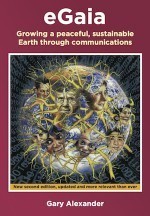
eGaia: Growing A Peaceful, Sustainable Earth Through Communications

Rate this book
A positive vision is emerging…

a community-based, but globally linked and co-ordinated society, a global human family looking after each other and the Earth.

eGaia describes many starting points around the world, and next big steps where they join and link up. It clarifies the vision, gives background and organsising principles, and a light fictional picture of a sustainable world.

299 pages, Paperback

First published July 15, 2002

174 people want to read

About the author

Gary Alexander

2 books2 followers
I’m Gary Alexander, the author of eGaia, Growing a peaceful sustainable Earth through communications . I developed the positive vision of a sustainable future described in it over many years, as you can see from my papers and talks.

I’ve been working to implement these visions through a range of community projects to ‘re-invent community’ to create a ‘connected community’ that is sustainable and in which people work for mutual benefit. As many such local communities develop and are linked regionally, nationally and globally they will form ‘Earth Connected’, an organism-like global culture.

I have recently completed a 4 year term on the Board of Trustees of the Transition Network, which I think of as on the leading edge of cultural change in the world today.

I retired from the Technology Faculty at the Open University after 37 years, where I was a pioneer in putting distance learning on-line, with an emphasis on collaborative learning and on-line support communities.

Ratings & Reviews

What do you think?
Rate this book

Friends & Following

Create a free account to discover what your friends think of this book!

Community Reviews

5 stars
3 (50%)
4 stars
0 (0%)
3 stars
3 (50%)
2 stars
0 (0%)
1 star
0 (0%)
Displaying 1 - 3 of 3 reviews
Profile Image for Stephanie Bradley.
Author 5 books4 followers
April 16, 2015
eGaia is a curious blend of accessible text book, complete with cartoons and little dialogues between the author and his imagined reader, Utopia dreaming, practical philosophy and a concise history of how we got where we are today with an overview of the emerging new paradigm we are living in.
Its vision can be summed up thus;
“We will see the emergence of [an] embryonic unified global network of people working for the benefit of all humanity and the natural world.” Ch 15 p240
In just 240 pages it is an ambitious undertaking, particularly because author Dr Gary Alexander sets out not only to cover our journey from distant anthropological beginnings to the unified global network he believes we are stepping into, but also to suggest and exemplify ways to get there and what it might look like when we do.
Its name, which points to a reality still in the making, is slightly misleading, as it suggested, at least to me, on first holding a copy in my hands, a focus on the electronic age we are now well and truly ensconced in; a world connected by the myriad internet based activities we have grown accustomed to; social media, sales portals, ‘pedias, and online opinion and information sharing in all guises from the personal blog to the slick and professional websites of academic institutions and international organisations.
eGaia though does nothing more than pay fleeting lip service to these, whilst at the same time advocating the internet as one of the tools for creating what the author refers to as the nervous system of the planet that he believes humankind truly are.
My expectations that the book’s main focus would be on the how of how positive exchange mechanisms such as the gift economy and localised economies and ethical non political global communications would be linked up by means of an internet based network, and how they can and will work in service to a humankind dedicated to the permaculture principles of people care, earth care and fair shares on which Dr Alexander’s Utopia stands firm, were not met. Rather there is a feeling, upon reading, that the bulk of eGaia concentrates on the background material; what led us to this place of over dependence on material well being, profit and apparent blind disregard for the destruction we leave in our wake.
It is a fascinating ride; from the cooperative ape to pacific tribes still in existence in far flung places to the close on catastrophic consequences we are all too aware of in current times of having put profit on a pedestal and in the doing become a slave to its insatiable needs. The principles Dr Alexander expounds are sound; organised into four key areas; Relationship, Peace, Sustainability and a Cooperative Economy, and his skill in describing complex issues in simple easy to digest bite sized chunks makes this book one worthy of recommending to any who feel they are floundering in a sea of complexity around the mess we find we have inherited, the global cancer that the author suggests it is.
Whilst the economy is key to the vision of the future eGaia describes rather engagingly in the fictional chapter which tells of life in the Pinecone Partnership, it is in fact communication, as the subtitle of eGaia tells us, “growing a peaceful, sustainable Earth through communications” that is of equal if not more import.
Throughout the book the author reminds us that we have the technology, the knowhow and the resources to live well on the earth, in fact, he tells us, research has shown we could do it on a quarter of the materials we currently use, but that is not at the core of what will take us to the cooperative society he and many writers today believe we are headed towards. Social change in the sense of a shift in focus to the acknowledgement that we are all interdependent, and effective communication, he says, is what is needed.
Although the explanations for how better communication could impact on our personal relationships as well as community and inter community relations and global interactions are based on solid positive approaches to conflict, advocating better listening in order to meet the needs of a diverse global population and the earth we steward, the theme is not explored in any great detail.
In a comparatively short book with such a wide scope there is the inevitable frustration that where there is breadth there cannot also be depth and that for me is what makes the book more starter text book than a comprehensive how- to manual for the future. It is nonetheless a starting point, and a good one, if what you are looking for is clarification and a sound overview of the subject with plenty of pointers for where to go to dig deeper.
Dr Alexander’s book is, in the end, an invitation. It’s a call to arms of a new way. When we begin to “join up the starting points” he suggests, having detailed those many positive initiatives that have sprung up in latter years; the Transition Movement, New Economics, the Permaculture Association and the Global Village Network (GEN) to mention just a few, then “they will all eventually be small parts of a single whole, humanity working to look after itself and the natural world.”
If it leaves you hungering for more, then perhaps eGaia has accomplished what it set out to do.
Profile Image for Gary Alexander.
Author 2 books2 followers
Read
November 26, 2014
Many people look at the way the world is developing with horror and are looking for a new way, a new vision. My book, eGaia, Growing a peaceful, sustainable Earth through commuications, second edition just released, is an important contribution to that new vision, giving more detail than I have seen elsewhere, not just on the physical aspects, such as energy use, reuse and recycling, etc. but especially on the social aspects: a collaborative society that is locally based, self-organised, and co-ordinated on many scales.

I hope you will agree that it makes a convincing case that the basic features of this vision are necessary if we are to move beyond the social and environmental horrors that plague us now.
Profile Image for John Naylor.
929 reviews22 followers
November 23, 2018
I received this book for free Via Goodreads First Reads. I openly admit this was over 3 years ago but things happen in life and books sometimes get left on to read piles.

The world does need to change to survive. We humans need to change our practices and ourselves to accomplish this. This book gives a way to do this.

I feel that the author did a lot of research and has his utopian idea firmly placed. I think his plans could work except for one massive problem. Humanity itself. We are programmed not to follow his ideals and ultimately Ok foresee failure for eGaia.

That being said, I do think small scale improvements based on his big ideas are implementable in my lifetime if successfully marketed and supported. We all can make a difference to the future of the planet. We need to.

A thoughtful and intelligent read. Although I don't think it is actionable, I think it has ideas that could help the world if not change it.
Displaying 1 - 3 of 3 reviews

Can't find what you're looking for?

Get help and learn more about the design.