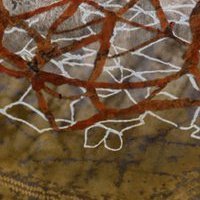
Dutch world maps of the sixteenth and seventeenth centuries, with their decorative pictures and elaborate typography, stand in sharp contrast to the wholly practical maps of today, which emphasize precise detail and consistent scale. Art, since the Impressionist period, has seemingly moved in the opposite direction, toward a less realistic interpretation of the world around us. Edward S. Casey demonstrates that the disciplines of mapping and painting, long thought to have diverged, are again intersecting. Earth-Mapping describes the ways in which artists of the last half century have incorporated ingenious mapping techniques into their art works. Beginning with a reassessment of the pioneering earth art of Robert Smithson in the 1960s and 1970s, Casey follows Smithson's legacy in the works of Sandy Gellis, Margot McLean, and Michelle Stuart. He also explores the visions of the earth found in the abstract paintings of Richard Diebenkorn, Jasper Johns, Willem de Kooning, Eve Ingalls, and Dan Rice. Focusing on forms of mapping that depart radically from conventional cartography - particularly "mapping with/in," being with or in a place, and "mapping out," communicating that experience of connection with others - Casey shows how earth art and abstract painting respectively reshape our landscape and our view of it, drawing us in from our bird's-eye view of the grid of highways and roads. In these works, we come to see the earth as it is sensed, remembered, and reshaped by artists as they explore the effect of the landscape on humans and the human effect on the landscape, and as they demand a response to the changing world around us.
Professor Edward Casey was the president of the American Philosophical Association (Eastern Division) from 2009-10, and he was chairman of the Philosophy Department at Stony Brook University for a decade. He works in aesthetics, philosophy of space and time, ethics, perception, and psychoanalytic theory. He obtained his doctorate at Northwestern University in 1967 and has taught at Yale University, the University of California at Santa Barbara, The New School for Social Research, Emory University, and several other institutions. He is currently Distinguished Professor of Philosophy at Stony Brook University.
His recent research includes investigations into place and space; landscape painting and maps as modes of representation; ethics and the other; feeling and emotion; philosophy of perception (with special attention to the role of the glance); the nature of edges.
While they have shared pasts in terms of representation, cartography has increasingly reduced decorative and pictorial in elements in lieu of showing exact, measured spaces. Painting, on the other hand has headed in the opposite direction, especially since the 20th century. Casey makes the argument here that the two are coming back together now in a new way.
One major critique I have of Casey is that he depends too heavily on artistic intention, a very modern assumption, and also a common pitfall I’ve noticed when academics from other fields enter into an art dialog. He almost completely ignores the audience (gender, race, class, education) and context (culture, place), and puts all agency on the “sublime” intention of the artist. Casey conveys images of a stereotypical brilliant artist in his studio, laboring endlessly to create the one perfect and beautiful object which will cull society out of the gutters.
I also think that Casey projects a lot of ideas onto the artists that he discusses. He takes a lot of pleasure in describing their work, without taking or acknowledging a critical perspective.
Finally, in the “Woman in/as Landscape” section in the de Kooning chapter, Casey fails to consider the male gaze regarding the representation of women by male artists, and even finds himself repeating this power play by sexualizing images of landscapes and associating them with female anatomy. For example, on 141 he interprets somehow in de Kooning's, “Montauk Highway,” visual elements depicting a “male organ being thrust into a vagina.” In one of Eve Ingalls' works he sees an "enormous vagina." Seriously?
I did learn and enjoy a few things from this book, primarily in the first Unit, in his discussion of Robert Smithson and Michelle Stuart. If you do read this unit make sure to watch Smithson's film, Spiral Jetty, which he considered the cinematic counterpart to the earth work, because it is pretty clear that Casey did not.