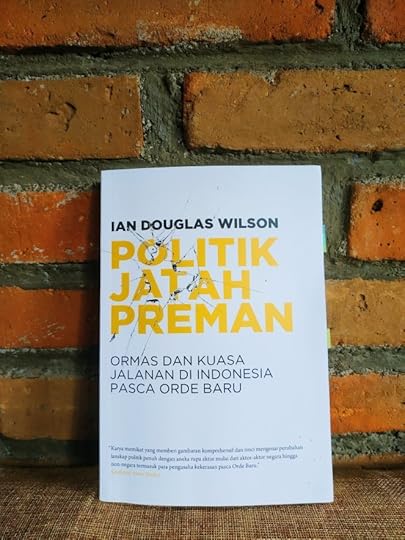
Politik Jatah Preman: Ormas dan Kuasa Jalanan Di Indonesia Pasca Orde Baru by Ian Douglas Wilson (1969).
An interesting book to read for you who wants to know about Indonesian politic in bottom base. Ian learn about Indonesia and the people in contemporaneous era, especially about economy, gangster politics, vigilantism, violence, and street politics and its relation with the authority. The cover of this book interest the reader, this second edition of this book successful to make a sense by the design. Using white color as the basic color the cover of this book, and yellow on the main title, and a little bit accent, give this book eye catching appearance in delicate workmanship. The description of the book was written in the back cover of this book.
Published for the first time in English, on 2015 with the title “The Politics of Protection Rackets in Post-New Order Indonesia: Coercive Capital, Authority and Street Politics”, translated in Bahasa by Mirza Jaka Suryana and published for the first time in Indonesia on December, 2018, by Marjin Kiri. Over all, this book is talking about Indonesia and the people in contemporaneous era, especially about economy, gangmster politics, vigilantism, violence, and street politics and its relation with the authority. The existence of gangs, thugs, and militias has become an inherent characteristic of Indonesia's socio-political life. During the New Order era, they were used as a tool to uphold the country's version of social order and perpetuate regime power, for example the "authority" held by youth organizations to beat critics of the regime in the name of Pancasila. Post-1998 democratization did not result in the disappearance of these groups, but rather they adapted and looked for loopholes in the changing political context. Defending religion - no longer defending the regime - is now one of the reasons for their existence. Then decentralization reinforces the element of ethnicity as a foundation for mass organizations. This new type of street mass organization combines rent hunting predatoryly with claims to represent marginalized socio-economic groups.
Based on intense and lengthy field research, this book presents a comprehensive analysis of the changing relationships between these groups with the authorities and post-New Order political power. In consolidating their territorial power at the local level, these groups have managed to win a certain level of legitimacy that is not solely based on acts of bullying and violence. In the context of electoral democracy in Indonesia, they also succeeded in becoming an intermediary between informal street politics and formal parliamentary politics. How they utilize this position to increase their bargaining power, and how the formal political world utilizes their "services" will greatly influence the future of socio-political life in Indonesia.