Jump to ratings and reviews
Rate this book

Die Salzburger Stücke

Rate this book
Thomas Bernhards »Salzburger Stücke« sind über den äußeren Anlaß hinaus – sie wurden in Salzburg uraufgeführt – sowohl inhaltlich als auch formal an die Stadt und ihre Festspiele gebunden. Eine musikalisch-künstlerische Tätigkeit auszuüben, sie perfekt auszuüben, das ist das Thema, das Bernhard in beiden Stücken anschlägt. Sowohl die Perfektion beherrschende, exzentrische Opernsängerin in Der Ignorant und der Wahnsinnige als auch der Cello-Perfektion erstrebende, aber nie erreichende Zirkusdirektor Caribaldi in Die Macht der Gewohnheit verkörpern den gleichen Typus: den des Künstlers, der nicht versteht, wie diese künstlerische Tätigkeit – ob erfolgreich oder erfolglos – auf seine Umwelt wirkt oder wie sie damit zurechtkommt. Die künstlerische Perfektion als Kompensation für die Unvollkommenheit der Welt, als Kontrapunkt der Notwendigkeit zum Tode, das ist es, was Bernhard in seinen Figuren thematisiert.

196 pages, Paperback

First published January 1, 1975

Loading...
Loading...

About the author

Thomas Bernhard

293 books2,543 followers
Thomas Bernhard was an Austrian writer who ranks among the most distinguished German-speaking writers of the second half of the 20th century.

Although internationally he’s most acclaimed because of his novels, he was also a prolific playwright. His characters are often at work on a lifetime and never-ending major project while they deal with themes such as suicide, madness and obsession, and, as Bernhard did, a love-hate relationship with Austria. His prose is tumultuous but sober at the same time, philosophic by turns, with a musical cadence and plenty of black humor.

He started publishing in the year 1963 with the novel Frost. His last published work, appearing in the year 1986, was Extinction. Some of his best-known works include The Loser (about a student’s fictionalized relationship with the pianist Glenn Gould), Wittgenstein’s Nephew, and Woodcutters.

Ratings & Reviews

What do you think?
Rate this book

Friends & Following

Create a free account to discover what your friends think of this book!

Community Reviews

5 stars
0 (0%)
4 stars
3 (100%)
3 stars
0 (0%)
2 stars
0 (0%)
1 star
0 (0%)
Displaying 1 of 1 review
Profile Image for Noam.
266 reviews39 followers
April 22, 2025
Mozart’s ‘Die Zauberflöte‘ and Schubert’s ‘Forellenquintett‘ will never sound the same after reading these plays!

In the first play, ‘The Ignoramus and the Madman’ (‘Der Ignorant und der Wahnsinnige‘), the ignoramus is the father and the madman is the doctor. You wouldn’t like to be anyone of them. The father is old, blind and he drinks all day long. The doctor doesn’t keep his mouth shut. What brings them together is the father’s daughter, a singer, which we get to know only as ‘The Queen of the Night’, the role she sang too many times and still sings in Mozart’s ‘The Magic Flute’. The two parts of the play take place just before and just after her performance. The doctor talks about what the papers say about the queen’s performance, about father’s alcoholism and, most disgusting, about the dissection of a corpse. The father needs his daughter, but she doesn’t treat him well. The Queen of the Night suffers, being a singer and singing such a demanding role.
'Das Theater
insbesondere die Oper
geehrter Herr
ist die Hölle'
p.60

'Wenn wir etwas erreicht haben
und sei es das höchste
sehen wir
daß es nichts is'
p.69
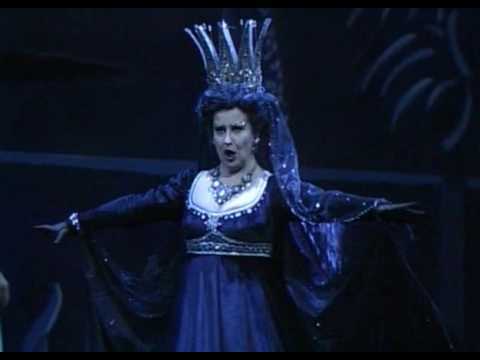
The Queen of the Night
Luciana Serra as Queen of the Night, Metropolitan Opera 1991

In the second play, ‘The Force of Habit’ (‘Die Macht der Gewohnheit’), circus director Caribaldi conducts a rehearsal of Schubert’s Trout Quintet. The players are his family members and employees. Caribaldi started playing this piece of music 22 years ago, to fight his loss of concentration. As the leading player he aims to control the performance but he just cannot get things right, ever, at least not with these players. Whatever he’s doing to get things right, just keeps going wrong. Sometimes a sublime piece of music can sound like a nightmare.

'Die Warheit ist
ich liebe das Cello nicht
Mir ist es eine Qual
aber es muß gespielt werden'
p.123

'Ein Dummkopf
der heute noch einem Künstler glaubt
ein Dummkopf'
p.131
As often in Thomas Bernhard’s plays, people seem to talk to themselves, rather than to the people they are surrounded by. Or at least they don’t seem to listen. The highest artistic and human goals collide with the lowest side of our existence. Aiming for the highest, doesn’t change how miserable and helpless our lives are.
Displaying 1 of 1 review