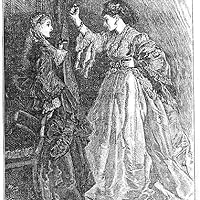
"Oh how I do wish I could have a little help in maintaining my home. I shall dread the cold winter so much. I don't have very good success getting employment," wrote Emily French in her diary in 1890. Emily was recently divorced but received no alimony or child support. She worked as a laundress, cleaning woman, and nurse, first in the farming community of Elbert, Colorado, then in the growing city of Denver, the mining town of Dake, and back into Denver. Emily's diary discloses an example of the desperate lives lived by many. Having enough money and food is a source of constant anxiety, but her deepest fears center on the loss of family and of home. She becomes discouraged but never gives up, recognizes others less fortunate than herself, and always believes things will change. This is a moving work that provides an unusual look into the life of the working poor in the late-nineteenth-century West.
I found a used copy of this book in the history section of my favorite local bookstore. It is really a wonderful read in many ways, with just enough framing by Janet Lecompte to fill in what may not be understood from the text alone. Emily French was a literate, formerly middle-class woman who went through a divorce and found herself "working out" doing household chores for other families. Although some of the language is halting (not surprising if you imagine her slaving away all day and then writing in her few private moments)you become used to the style very quickly. The descriptions of the sheer amount of work necessary to meet basic needs without many modern conveniences are exhaustive. Nearly every day Emily describes what she eats, what she is paid for all of her chores,and other practical snippets. She details the everyday suffering from various illnesses,both transitory and chronic, that bedevil the people of 1890s Colorado. Perhaps most colorfully, she describes the behavioral quirks of her employers, including one who calls her an "adventuress" -- not a compliment in those days, certainly.
Great if you're interested in history or what it was like to live in Colorado in 1890. I was interested because Emily French worked one summer in a town that no longer exists, Dake. Dake was between Webster and Kenosha, and our historical society visited the site several years ago. If not for that, I would have been bored by most the book, which seems kind of dreary, repetitive, and often hard to keep track of all the people mentioned. It names several other small towns and streets in Denver. Mostly Emily struggles to make ends meet and keep at least a portion of her family together in bad times and cold winters. Usually she works as a cook or nurse, or takes in sewing. In other parts she talks about the winter in Elbert and building a small house in Denver.
An interesting read. Just daily entries in a little 1890 diary by an increasingly desperate 46yo woman, trying to support herself and 2 of her 6 children. (The others were estranged. Her youngest died at 4yo of accidental poisoning.) The miseries of traveling by horse and wagon between Elbert and Denver, and then into the mountains for work, and then dealing with unpleasant employers and rotten conditions, were easy to imagine, with Emily’s clipped shorthand notes full of details. The diary mysteriously ended up in the old Pioneer Museum in Colorado Springs so nothing more is known about her afterwards. I hope her life got easier somehow.
I wrote a summary more than a review. Last ¶ = my comments.
14 August 1843, DOB near Marshall, Michigan to Morgan Rood and his first wife. He married Mrs. Anna Bickford in 1868 and lived with her in prosperity in Denver until he died in 1881. 17 March 1858, Emily eloped with Marsena French. They worked hard; in 1867 bought a store and clothing business. They had 7 or 8 children. He became a doctor in Anamosa, MI, after leaving home to study medicine. He was not successful financially as a doctor. 1876 the family moved to Golden, CO. Emily had to “work out” for other families, serving as cook, laundress, cleaner, nurse. Their first child was born in 1860, last one in 1977. Marsena filed for divorce against Emily; it was granted 29 June 1889; marriage lasted 31 years. How awful! The rest of her life Emily just works herself to death trying to make ends meet. She and her sister Annis homesteaded but not successfully. Much of the pay for her various jobs was in food for her and for her horse. This story is so sad. Unmarried women had few opportunities to make a decent living. What is even sadder to me is that her father did fine; he left his money to his second wife. Emily and her siblings sued to get some of his estate but got nothing from the courts. Marsena married right away. 1890 was a hard, hard year for Emily, so reading the diary depresses me. She apparently married somebody Varney around 1894 and disappeared from records in CO, IA, and MI.
From a historian perspective, this book is amazing because diaries about the everyday life of an average person are hard to find. From a reader perspective, this book dragged considerably and it took me a solid 3 weeks to finish its 166 pages. It's not exciting in any way--it details Emily's moves around Colorado to new jobs, her time at those jobs (mostly housekeeping positions), and her issues with her children and ex-husband. She's also extremely religious, starting each entry with a Bible verse.
Can't say I recommend it, unless you have a strong interest in diaries and/or women in the West.
It's just so incredible that this diary even exists. We don't usually get to hear from poor, uneducated middle-aged women from the 19th century, and Emily was a keen observer, and didn't mince words if she liked, or didn't like, something. Lots of good tidbits for gender and class relations nerds, too. The background research the editor did is also really helpful; I learned stuff about American history and economics I didn't know before.
Didn't finish it actually. I understand why the editor chose to leave it in its original format - but on the other hand it made it very difficult to read/follow/understand. The spelling was horrific - understandable for a woman who was uneducated but I feel like the editor could have chosen to include an edited version which would explain words and terms that Emily used.
3.4 This is really rather dull reading, but it is the story of a hard-worked woman, and she didn't have a lot of exciting experiences. It is worth reading.
2023 If I read this again, I think I'd appreciate it more. She often had very little to write bec cause she found her life so tedious and repetitious. That in itself is important.
It was a hard life for a divorced woman in 1890's Colorado, even for someone like Emily who was willing to work very hard. Every entry in her diary is similar, telling what she eats, how long she works, how little she gets paid for it, and how she worries about losing her family.
Interesting from an historical point of view but a sad and somewhat boring account of working day to day just to barely survive. Amazing that Emily was so articulate and faithful to her diary even through exhaustion and illness. A rare and unique book!