

What do you think?

The Evolution and Emergence of RNA Viruses
RNA viruses provide unique insights into the patterns and processes of evolutionary change in real time. The study of viral evolution is especially topical given the growing awareness that emerging and re-emerging diseases (most of which are caused by RNA viruses) represent a major threat to public health. However, while the study of viral evolution has developed rapidly in the last 30 years, relatively little attention has been directed toward linking work on the mechanisms of viral evolution within cells or individual hosts, to the epidemiological outcomes of these processes. This novel book fills this gap by considering the patterns and processes of viral evolution across their entire range of spatial and temporal scales.
The Evolution and Emergence of RNA Viruses provides a comprehensive overview of RNA virus evolution. This is the first book to link mechanisms of viral evolution to epidemiological outcomes, incorporating case studies in RNA virus emergence and evolution using topical examples such as influenza, HIV, dengue fever, and rabies. It reveals the underlying evolutionary processes by which emerging viruses cross species boundaries and spread in new hosts.
The Evolution and Emergence of RNA Viruses provides a comprehensive overview of RNA virus evolution. This is the first book to link mechanisms of viral evolution to epidemiological outcomes, incorporating case studies in RNA virus emergence and evolution using topical examples such as influenza, HIV, dengue fever, and rabies. It reveals the underlying evolutionary processes by which emerging viruses cross species boundaries and spread in new hosts.
268 pages, Hardcover
First published June 25, 2009
Ratings & Reviews
Friends & Following
Create a free account to discover what your friends think of this book!
Community Reviews
Displaying 1 - 1 of 1 review

May 15, 2020
I put this one on my list in the current COVID-19 climate, to further my understanding of virology, and RNA viruses in particular.
I'm not quite sure how to "review" this one...
It reads more like a textbook, or a long-form encyclopedia article than a regular book.
"The Evolution and Emergence of RNA Viruses" is a technical look into RNA viruses; their mutations, related epidemiology, and their relationships to environmental pressures.

The tone of this book is somewhat typical academic; it is extremely dry, arduous, and technical. Also: This is most certainly not a book written for the layperson, so be aware of that before proceeding. If you don't have a somewhat decent literacy of evolutionary biological concepts and virology, much of the jargon in here will read like Greek to you.
Nevertheless, there was some interesting info here. The author talks about "Eigen's Paradox", a concept he summed up well in David Quammen's 2013 book Spillover: Animal Infections and the Next Human Pandemic:
"...And why are RNA genomes so small? Because their self-replication is so fraught with inaccuracies that, given more information to replicate, they would accumulate more errors and cease to function at all. It’s sort of a chicken-and egg problem, he said.
RNA viruses are limited to small genomes because their mutation rates are so high, and their mutation rates are so high because they’re limited to small genomes. In fact, there’s a fancy name for that bind: Eigen’s paradox.
Manfred Eigen is a German chemist, a Nobel winner, who has studied the chemical reactions that yield self-organization of longer molecules, a process that might lead to life. His paradox describes a size limit for such self-replicating molecules, beyond which their mutation rate gives them too many errors and they cease to replicate. They die out.
RNA viruses, thus constrained, compensate for their error-prone replication by producing huge populations and achieving transmission early and often. They can’t break through Eigen’s paradox, it seems, but they can scoot around it, making a virtue of their instability. Their copying errors deliver beaucoup variation, and beaucoup variation allows them to evolve fast."
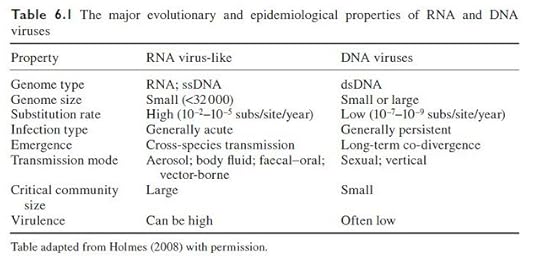
The book also included some talk about the general differences in the epidemiological impacts of RNA viruses versus their DNA counterparts. A handle table summed up some of the major trends:
So, I'm not sure that I would recommend this one to others. It appears to be a science textbook, written for other scientists; virologists, epidemiologists, etc...
If you have a high degree of technical literacy, then give it a shot. If not, you might want to give this one a pass.
3 stars.
I'm not quite sure how to "review" this one...
It reads more like a textbook, or a long-form encyclopedia article than a regular book.
"The Evolution and Emergence of RNA Viruses" is a technical look into RNA viruses; their mutations, related epidemiology, and their relationships to environmental pressures.
The tone of this book is somewhat typical academic; it is extremely dry, arduous, and technical. Also: This is most certainly not a book written for the layperson, so be aware of that before proceeding. If you don't have a somewhat decent literacy of evolutionary biological concepts and virology, much of the jargon in here will read like Greek to you.
Nevertheless, there was some interesting info here. The author talks about "Eigen's Paradox", a concept he summed up well in David Quammen's 2013 book Spillover: Animal Infections and the Next Human Pandemic:
"...And why are RNA genomes so small? Because their self-replication is so fraught with inaccuracies that, given more information to replicate, they would accumulate more errors and cease to function at all. It’s sort of a chicken-and egg problem, he said.
RNA viruses are limited to small genomes because their mutation rates are so high, and their mutation rates are so high because they’re limited to small genomes. In fact, there’s a fancy name for that bind: Eigen’s paradox.
Manfred Eigen is a German chemist, a Nobel winner, who has studied the chemical reactions that yield self-organization of longer molecules, a process that might lead to life. His paradox describes a size limit for such self-replicating molecules, beyond which their mutation rate gives them too many errors and they cease to replicate. They die out.
RNA viruses, thus constrained, compensate for their error-prone replication by producing huge populations and achieving transmission early and often. They can’t break through Eigen’s paradox, it seems, but they can scoot around it, making a virtue of their instability. Their copying errors deliver beaucoup variation, and beaucoup variation allows them to evolve fast."
The book also included some talk about the general differences in the epidemiological impacts of RNA viruses versus their DNA counterparts. A handle table summed up some of the major trends:
So, I'm not sure that I would recommend this one to others. It appears to be a science textbook, written for other scientists; virologists, epidemiologists, etc...
If you have a high degree of technical literacy, then give it a shot. If not, you might want to give this one a pass.
3 stars.
Displaying 1 - 1 of 1 review