Jump to ratings and reviews
Rate this book

Antony Gormley: Blind Light

Rate this book
Over the past 25 years, Antony Gormley, perhaps Britain's best-known living sculptor, has revitalized the human image in sculpture. He won the 1994 Turner Prize and has had solo exhibitions at the Whitechapel, Tate, and Hayward galleries, White Cube and The British Museum, and internationally at the Corcoran Gallery, Documenta and the Venice Biennale. His radical investigations of the body as a place of memory and transformation use his own corpus as subject, tool and material. Conflating figure and ground, inside and outside, the physical and the psychological, Gormley explores complex relationships between the city, its architecture and its people. This richly illustrated catalogue is filled with new, never-before-seen sculptural works--a series of figures in light-infused webs of steel, and the monumental steel-block "Space Station," 20 feet high. Photographer Gautier Deblonde also chronicles a major new public project, "Event Horizon," which sites some 30 sculptures on buildings across central London, dramatically altering the city skyline. An in-depth interview with Gormley explores the development of his new work, as well as his relationship to the artists who have inspired him and to his contemporaries in the field of figurative sculpture.

160 pages, Hardcover

First published July 1, 2007

21 people want to read

About the author

W.J. Thomas Mitchell

102 books60 followers
William J. Thomas Mitchell is a professor of English and Art History at the University of Chicago. Editor of the journal Critical Inquiry.

His monographs, Iconology (1986) and Picture Theory (1994), focus on media theory and visual culture. He draws on ideas from Sigmund Freud and Karl Marx to demonstrate that, essentially, we must consider pictures to be living things. His collection of essays What Do Pictures Want? (2005) won the Modern Language Association's prestigious James Russell Lowell Prize in 2005. In a recent podcast interview Mitchell traces his interest in visual culture to early work on William Blake, and his then burgeoning interest in developing a science of images. In that same interview he discusses his ongoing efforts to rethink visual culture as a form of life and in light of digital media.

Ratings & Reviews

What do you think?
Rate this book

Friends & Following

Create a free account to discover what your friends think of this book!

Community Reviews

5 stars
4 (50%)
4 stars
4 (50%)
3 stars
0 (0%)
2 stars
0 (0%)
1 star
0 (0%)
Displaying 1 of 1 review
Profile Image for Leif.
1,974 reviews105 followers
May 30, 2013
Three prominent scholars of art & architecture, poetics & language, and literature & mixed media: one book to include them all, bound by the work of visionary sculptor and artist Antony Gormley. Anthony Vidler contributes "Uncanny Scuplture," while Susan Stewart contributes "The Sculpter as First Finder" and W.J.T. Mitchell "Architecture as Sculpture as Drawing: Antony Gormley's Paragone."


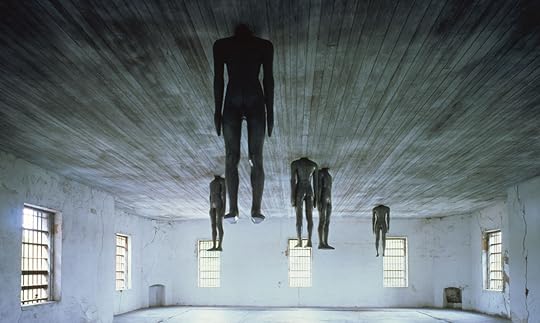
Learning to Think, Antony Gormley (1991), Charleston City Jail, South Carolina

Take the following, from Susan Stewart's densely suggestive "The Sculptor as First Finder," where she revisits the judgement of Dedalus as protos heuretes (first finder) to suggest that Gormley continunes from where Dedalus went wrong (those wings for Icarus, remember?), and that "[t]o a logic of scarcity and escape, Antony Gormley counterpoises an ethic of concentration and expansion, one where freedom is a relation of dependency, and descent into matter, true gravitas, figures the progress of human form." Here's more:
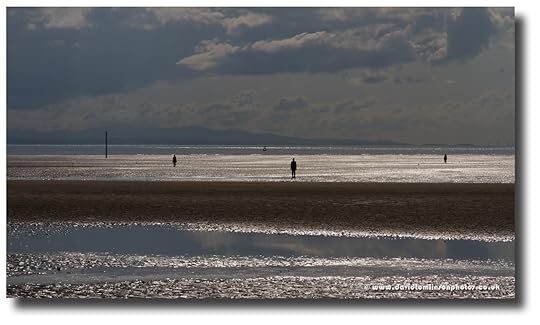
The array of Gormley's figures ambiguously suggests worshippers entering the sea, ancient figures fleeing fire and cast forever in its ashes, postures of banishment and welcome, self-containment, enclosure and embracing. Some figures swarm and spark; others seem the very embodiment of patience and stillness. We recognise the casts of Gormley's own body, yet we also come to know the precise dimensions of myriad other people.

Can you say, Yes? Yes.


Another Place, Antony Gormley (1997), Crosby Beach, England
Displaying 1 of 1 review

Can't find what you're looking for?

Get help and learn more about the design.