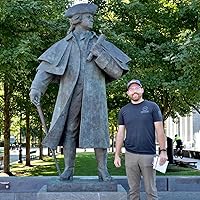
Frank Bartlett was an indifferent student at Harvard when the Civil War began in 1861, but after he joined the Union army he quickly found that he had an aptitude for leadership and rose from captain to brevet major general by 1865. Over the course of the war he was wounded three times (one injury resulted in the loss of a leg), but he remained on active duty until he was captured in 1864. His political stance gained him some national fame after the war, but he struggled with repeated business stress until tuberculosis and other illnesses led to his early death at age 36.
William Francis Bartlett : Biography of a Union General in the Civil War by Richard Sauers and Martin Sable . . There are thousands of untold stories of civil war soldiers who were lesser known or were poor self promoters out there and this is one of those examples. In this case, the soldier is William Francis Bartlett, a hardy new englander from Massachusetts, who would start the war as a Capt of the 20th Massachusetts “Harvard Regiment” Infantry. He would participate in the Battle of Balls Bluff where he commanded his men admirably during that debacle. After he would be wounded at the Battle of Yorktown during the peninsula campaign being shot in the knee which resulted in an amputation of his leg. Frank recuperated at home and returned as colonel of the 49th Massachusetts Regiment which would see action at Port Hudson during the Louisiana campaign under General Nathaniel Banks. Frank gallantly rode into battle on horseback leading his troops only to be wounded again, this time shot in both the wrist and the leg. After recovering a second time, Bartlett would form the 57th Massachusetts Regiment as colonel. This regiment would be placed under Burnsides command in the 9th corps just in time for the overland campaign with Bartlett being promoted to brigadier general leading a brigade in Ledlie’s division. Frank was the lead officer during the battle of the crater, which quickly devolved into chaos, and he would be captured and held as a POW for the remainder of the war, severely taking a toll on his health. He would be exchanged and would end the war as a brevet Major General and leave the army in 1866. Post war Frank’s health steadily declined due to his multiple war wounds as he started his family in Pittsfield Massachusetts with his wife Agnes. They would have many children by the time of Frank’s death at the young age of 35 in 1876. Frank refused to play politics after the war and was a strong proponent of reconciliation with the south, a self labeled war democrat, and when nominated for political leadership he declined all offers. He also made a career in the iron works industry, managing a works in western Mass as well as Tredegar Iron works in Richmond.