

What do you think?

A month of Sundays: A comedy
To the painful ritual of Sunday family visits and empty condescension, Cooper and his friend Aylott reply with humour and wit, aware that life can only be endured if treated as a comedy.3 women, 3 men
99 pages, Paperback
First published June 1, 1986
Ratings & Reviews
Friends & Following
Create a free account to discover what your friends think of this book!
Community Reviews
Displaying 1 - 1 of 1 review

October 4, 2015
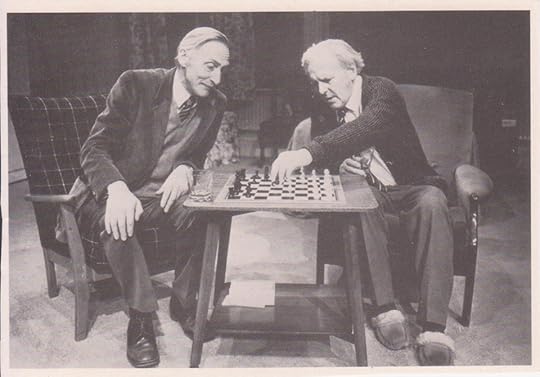
A Month of Sundays, a play by Bob Larbey, is a bittersweet comedy about growing old. It is mostly a two-hander, with a few minor supporting roles. The main character, Cooper, has voluntarily gone into a nursing home rather than become a burden on his family. We deduce his valiant determination to hold on to his remaining dignity and independence through his banter, as he jokes with the other old folks, flirts with the female staff, and keeps a close check on his own "record of physical deteriorations". Cooper is on stage throughout, driving the emotional development of the play with his acerbic wit and waspish asides, but we also glimpse his vulnerability.
His friend Aylott is a foil to Cooper, who is the more dominant of the two. Aylott is a sensitive gentle soul, nowhere near as hearty or self-important as Cooper. The two geriatrics agree that their lives now can only be endured if they treat life as a comedy. Whether the play is showing the painful ritual of a Sunday duty visit by Cooper's daughter and son-in-law, or the inevitable condescension shown by the young and fit to the old and infirm, Cooper and Aylott behave with humour and wit. Yet throughout there is underlying sadness. Where some writers would highlight the harrowing elements of the gradual onset of senility, Bob Larbey shows us the same experince with a sharp comedy. The two inmates of the retirement home are covering their fear of what awaits them with a brave veneer of humour.
The drama shows how others interact with the two old people. We see how the presence of the nurse and the cleaner reinforce Cooper and Aylott's painful consciousness of their situation, clearly indicating that this too is inevitable. They bustle about in a determined fashion, yet neither are caricatures. We see Cooper’s hurt when he learns that his grandson does not want to visit him. Yet even when the young are well-meaning in their dealings with the old, the difference is profound. The energetic and youthful Nurse Wilson is genuinely kind and tender towards Cooper; there is mutual repect.
Cooper’s daughter, Julia, shows a composite of duty, affection and irritation. Her cameo may feel eerily and uncomfortably familiar to anyone who feels they have experienced a similar situation with an elderly parent. It is all too easy to characterise the old as "difficult" or "feisty". Yet although Cooper is now a stiff, bent old man, he is still fully in charge of his mental faculties, and has many long witty speeches where he holds forth. He runs rings around Julia's rather dull husband, Peter, who is no match for Cooper’s biting wit. It is with despair and frustration that at one point Julia bursts out, "I do wish you’d talk to me!"
In some ways it is a play as much about the relationships between family members as about old age. Studies into the ways different people behave towards each other, and group dynamics, are also the chosen province of Alan Ayckbourn. However Bob Larbey's approach is more of a subtle exploration, using delicacy and humane consideration, rather than being being the savage bitter parody which Alan Ayckbourn would have written. Interestingly, Esmonde and Larbey used one of Alan Ayckbourn's plays, the 1973 trilogy, "The Norman Conquests" as a template for "The Good Life", but their humour, although sharp, was far more gentle.
A Month of Sundays is Bob Larbey's first stage play, although he is well known as a co-author with John Esmonde of many superb British television series such as "The Good Life", "Please Sir", and "Ever Decreasing Circles". There are several such male duos who have written situation comedies for British TV: David Croft and and Jimmy Perry, Dick Clement and Ian La Frenais, Ray Galton and Alan Simpson, to name but a few. John Esmonde and Bob Larbey met at school and remained friends all their lives, having tried their luck in BBC radio comedy because they loved listening to it. After these successes Bob Larbey then went to write "A Fine Romance", a solo venture for television, which like the earlier ones, also ran to several series and won a Best TV Comedy award.
Larbey had no theatrical background, but A Month of Sundays, also won the Best Comedy of the Year award in 1986, having transferred the West End from Southampton in 1985. This award-winning performance was the one I saw. It starred George Cole as Cooper and Geoffrey Bayldon as Aylott.
The denoument of the play is the most affecting part of the play, For all their differences and back-biting, despite the fact that these two are chalk and cheese, they are mutually dependent.
This is a memorable and subtly thought-provoking play.
His friend Aylott is a foil to Cooper, who is the more dominant of the two. Aylott is a sensitive gentle soul, nowhere near as hearty or self-important as Cooper. The two geriatrics agree that their lives now can only be endured if they treat life as a comedy. Whether the play is showing the painful ritual of a Sunday duty visit by Cooper's daughter and son-in-law, or the inevitable condescension shown by the young and fit to the old and infirm, Cooper and Aylott behave with humour and wit. Yet throughout there is underlying sadness. Where some writers would highlight the harrowing elements of the gradual onset of senility, Bob Larbey shows us the same experince with a sharp comedy. The two inmates of the retirement home are covering their fear of what awaits them with a brave veneer of humour.
The drama shows how others interact with the two old people. We see how the presence of the nurse and the cleaner reinforce Cooper and Aylott's painful consciousness of their situation, clearly indicating that this too is inevitable. They bustle about in a determined fashion, yet neither are caricatures. We see Cooper’s hurt when he learns that his grandson does not want to visit him. Yet even when the young are well-meaning in their dealings with the old, the difference is profound. The energetic and youthful Nurse Wilson is genuinely kind and tender towards Cooper; there is mutual repect.
Cooper’s daughter, Julia, shows a composite of duty, affection and irritation. Her cameo may feel eerily and uncomfortably familiar to anyone who feels they have experienced a similar situation with an elderly parent. It is all too easy to characterise the old as "difficult" or "feisty". Yet although Cooper is now a stiff, bent old man, he is still fully in charge of his mental faculties, and has many long witty speeches where he holds forth. He runs rings around Julia's rather dull husband, Peter, who is no match for Cooper’s biting wit. It is with despair and frustration that at one point Julia bursts out, "I do wish you’d talk to me!"
In some ways it is a play as much about the relationships between family members as about old age. Studies into the ways different people behave towards each other, and group dynamics, are also the chosen province of Alan Ayckbourn. However Bob Larbey's approach is more of a subtle exploration, using delicacy and humane consideration, rather than being being the savage bitter parody which Alan Ayckbourn would have written. Interestingly, Esmonde and Larbey used one of Alan Ayckbourn's plays, the 1973 trilogy, "The Norman Conquests" as a template for "The Good Life", but their humour, although sharp, was far more gentle.
A Month of Sundays is Bob Larbey's first stage play, although he is well known as a co-author with John Esmonde of many superb British television series such as "The Good Life", "Please Sir", and "Ever Decreasing Circles". There are several such male duos who have written situation comedies for British TV: David Croft and and Jimmy Perry, Dick Clement and Ian La Frenais, Ray Galton and Alan Simpson, to name but a few. John Esmonde and Bob Larbey met at school and remained friends all their lives, having tried their luck in BBC radio comedy because they loved listening to it. After these successes Bob Larbey then went to write "A Fine Romance", a solo venture for television, which like the earlier ones, also ran to several series and won a Best TV Comedy award.
Larbey had no theatrical background, but A Month of Sundays, also won the Best Comedy of the Year award in 1986, having transferred the West End from Southampton in 1985. This award-winning performance was the one I saw. It starred George Cole as Cooper and Geoffrey Bayldon as Aylott.
The denoument of the play is the most affecting part of the play, For all their differences and back-biting, despite the fact that these two are chalk and cheese, they are mutually dependent.
This is a memorable and subtly thought-provoking play.
Displaying 1 - 1 of 1 review