Juste avant 1914, dans une petite ville bretonne, près de la cathédrale, vit l'infâme rue du Tonneau, avec ses taudis, ses maisons de prostitution, ses cafés douteux. Une écurie sert de logis aux Nédelec, la mère, les deux enfants et le grand-père, tailleur qui fait vivre tout le monde et travaille jusqu'à ce que mort s'ensuive. Puis arrive la cousine Zabella, personnage haut en couleur. La poésie, l'amour, la noblesse du cœur illumine ce récit, le plus beau peut-être qu'aient jamais inspiré l'enfance et la misère. «Je doute qu'aucun amour vaille celui des pauvres», écrit Louis Guilloux dans Le pain des rêves.
Louis Guilloux was a French known for his Social Realist novels describing working class life and political struggles in the mid-twentieth century. His best-known book is Le Sang noir (Black Blood), which has been described as a "prefiguration of Sartre's La Nausée."
Before becoming a professional writer, literary translator and interpreter, Guilloux worked in various trades, including journalism. He was well known for his fluency in the English language. He married in 1924, and published La Maison du Peuple in 1927.
The success of the book led to a long series of novels on socially committed themes, usually based in his native Brittany. His masterpiece Le Sang Noir was notable for its departure from his earlier, more staightforwardly socialist literature, since it contains elements of what was later associated with an existentialist or absurdist vision. It centres on the suicidal thoughts of the anti-hero, Cripure, who feels overwhelming disgust at humanity in the destructive circumstances of militarism during World War I.
Contrasted with the figure of Cripure is the nominal hero, Lucien, who aspires to work for a better future. But the grotesque and self-excoriating visions of Cripure are repeatedly portrayed as more powerful and compelling than Lucien's idealism. The book was translated into English under the title Bitter Victory.
Le Pain des Rêves (Bread of Dreams), which he wrote during the Occupation, won the Prix du roman populiste in 1942. After the liberation of France, Guilloux worked as an interpreter for the American Army of occupation. In "OK Joe!" he explored racial inequalities and injustice in the segregated American army of the time. Guilloux's experiences at this time are described by Alice Kaplan in her 2006 book The Interpreter.
His 1949 novel Le Jeu de Patience (Game of Patience) won the Prix Renaudot. It has been described as his most experimental work, "an intricate text demanding patient reconstitution by the reader. Micro- and macro-history collide: the horrors of war, and anarchist and Popular Front politics or right-wing coups, impinge violently on private dramas. It is a haunted kaleidoscope, often hallucinatory."
Guilloux was also a translator of a number of books, including the novel 'Home to Harlem' written by black American author Claude McKay, published in 1932 under the title Ghetto Noir. He also translated John Steinbeck, Margaret Kennedy, and Robert Didier, and some of the Hornblower series of novels by C.S. Forester. Towards the end of his life he created scripts for television adaptations of literary classics.
Louis Guilloux was friendly with many notable writers. He knew the philosopher Jean Grenier from his teenage years, and was close to Albert Camus. He was also friends with André Malraux and Jean Guéhenno. Camus praised his work highly, and compared his story Compagnons (Companions) to Leo Tolstoy's 'The Death of Ivan Ilyich.'
Louis Guilloux delivers his childhood memories through two characters from his family - his grandfather - cousin Zabelle Impoverished childhood where the grandfather struggled from morning to night in his trade as a tailor. This first part is moving, even if the style is simple and outdated. The second part, dedicated to the extravagant cousin Zabelle, flanked by her husband, "poor Michel", and her apathetic lover, is much more lively and attractive. Admittedly, the text has aged a little, but it is not boring so far and can read without displeasure.
I have just come to finish my first read of Le Pain des rêves, i.e. The Bread of Dreams, now geese that sounds 10 times better in English XD
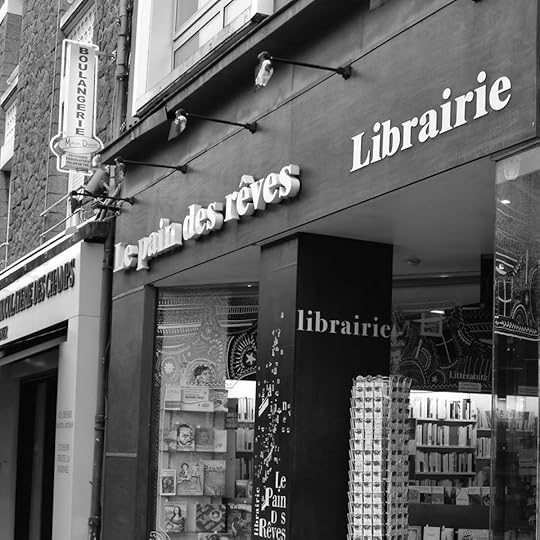
- Bookstore Le Pain des Rêves, Saint-Brieuc, Brittany
In a span of a mere 500-ish pages, here is a manyfold, variegated book that heralds profound change in you.
Let us go to in Brittany and be spirited away, in the meandering streets of Saint-Brieuc. As you stroll in this maze of stone, looking for landmarks, your eye is caught by countless monuments on the local Breton writer Louis Guilloux. And so, you are naturally doomed to visit the namesake library... Le Pain des rêves, which is even more awesome as it is flanked by boulangeries on both sides! =D You can't possibly dream any better introduction to local French/Breton culture ;)
Now let's talk about the book! It is :
A study of the merry folk of Saint-Brieuc in the 19th century, with their funny minstrels, their lowlives, their uplip bourgeois, and how they interrelate with one another. As such, it is an incredibly rich book, a bildungsroman, a family tragedy, some sort of sentimental education, and a lively tapestry, a tribute to the surreal powers of imagination.
To me, this book is an irreductible item, a sort of rough garden, strewn with ruins, going back to wilderness, enclosing countless desire paths, rich with undisclosed possibilities.
The prose is sometimes clunky, perhaps due to faithfulness to the author's modest upbringing and his being straightforward, yet you can make out the frankness, the flesh and creaks of the real, and the story of a good many fancied lives. Mid-way, I preferred the narrator over the wordsmith, when I reached the last page, I would not sever those two characters, as undistinguishable as the lad with the young man, skillfully reconciled as you close the book to wander in Saint-Brieuc again.
Matching Soundtrack : Spring Song - Gryphon
------------------------------------------
Je viens de terminer ma première lecture du Pain des Rêves. Voilà un livre qui ne se ressemble pas d'un bout à l'autre. Ça a commencé avec des effets d'annonce par les rues du vieux Saint-Brieuc, ça s'est prolongé dans le nom biscornu d'une librairie flanquée de deux boulangeries, qui avait son nom en partage avec ce livre. Le Pain des Rêves.
Tour à tour reconstitution quasi-ethnographique du petit peuple de Saint-Brieuc avec ses échansons bouffons, ses épaves humaines et ses bourgeois, récit initiatique, drame familial, éducation sentimentale, illustration vivante des pouvoirs surréalistes de l'imaginaire.
Pour moi, le livre ressort comme un objet irréductible, changeant, moiré de potentiels inexplorés. Et, dans un verbe qui me paraît parfois rétif, j'aperçois la sincérité, le charnu et les bosselures du vrai, et le récit d'une multitude de vécus imaginés. Si j'avais dû en juger en cours de route, je n'apprécie pas tant le prosateur que le conteur, mais arrivé en dernière page, je n'irais plus distinguer ces deux personnages, aussi indissociables que le garçonnet et le jeune homme, adroitement accointés en fin de livre.