

What do you think?
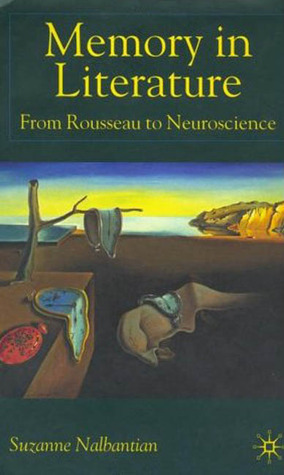
Memory in Literature: From Rousseau to Neuroscience
This book is the first to discover and probe in depth memory phenomena captured in literary works. Using literature as a laboratory for the workings of the mind, this comparative study of writers from Jean-Jacques Rousseau to Octavio Paz, including Proust, Breton, Woolf and Faulkner, uncovers valuable material for the classification of the memory process. Nalbantian's daring interdisciplinary work, involving literature, science, and art, forges a new model for dialogue between the disciplines.
195 pages, Hardcover
First published January 1, 2003
About the author
Suzanne Nalbantian
11 books3 followersSuzanne Nalbantian is Professor of English and Comparative Literature at Long Island University and an interdisciplinary scholar in the humanities and neuroscience. She holds the BA from Barnard College (’71) and the PhD from Columbia University (’75), and she is a permanent member of Columbia University’s Society of Fellows in the Humanities. At LIU, she has been the winner of the TASA Award for Lifetime Scholarly Achievement and the David Newton Award for Excellence in Teaching. Dr. Nalbantian is the author of four scholarly books and two edited volumes. She is the principal editor of The Memory Process: Neuroscientific and Humanistic Perspectives (MIT Press 2010). Her pioneering book Memory in Literature: From Rousseau to Neuroscience (Palgrave 2003) forged new pathways linking literary memory studies to neuroscience. She has lectured nationally and internationally on the interdisciplinary study of memory and has directed several conferences on that topic. Since 2012, she has been the Chair of the International Comparative Literature Association Research Committee on Literature and Neuroscience.
Ratings & Reviews
Friends & Following
Create a free account to discover what your friends think of this book!
Community Reviews
Displaying 1 - 3 of 3 reviews

November 29, 2016
List of Plates
Acknowledgements
Note on the Text
Introduction
1. Memory in the Era of Dynamic Psychology: Nineteenth-Century Backgrounds
2. Rousseau and the Romantics: Autobiographical Memory and Emotion
3. Baudelaire, Rimbauld, and Le Cerveau: Sensory Pathways to Memory
4. Proust and the Engram: The Trigger of the Senses
5. Woolf, Joyce and Faulkner: Associative Memory
6. Apollinaire, Breton, and the Surrealists: Automatism and Aleatory Memory
7. Nin, Borges and Paz: Labyrinthine Passageways of Mind and Language
8. The Almond and the Seahorse: Neuroscientific Queries
9. Afterword: Images of the Artists: Dali, Dominguez and Magritte
Bibliography
Index
Acknowledgements
Note on the Text
Introduction
1. Memory in the Era of Dynamic Psychology: Nineteenth-Century Backgrounds
2. Rousseau and the Romantics: Autobiographical Memory and Emotion
3. Baudelaire, Rimbauld, and Le Cerveau: Sensory Pathways to Memory
4. Proust and the Engram: The Trigger of the Senses
5. Woolf, Joyce and Faulkner: Associative Memory
6. Apollinaire, Breton, and the Surrealists: Automatism and Aleatory Memory
7. Nin, Borges and Paz: Labyrinthine Passageways of Mind and Language
8. The Almond and the Seahorse: Neuroscientific Queries
9. Afterword: Images of the Artists: Dali, Dominguez and Magritte
Bibliography
Index

June 1, 2017
En rigtig god kilde ifb. med et semesterfag på engelskstudiet.
- Brugt på universitetet (engelsk)
- Brugt på universitetet (engelsk)

Read
November 29, 2017Chapters:
1. Memory in the Era of Dynamic Psychology: Nineteenth-Century Backgrounds
2. Rousseau and the Romantics: Autobiographical Memory and Emotion
3. Baudelaire, Rimbauld, and Le Cerveau: Sensory Pathways to Memory
4. Proust and the Engram: The Trigger of the Senses
5. Woolf, Joyce and Faulkner: Associative Memory
6. Apollinaire, Breton, and the Surrealists: Automatism and Aleatory Memory
7. Nin, Borges and Paz: Labyrinthine Passageways of Mind and Language
8. The Almond and the Seahorse: Neuroscientific Queries
9. Afterword: Images of the Artists: Dali, Dominguez and Mag
1. Memory in the Era of Dynamic Psychology: Nineteenth-Century Backgrounds
2. Rousseau and the Romantics: Autobiographical Memory and Emotion
3. Baudelaire, Rimbauld, and Le Cerveau: Sensory Pathways to Memory
4. Proust and the Engram: The Trigger of the Senses
5. Woolf, Joyce and Faulkner: Associative Memory
6. Apollinaire, Breton, and the Surrealists: Automatism and Aleatory Memory
7. Nin, Borges and Paz: Labyrinthine Passageways of Mind and Language
8. The Almond and the Seahorse: Neuroscientific Queries
9. Afterword: Images of the Artists: Dali, Dominguez and Mag
Displaying 1 - 3 of 3 reviews