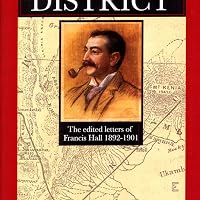
Francis Hall's letters are among the earliest colonial records of daily life in British East Africa. In 1892 he commanded Fort Smith in the days before the Uganda railway was built and before Nairobi existed. His orders were to keep the peace between the Kikuyu and the Maasai, to build 150 miles of road, and to re-supply caravans between the coast and Uganda. It was a lonely, hard life in difficult conditions and everyday was an adventure. Supplies were carried by porters from Mombasa, a thirty day march. He was gored by a rhino and mauled by a leopard which he strangled with his rifle, and survived bush surgery and frequent bouts of fever. He made friends with Kikuyu and Maasai chiefs and earned their trust, affection and respect.While on convalescent leave in England he met and later married Beatrice Russell, a colleague's sister, and they walked from the coast to set up house together in Fort Smith. As the railway line from Mombasa inched closer, so the early European settlers started to arrive. But the railway changed everything, and when Nairobi suddenly appeared on their doorstep in 1900, Fort Smith became redundant. The colonial government moved the Halls to Machakos and then to Mbirri in the heart of Kikuyuland to establish a new fort. Six months later Francis Hall was dead from blackwater fever at the age of 40. Mbirri was renamed Fort Hall in his memory and today the town is called Muranga.Kikuyu District is a fascinating account of the life of an early English administrator and settler. It is part adventure story, part love story, part historical document and a true story.
Paul Sullivan was born in Trenton, New Jersey, but he says: “I spent the best years of my boyhood in Tennessee. My father and I did a lot of hunting and fishing and traveling through the South. Those years, until I was about fourteen, were very free years. We camped by lakes or rivers, or went off to see what was over the next mountain. My father had a great love of travel, learning, and books, and I took them away with me. The greatest gift he gave me was a library card. I learned about Hemingway and Jack London. And today my own books are in that same town library.”
In the 1980s he traveled: to South America, Central America, Europe, Africa, and the Arctic. “I kept notes and I wrote and found Royal Fireworks Press who thought my work good enough to print. They have published six of my novels, with two more novels and a book of short stories in the pipeline.”
Paul Sullivan bases his stories and novels on places he has been, things he has seen and learned. “I try to give them some value and write books that can be read from age eight to eighty and still be enjoyed. The greatest compliment a person often gives me after reading one of my books is simply, ‘I never saw it that way,’or, ‘I learned something.’”
Astute and entertaining letters written by Francis Hall during his station in Kikuyu in the late 1800s. The letters--addressed to his father--give an account of the life of one of the first Europeans to live within the Nairobi environs.
Posted at Fort Smith, Kabete as an administrator first for the Imperial British East Africa Company then the East Africa Protectorate, Hall was for some years the only European living permanently in Kikuyu. From his post he supplied food, labour and security for European expeditions to Uganda and for the groups charting and building the infamous Kenya-Uganda Railway. The food supplies were procured from crops grown at Fort Smith, through trade with Kikuyu and sometime by deadly raids and plunder of Kikuyu villages.
Hall's letters are about his work, adventures and hopes for the future. The letters don't reveal much about the life of the Kikuyu people. Hall makes casual remarks and observations about the Kikuyu, Kamba and Masai as he narrates his adventures and challenges. This book is not an anthropological account of Kikuyu life in the late 19th century but about the life of a hard working, adventurous British administrator.
Hall is oblivious to how his presence and that of the British government invade and disrupt the lives of local inhabitants. Although Hall has little regard for the indigenous people, the letters show him develop into an able administrator and arbitrator. His organization skills are remarkable as he 'convenes' teams of 300 and up to 1,000 men to carry food, supplies and guns for expeditions.
Its a book worth reading for the careful details, the names and descriptions of the area and the people that came through Fort Smith and for the gallant adventures Hall lived through.
This bookcase an misery history into the origins of Kenya as a country. Through Francis Hall's eyes we walk through history and are given a front row seat into the hi!ble beginnings of this great nation. Through his adventures, we saw the human side of a man and a pioneer.
Val molt la pena per entendre com funcionava el colonialisme anglès, la relació amb els autòctons i la col·laboració entre empresa i estat per ocupar àfrica
A collection of letters written by Francis Hall - the British administrator working in the 1890's in British East Africa (modern Kenya) - to his parents back home in Great Britain.
The letters paint a vivid portrait of a colony rapidly changing. Hall's early letters paint a picture of a colony just beginning. As the years pass and the Uganda railway slowly snakes its way upcountry the letters turn to subjects such as the increasing influx of British settlers, missionaries, the largely subjugated Kenyas ("pacified"), visiting big game hunters, etc.
Hall, sadly, died young leaving behind a wife (who makes an appearance mid-way through the letters).
The racism casually displayed in the letters are hard to read. Hall's love for the country (especially Kikuyu and the highlands) clearly shine through. In his strange, Victorian way, he ends up respecting the locals too and disdains the effete desk-bound ("ink slinging", he calls it) administrators in far away Mombasa and London.
This is great book, a compilation of incredible letters written in a time when Africa was mostly unexplored by white men. And that was only a little over a hundred years ago.