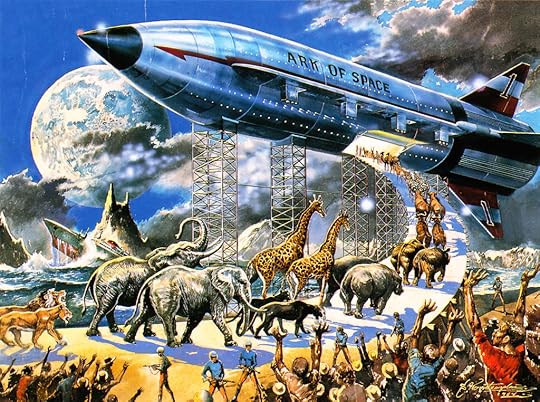
David Lavery argues persuasively that those intrigued by the challenge of perfecting a world ruled solely by human artifice are increasingly committed to abandoning the Earth. Writers ranging from physicists to rock stars salt their works with references—which Lavery calls "evolutionary Freudian slips"—revealing genuine "extraterrestrial urges." Because metaphors of space are now ubiquitous, Lavery rejects C. P. Snow’s dichotomy separating science from the humanities; the true split now is between Earthkind and Spacekind.
Firmly committing himself to the Earth—humanity’s last link to nature—Lavery notes that "for those who now insist upon the necessity and calculate the means of escape from this planet, the Earth itself is often left out of the equation." Those who are "late for the sky," those who with "infinite presumption" have "persuaded themselves (and seek to convince us all) that human longing for the stars is not a betrayal of human destiny but in reality its apotheosis; their conviction that the species has been given a cosmic mandate to inseminate the universe with the human…all testify to minds seldom any longer on the Earth."
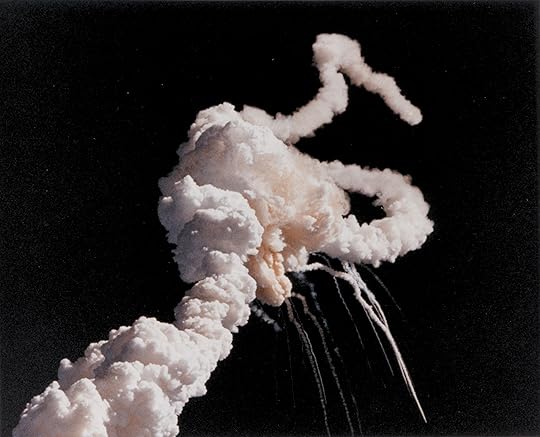
A deeply moving meditation on mankind's desire to escape a planet we have left in ruins, Lavery's Late for the Sky feels contemporary despite being published in 1992. The continued popular fascination with NASA's "discoveries" and the growth of companies like SpaceX prove that the compulsion towards the "extraterrestrial imperative," our new Manifest Destiny, has not waned. Even after the Challenger disaster exposed the hubris of space exploration, humans are still obsessed with leaving earth. Of course given the state of our world, this should be no surprise.
What lies at the root of this foolishness? A fear of the end of humanity. The disgust of the earthly, filthy, decaying bodies we inhabit, and the dread that unless we disperse like spores throughout the cosmos we will return to the Earth and it will be as if we never existed. It is ultimately a fear of death that keeps people longing to flee, and the desire to be something even bigger than divinity itself. Something that will reach throughout the vastness and incomprehensibility of the universe.
Without optimism or certainty and acknowledging the nothingness that came before and will exist long after we are gone, Laverly encourages us to retreat from outer space and return to inner space, back into our earthly existence.