The novel has an intriguing gentleness, with a dog's eye view of the world. Pondering on the nature of power, Archimedes begins with a political view point & grievance, insisting dogs are people too. With rights. But the fragmentation of their society leaves them powerless in the human tyranny. He conceives language and knowledge as political implements, the fulcrum and lever to move the world. Archimedes' perceptions shift and change through the novel as it traces his political ideals, his philosophical questioning, his troubled awareness of langauge as bot hliberating and imprisoning conscience and above all, his generous and innocent delight in the kaleidoscopic world around him in Ireland's familiar Sydney streets.
David Ireland was born in Lakemba in New South Wales in 1927.
Before taking up full-time writing in 1973 he undertook the classic writer's apprenticeship by working in a variety of jobs ranging from greenkeeper to an extended period in an oil refinery.
This latter job provided the inspiration for his second (and best-known) novel, The Unknown Industrial Prisoner, which brought him recognition in the early 1970s and which is still considered by many critics to be one of best and most original Australian novels of the period.
He is one of only four Australian writers to win the Miles Franklin Award more than twice
He was appointed a Member of the Order of Australia in the Queen's Birthday Honours of June 1981.
In this book we get the thoughts of a Red Setter called Archimedes.
I say that his name is Archimedes but as Archimedes himself writes “My name is Harrison B Guest. ‘Happy for short’” His human family, or employers as Archimedes explains early in the book, call him various names with the initial birth name being Spangler Red Brian Boru. “Other aliases I have, courtesy of human superiority are Blue (because I am red) Dog, Mr Dogg, Towser, Buster, Red, Here Boy, Hey You and Hey Mong”.
Archimedes has learnt to also understand what not only humans say but other animals. Archimedes can read. Archimedes is very articulate and can explain things to us human reader’s about dog thinking in a very human way. Archimedes explains the way dogs smell us for example. The reality is that we stink. We humans are repulsive to dogs. Not as in the way we physically smell but in the way we smell of things as unedifying as death and desperation. Archimedes can smell our loneliness, defeat, fear but then also our joy. Even our criminality. Archimedes notices that things pray on man’s minds, money issues for example. He notices when we are unwell. He sometimes tries to let us know but we never quite get that. He is good at observing us and is interested in everything. Archimedes says that if anyone can tell him of anything that is not interesting he would be “…..interested to see it”
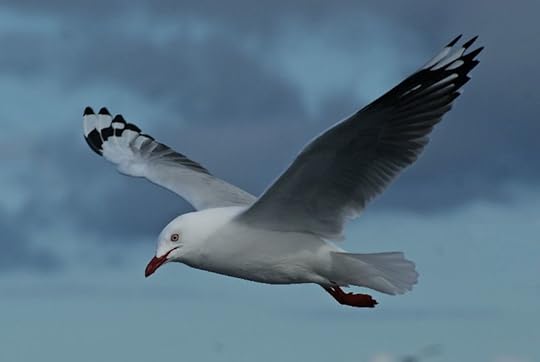
Archimedes watches Seagulls. He watches a protest one day. Gay seagulls are protesting about the “discriminating practises by heterosexual Gulls” As they protest Archimedes asks a profound question as to why they walk when they can fly.
Archimedes observes that he is one of The Fortunate Few. He writes that many dogs lose employment. With that their employers either take them a long way away and dump them or at worst take them to a concentration camp where they get a needle and then are incinerated. All that for just losing their jobs.
Archimedes observes two dogs fighting over territory. Apparently one had once been into “oblivion” but he heard a cat explain that after death there was a beautiful place where there was peace. Now said dog did nothing but fight. Archimedes profoundly observed that perhaps he fought “…to counter the threat of endless peace….”
Archimedes observes human debt. The fact that humans don’t have any money but are out to buy the world. In Archimedes opinion “…..the taker of credit is a thief of the future, and the giver of credit aids and abets the theft.”
Archimedes comments on democracy in Australia. He thinks that lies come from the government, press, business, educationalists, and are left lying around. He thinks that the spirit of Australia is the people. Though “not in the land they squat on”. The spirit of the land he thinks will stay a secret forever.
Archimedes see a Gulls wedding. He hears them chatter and finds that the groom is a member of the fire watch and that the bride a food researcher. Interestingly the couple’s parents are conservationists who “…..work to save the customs and the attitudes of the past….”
Archimedes wonders why humans think the way they do. He heard a beautiful bird song one day and jumped about to bring it to the attention of his family, they thought he wanted to eat the bird. He was almost annoyed at their presumption.
But in the end Archimedes is satisfied with his lot in life. He is happy in that kindness is “the foundation” of his religious beliefs and he finds kindness most temperate and fair. He has passed through all the stages of a dog’s life. And he has written a book! What more can he want!
We have a novel in similar structures of style from the past that David Ireland has written, the standard short, sharp essay like chapters. But the tone of his writing has changed considerably. Interestingly the most positive of his past books was for me The Glass Canoe but this one outshines that as it just glows with a future that is positive. David Ireland delivers Archimedes happy with his lot in life, able to observe human inanity and foibles but able to shrug them all off. Ireland writes with a wittiness beyond his usual dark satire and irony. The book ends on a hopeful note.
Does it work? To a degree but its whimsiness just leaves it short of being very good. Plus the themes of the past appear periodically and that in itself leaves it a little too close to being ‘more of the same’. But I would recommend it. Those that like light fantasy and dogs should enjoy Archimedes and the Seagle. Plus the joke about a dog called Dogenes is worth the entrance fee alone. At 228 pages easy to read. A sunny afternoon book.
A good contemplative, dreamlike read. Some of the seagull bits made me chuckle which is rare for a novel. Ireland paints such a lovely picture of Sydney it makes the reader dream of visiting, just to see it through Archimedes' eyes.