

What do you think?

Korean Folk Tales for Children #9
The Faithful Daughter Shim Ch'ong /The Little Frog Who Never Listened (Korean Folk Tales for Children, Vol 9)
Two folktales are included in this single volume. Shim Ch'ong, out of her love for her blind father, works endlessly to buy the medicine that could make him see again. She finally meets the Dragon King who helps her. In the second story, a little frog, who never listens to his mother, regrets it after she dies. The story explains the reason why frogs croak at the riverside. Vol. 9 of the 10-volume Korean Folktales for Children
- GenresFolk Tales
43 pages, Hardcover
First published January 1, 1990
Ratings & Reviews
Friends & Following
Create a free account to discover what your friends think of this book!
Community Reviews
Displaying 1 - 4 of 4 reviews

April 4, 2021
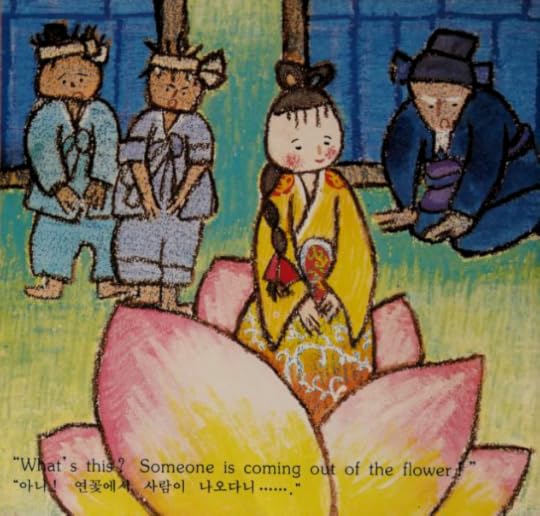
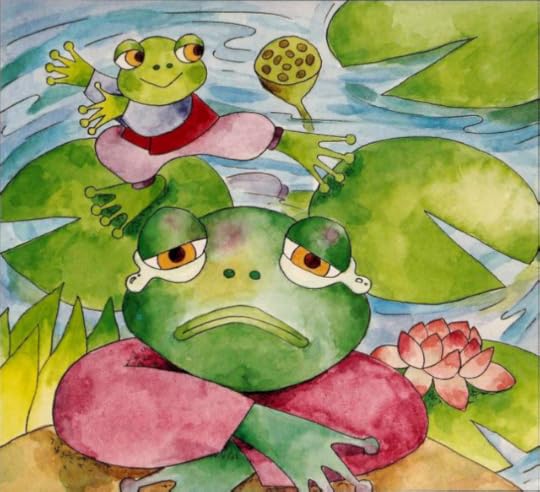
There are two traditional Korean folk tales in this bilingual Korean-English book, both of them dealing with parent-child relationships. In the first, a daughter makes the ultimate sacrifice for her blind father; in the second, a disobedient frog sends his mother to an early grave and then regrets his behavior. The story also explains why frogs come out and croak after it rains. Neither story was particularly compelling, but they pair well to urge children to be good and to show love to their parents (before it’s too late). Apparently, Korean parents call their children “green frogs” when they act up. Each story had a different illustration style.
I appreciated the comment that a Korean reviewer made in her review, saying that the idea of a kingdom under the ocean is common in Korean folk tales (I’ve noticed it) but perhaps an unfamiliar one for American children, for whom the idea of a kingdom in heaven is more typical.
I appreciated the comment that a Korean reviewer made in her review, saying that the idea of a kingdom under the ocean is common in Korean folk tales (I’ve noticed it) but perhaps an unfamiliar one for American children, for whom the idea of a kingdom in heaven is more typical.

March 20, 2017
Two Korean folktales told in English and Korean. "The Faithful Daughter Sim Cheong" is about the kind, hardworking daughter of a blind man. When her father pledges to donate an impossible amount of rice to the temple to regain his sight, his daughter finds a way to make him a man of his word even though it may mean her own death. "The Little Frog Who Never Listened" is about a contrary little frog who always does the opposite of what his mother tells him, until she dies and he learns his lesson too late.
I liked the first story for the devotion and sacrificial love of Sim Cheong, which is rewarded by the Dragon King and ends happily even though it could have been a very tragic story. The second is more of a cautionary tale/explanation of a natural phenomenon (why frogs croak during rain). I didn't like it quite as much. The first story is illustrated in oil pastels, a style that grew on me as the story went on. The second is illustrated in watercolors and ink in a cartoonish style. I was actually surprised to find two grammatical errors in the English in this book. I haven't found errors in any of the other books in this series, and this is the 2nd printing of the 2nd edition, you'd have thought they'd have caught those two missing words by now.
I liked the first story for the devotion and sacrificial love of Sim Cheong, which is rewarded by the Dragon King and ends happily even though it could have been a very tragic story. The second is more of a cautionary tale/explanation of a natural phenomenon (why frogs croak during rain). I didn't like it quite as much. The first story is illustrated in oil pastels, a style that grew on me as the story went on. The second is illustrated in watercolors and ink in a cartoonish style. I was actually surprised to find two grammatical errors in the English in this book. I haven't found errors in any of the other books in this series, and this is the 2nd printing of the 2nd edition, you'd have thought they'd have caught those two missing words by now.
July 30, 2025
Read as part of research into children book versions of the Tale of Shim Ch’ong. Bilingual book part of extensive translation of Korean stories for children. Simple illustrations.
March 3, 2015
Personal Reaction - I have not heard about this book before taking this course. This story became my favorite. There is a daughter whose father is blind and to save his life. Her father needed to borrow foods and living things but at the end, he could not repay them. Instead of those stuffs, his daughter was sold and she had to die by drowning. However, the king of the ocean saved her life and his son, the prince, married to the girl. After getting married, they went to her home, the father restored his eyesight and they lived happily together. This is beautiful story. Although the setting is very typical, the theme is very impressive. Unlike to other stories which usually indicate parents' love, it shows a daughter's devotion to her father. It made me look back upon myself.
Purposes-
Read aloud to third graders of elementary school for several potential purposes:
- Children usually learn about their parents' love from books, movies, etc. However, they don't have many chances to learn how they should love their parents. This story will teach them about it.
- This story might be unfamiliar to American children because of its different culture. In Korea, people give weight to good manners especially toward older people. Thus, we have put specific ending words when we talk to older people. This would teach new language styles to American students.
- It might be very new concept for American children that there is a kingdom under the ocean. It is very common in Korean folktales. Based on christian culture, American children are more exposed to kingdom in heaven. Thus, this story will help them expand their range of imagination.
Purposes-
Read aloud to third graders of elementary school for several potential purposes:
- Children usually learn about their parents' love from books, movies, etc. However, they don't have many chances to learn how they should love their parents. This story will teach them about it.
- This story might be unfamiliar to American children because of its different culture. In Korea, people give weight to good manners especially toward older people. Thus, we have put specific ending words when we talk to older people. This would teach new language styles to American students.
- It might be very new concept for American children that there is a kingdom under the ocean. It is very common in Korean folktales. Based on christian culture, American children are more exposed to kingdom in heaven. Thus, this story will help them expand their range of imagination.
Displaying 1 - 4 of 4 reviews