But I am jumping ahead in the chronological order I imposed on the telling of this story, so I shall make amends by saying that in April 1914 Klee made a thirteen-day visit to Tunis which was to have a great impact on his art. The journey was made with two friends of his, the Swiss Louis Moilliet and the German August Macke, whom he had met in "Der Blaue Reiter." A pharmacist from Bern called Bornand covered Klee's traveling expenses, while the three artists' stay was financed by Jägi, a doctor from Bern who lived in the residential area of Saint Germain in the Tunisian capital. On this trip Klee was enraptured by the light, and he wrote in his diary:
The color has seized hold of me. I do not need to take it. It has taken me forever, I know. This is the meaning of this happy hour; color and I are as one. I am a painter."
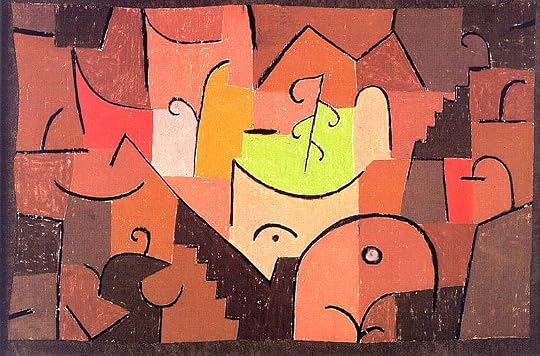
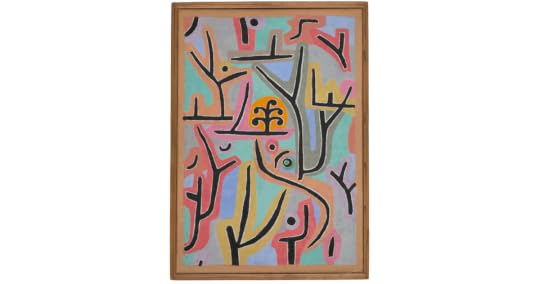
"The paintings from his final period, begun in 1936 and largely unfinished due to the death of the artist, differ substantially from his previous work. He used bright, ungraded colors and heavy strokes—generally in black—which plough through the composition. The art of Paul Klee is deliberately brutal. It could be said that the painter wished to reflect the unease he felt about his illness, which he knew to be incurable, and his anxiety about the political situation in his beloved Germany and the approaching world catastrophe he foresaw."
Stage Landscape. 1937. Pastel on cotton cloth mounted on burlap.
Park near Lu[cerne]. 1938. Oil on newspaper mounted on burlap,
Beautiful monograph in colors of 116 paintings of Klee. Easy to navigate, no reproduction cut in the middle of the book. The weakness of this study is the 20-page text accompanying it. The text is scattered and badly translated. It's merely a chronological biography without much structure or transition. The final page serves as a grandiloquent interpretation of Klee's work, with no real accuracy or analysis.
My favorites are:
- Polyphonically Enclosed White, 1930 - Pyramid, 1930 - Phantoms' oath, 1930 - Mask of fear, 1932 - Small Town among the Rocks, 1932 - Death and Fire, 1940