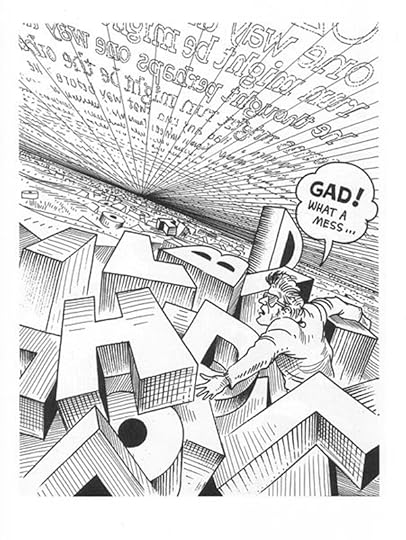
John Riddell's first published story appeared in 1963 and his work has continued to appear ever since in little magazines like Kontakte, Ganglia, Descant, NBR Showcase and grOnk. An early associate of Ganglia magazine, he later became a contibuting editor of grOnk and then, in 1975, co-founded, with Richard Truhlar, Phenomenon Press. He has had visual work in exhibition in Europe and Canada and was included in the first Canadian anthology of concrete poetry, The Cosmic Chef. Criss-Cross is his first collection of stories, a long-over-due debut by one of our most striking new fictioneers.
How utterly weird. The strangest aspect of this book is the tension between the final story The Ramp, and the rest of the book. The Ramp is a beautiful piece of poignant science fiction which reframes society's creation of religion, the Adam and Eve myth and politics, among other things, all driven by an anti-hero who finds himself on a vacant odyssey. I certainly did not expect such a story to be part of this collection. I didn't expect it because, while the rest of the book is, at times, intriguing as an exhibition of form, mainly exploring the visual, the subject matter of the pieces is not particularly engaging - pre Ramp, the value of the works is focused in the various forms. They are cerebral, and sometimes a laugh, and sometimes downright boring. But, what struck me as the failure of the book was the ultimate success of The Ramp. Riddell states that "traditional and avant garde literature have each virtually polarized around what [he] call[s] two dogmas of literality" and that "a synthesis may not be desired / is certainly not effected by displaying both schools under the same roof" but that "still when brot together the prospect of marriage does not seem as remote as may have been supposed". Yes, he states that a synthesis is not effected, in so many words, even in his own book, and in fact, the contrast between The Ramp and the remaining contents of Criss Cross is so extreme that there arises the feeling of a performative argument, mainly, traditionalism against the avant garde. Traditionalism wins, no doubt in this reader's mind. Had The Ramp been left out of the book, Criss Cross would have retained at least a formalistic coherence. Everybody knows how a traditional short story, generally, reads, and can predict its (usually) linear form. It must have been inserted for its force, despite its glaring inconsistency with the rest of the book. That it is the most powerful piece in the book has one draw certain conclusions (conclusions which, I happen to disagree with) about the avant garde.