1. I got it for next to nothing because it was over a year since the exhibition. For some reason, bargain buying always triples the enjoyment I get out of any book.
2. That exhibition was pretty fucking great. It was a selection of works from the Guggenheim Collection borrowed from the various galleries around the world (needless to say, I have never even been in the same country as any of them). I was quite upset the day I went to see it, but as I started to walk around I felt my spirits lift in a most irritatingly clichéd way. And it was so amazing because everything I'd read about, everything I'd dreamed about one day maybe seeing and being enthralled by, was right there, in front of me. In Melbourne! Somehow, seeing the real object has so much more of an impact than seeing a picture or reading about it. I still can't believe that I saw it all, that it was all there in front of me. It seems like too much luck for one short life. I don't understand what I did to deserve something so good.
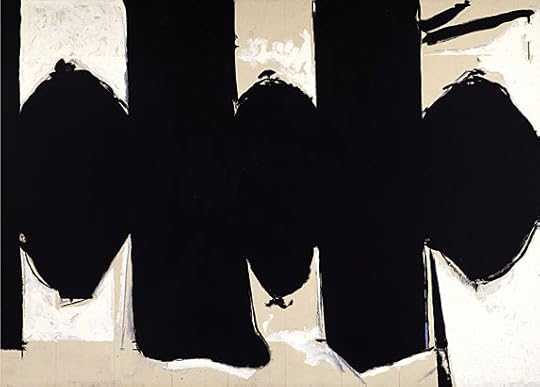
3. It is full of shiny, pretty pictures. Here is one of my favourites:
Robert Motherwell, Elegy to the Spanish Republic No. 110
I'd never heard of this artist (I don't know much about art) but standing in front of this painting was to experience raw emotion, much more vivid than any of the pale impersonations my life has occasionally presented to me. I remember being very much not sold on abstract expressionism in year 9 visual art, when I wrote in my sketchbook that I hated Rothko because what he did was crap (or something equally eloquent and pithy - I had a bit of anger). After a while I eventually came around to appreciating the theory, but still thought that the practice, like (I thought) much of modern art, never quite lived up to it. But no! Abstract expressionism is genius, and I challenge anyone to prove otherwise!
4. It has informative, helpful, highly readable information in it that helps to situate the work and the artist in context.
5. The informative, helpful, highly readable information occasionally breaks into some pleasingly far-fetched and ridiculous theories, which is the cause of much hilarity. About the above Motherwell painting, for example:
"The abstract motif common to most of the Elegies - an alternating pattern of bulbous shapes compressed between columnar forms - may be read as an indirect, open-ended reference to the experience of loss and the heroics of stoic resistance. The dialectical nature of life itself is expressed through the stark juxtaposition of black against white, which reverberates in the contrasting ovoid and rectilinear slab forms."
I mean really. "Dialectical nature of life"? Who do they think they're kidding? But what I really love about art is that you can start with a concept as vague and abstract as that, and you can make it even more vague and abstract by splashing some paint on a canvas and calling it art, but in the end it doesn't matter. You can call it whatever you want, you can take it as far away from your starting point as you need to do what you feel you need to do, and it's still ok. No matter how tenuous the connection, it's valid because of how you got there (maybe the process of creation is a fourth pole?). I don't think I'm being at all coherent here, but it's truly the most profound and wonderful thing: even though when you read something like that it seems completely stupid and even worse than the most ridiculous and far-fetched literary criticism you've ever read, if like me you once stood in front of that painting and let yourself be immersed in everything that it was and everything that it stood for, you can understand it. The feeling is there, it's real. And almost two years later I can still remember it, as if I was standing there now.