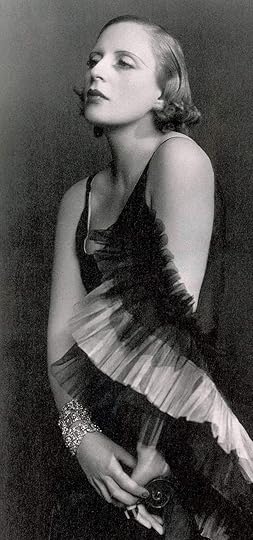
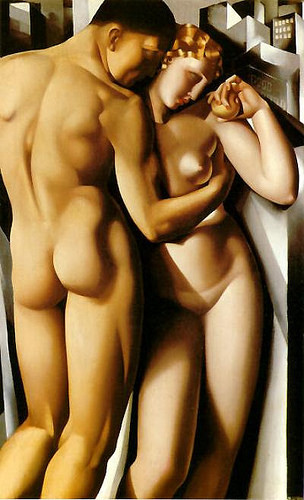
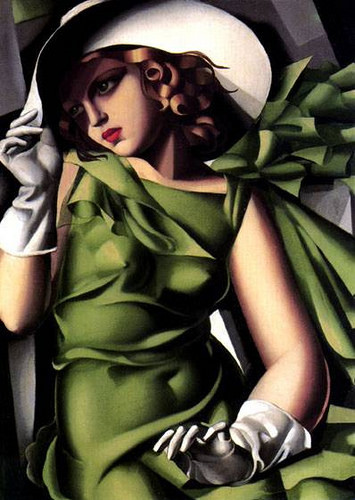
A femme fatale to equal Greta Garbo and Mae West, and a fashion icon in her own lifetime, this exhibition catalog is dedicated to the artist as well as the concept of the modern woman she represented. Born in 1898 in Warsaw, Lempicka fled during the Bolshevik Revolution, arriving in Paris in 1918 where she began painting under André Lhote. Influenced by a trip to Italy, she combined neo-cubism and Renaissance influences, reducing the harmony of her colors to the essential and tightly framing her portraits in order to give the figures energy and stature. In 1933 she married her best client, Baron Raoul Kuffner de Dioszegh, and in 1939 they left for America where Tamara conquered New York and Los Angeles exhibiting in important galleries.Divided into three sections, the book focuses on her distinctive artistic style, and on her fascination with the female form, which she glorified in paintings such as her famous Beautiful Rafaela, Portrait of a Young Girl in a Green Dress, and Portrait of Suzi Solidor. In the third section, author Emmanuel Bréon and the artist's granddaughter unveil the legend of Lempicka, illustrated with rare and sultry archival photographs of the artist. The appendixes include a detailed illustrated chronology and a catalog of works. The book's modern design reflects the Art Deco style and makes Tamara de Lempicka an attractive addition to the library of Lempicka and Art Deco fans.
Lempicka was quite the savvy woman! She could paint and mix well with the jazz age set of the 1920’s. She always knew how to market herself – her image and her paintings. She posed well for photographers. She lived the dazzling high-life.
She was an independent person and her art reflects this. The women in her paintings exude power and freedom. Perhaps, as some critics have observed, her paintings are too poster-like (and indeed have become part of the poster world). But what posters they are! They contain expressiveness and an upfront singularity.
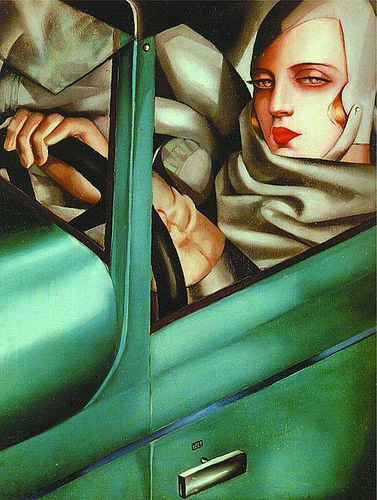
My Portrait 1929
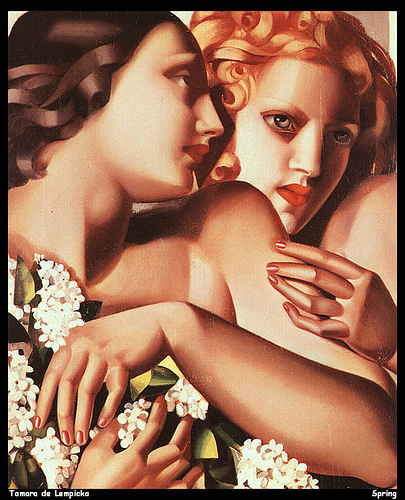
Spring, 1930
Page 72 (my book)
The mannerist painters abhorred empty space. Lempicka’s figures twist and writhe in order to express the dominant feelings of the piece with maximum intensity, while at the same time filling the tightly framed picture area to the point of overflowing.
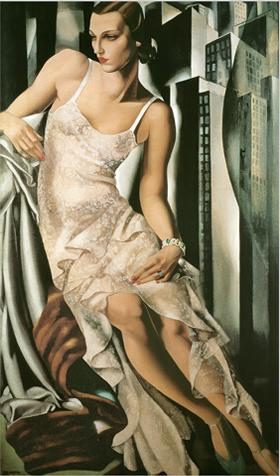
Portrait of Mrs. Alan Bott 1930
This book has several authors so lacks a unity of approach. I would have liked to know more of her children and grandchildren, as some are featured in her portraits.
Madonna (the pop star) used some reproductions of Limpicka’s works in her concert tours. There is a resemblance between the two – both knew (or know in the case of Madonna) how to spread the fame of celebrity. Both control their lives – they do the manipulating.