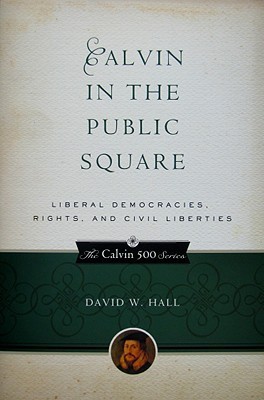
Hall seeks with this book to establish Calvin as the father of liberal democracies. The reason is two-fold. Calvin, following after Luther's thought, saw the government as limited in scope and under the purview of God and God's word. Thus, an assertion of divine right or unquestionable obedience to authority was ruled about by God's word. Hall puts a lot of work into not only explicating Calvin's political thought, but also the thought of contemporaries or near contemporaries as well as modern issues such as the concept of 'rights' in contradiction to equality and equity. Moreover, he gives attention to Puritans in America and how the founding fathers echoes and even explicitly connected their understanding of democracy to Calvin and his heirs. He then concludes the book by exploring Dutch Reformed heirs of Calvin, such as Abraham Kuyper, to show how they continue in the vain of Calvin.
It is undeniable that there was a dramatic shift with the Reformation regarding how political authority is conceived. Though, as Hall rightly notes, there were precedents in medieval times, the shift that took place during and after the Reformation was unprecedented. The greatest strength of this book is perhaps also its greatest weakness. Hall provides an intellectual history of liberal democracy, going back to Calvin but continuing into our modern era. This is an incredible strength and he marshals statements from various primary sources to substantiate his argument. However, as those who are familiar with American history are aware, the emergence of liberal democracy as we understand was not merely an intellectual history but was also shaped by various sociological, historical and even psychological factors. If one allows this book to be what it is, namely, an intellectual history, then Hall successful traces a thread from the Renaissance to late modernity. Was it a major thread? Arguably. What is the only thread? Certainly not. Thus, if one desires a fuller picture, other works need to be consulted such as the fantastic historical work of Gordon S. Wood, among others.
The tremendous impact of John Cavin in the realm of modern history must be considered and evaluated. David W. Hall is a presbyterian pastor who has deeper insight of Calvin's legacy. I can't hardly emphasize the importance of the permeation of Calvinism into our modern day lives. Free market system, freedom of religion, freedom or speech and so on... The religious contemplation through Scripture handed down toward secular area by John Calvin.
Excelente livro sobre como o pensamento de Calvino impactou ideais políticos modernos, principalmente no que diz respeito ao republicanismo, constitucionalismo e estado de Direito. É impossível entender a formação política moderna sem estudar Calvino e seus seguidores com profundidade!