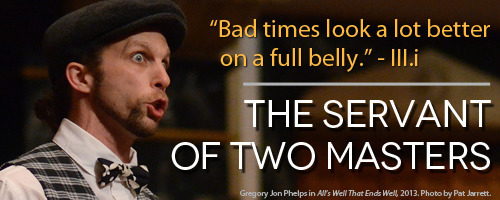
I’ve seen this staged in Italian in Milano, and in translation at Harvard’s American Repertory Theater, where for instance the Dottore was played like Chaplin, with clown shoes; where the masked Zanni trickster of commedia turns into the Servant Arlechino who’s more animalistic— his stage business includes eating from a body. Goldoni adapts the stock characters of commedia dell’arte: two old men, here Pantalone and Dottore; the Zanni Harlequin Truffaldino; the old men’s daughter and son in love, Clarice and Silvio (son of Dottore); another couple in love, and in disguise. Maids and porters who speak, maids who don’t.
While Shakespeare wrote of few bourgeois, a century later Goldoni shows the emerging bourgeois world. Director Giorgio Strehler says he also removed the commedia dell’ arte masks, finding equivalents in the society, so Harlequin becomes an actual servant, not one in the abstract, and Pantalone becomes not just a merchant, but one with a name and a family name, here de Bisognosi.* Pantalone here loses his commedia grumpiness (157).
The play begins with the Pantalone and Dottore sealing their daughter and son’s engagement, though Silvio calls Beatrice “mia cara sposa,” conventional “wife” for “amorosa,” lover. Couple of scenes later, Servant Truffaldino enters only to learn that his master in Turino has died; his master had been Pantalone’s agent. Here the dead man, Frederigo, shows up, earlier promised the daughter; we know Frederigo is his sister disguised as a man (shades of Shakepeare, like Rosalind/Ganymede); his sister's lover Florindo had killed the brother, but the sister, Beatrice, still loves him.
Great stage business throughout, before more added in the American Rep version; for instance, the Porter carries Florindo's trunk on his back, then Truffaldino helps by raising both the porter and the trunk onto his own back, but the Porter falls to the ground. Florindo pays for the Porter with two five coins; when asked for another, hegives him a kick (calcio). Five what you ask. Well each area made its own coins and in fact someone from Turin asks a gift of Venetian money because they didn't want to exchange theirs at the border (and lose value).
In scene XX, the disguised Beatrice reveals herself to Clarice as not the feared alternative suitor, but a woman. She's disguised to avoid detection as the sister of the killed seeking her lover, the killer.
Such drama descends in Act 11. 14, to discussion of mutton soup versus veal (castra o vedelo) and minestra vs. zuppa--for us, minestrone a soup. Truffaldino of course, delivers to the wrong one of his two masters, keeping some of the meatballs (polpette) for himself. He also delivers the money purse to the wrong intermediary.
In the last act, III, scene 6, the Turinese lovers who have fled their city to find the other in Venice, told by Truffaldino that their lover has died (to clear up his theft of their trunks [bauli]), arrive onstage with knives to kill themselves. Back to back they faced each other, then turning they recognize, asking "Siete in vita?" You're alive?
Six more scenes take us to the end, which I leave it to readers to discover.
Pantalone, a dynamic part, speaks strong Venetian dialect, but that does not suggest lower class. Consider tht Sir Walter Ralegh's broad Devonshire at Queen Elizabeth's court did not mark him out as a parvenu, any more than king James I's strong Scots accent was a sign of lack of culture. (Allardyce Nicoll, The World of Harlequin, Cambridge, 1963) The varieties of speech enhanced the play and gave regional qualities to characters: Pantalone, Venetian (international traders); Zanni, Bergamesc tricksters; the Pedant Bolognese or Sicilian; the Captain, Neapolitan, etc.
Goldoni’s plays are Venetian, and this one in Venetian dialect, with z for gi, as in “zenero” for son in law, z for ch as in “xe”, and d for t, s for ci as in “disi,” I said. His Memorie recount being chased from Venice during the Austrian war, to Rimini (run by Spain, as was Napoli) and finally to Pisa, where the Arcadi Alfea poetry assembly met near the Castello, sat in a circle in the “giardino” or yard. They invited him to sit, though not from Pisa. He listened and heard “del buono e del cattivo,” though he applauded both equally. Asking whether though foreign he could say a poem, they announced his request and the group consented. He had by memory a sonnet he’d composed when young for a like occasion. He changed a few words referencing locale, and recited his lines “con duel tone e quelle inflessioni di voce che mettono in relieve i sentiment e la rime” (48). His skills as actor and director make his assessment of his own speaking revelatory. He says, “It appeared improvised, and was greatly applauded. (I had a similar experience a couple times, once at my town poetry reading I sponsored, “Poetry from Memory,” and once a month ago when my play-reading group (from printed page) included my reading my own poems I had memorized.
*Director Giorgio Strehler’s note links Goldoni and Brecht as turning points in the history of theater.