Experience the entire history of Triumph sports cars in this comprehensive volume featuring stunning studio photography, rare archival images, and period advertising.
Triumph Cars chronicles the company and its remarkable vehicles, from the first 10/20 through a string of automobiles sought after by collectors, from the early Supers and Glorias through the entire TR and Spitfire ranges , and on to the legendary GT6 and the latter-day 1300, 1500, and Dolomite sedans —filled with images, history, and in-depth analyses of players, tech, and styling.
With roots extending to a London bicycle importer established in 1885, Triumph built its first car in 1923 : the Triumph 10/20. By 1930, the Triumph Cycle Co. had become Triumph Motor Company and was on its way to establishing seven decades of automotive heritage.
Author Ross Alkureishi showcases how company visionaries developed the brand —and how the brand changed hands —in the trying economic times of the 1930s and during the war years. The Standard years beginning in 1944 are also examined, along with associations with Jaguar and the range of roadsters and saloons developed, arguably peaking with the introduction of the TR2 sports car in 1953.
Alkureishi proceeds through the stylish 1950s cars and on to the Leyland years beginning in 1960 , and associated engine and styling developments. The story ends with the last Triumph model, the Acclaim introduced in 1981 , and the marque’s subsequent mothballing. Along the way, Alkureishi also highlights Triumph motorsport exploits , particularly in the realm of rally cars.
From the 1923 steel-paneled 10/20 through a range of roadsters, saloons, and sports cars, Triumph Cars offers a definitive review of an iconic British marque. The book is illustrated with hundreds of historic, contemporary, and racing photographs , as well as detailed text . This is the one volume no sports car enthusiast can be without.
The Publisher Says: Triumph Cars is a comprehensive, gorgeously illustrated history of the Triumph sports cars sought by today’s collectors and admired by automotive enthusiasts.
Experience the entire history of Triumph sports cars in this comprehensive volume featuring stunning studio photography, rare archival images, and period advertising.
Triumph Cars chronicles the company and its remarkable vehicles, from the first 10/20 through a string of automobiles sought after by collectors, from the early Supers and Glorias through the entire TR and Spitfire ranges, and on to the legendary GT6 and the latter-day 1300, 1500, and Dolomite sedans—filled with images, history, and in-depth analyses of players, tech, and styling.
With roots extending to a London bicycle importer established in 1885, Triumph built its first car in 1923: the Triumph 10/20. By 1930, the Triumph Cycle Co. had become Triumph Motor Company and was on its way to establishing seven decades of automotive heritage.
Author Ross Alkureishi showcases how company visionaries developed the brand—and how the brand changed hands—in the trying economic times of the 1930s and during the war years. The Standard years beginning in 1944 are also examined, along with associations with Jaguar and the range of roadsters and saloons developed, arguably peaking with the introduction of the TR2 sports car in 1953.
Alkureishi proceeds through the stylish 1950s cars and on to the Leyland years beginning in 1960, and associated engine and styling developments. The story ends with the last Triumph model, the Acclaim introduced in 1981, and the marque’s subsequent mothballing. Along the way, Alkureishi also highlights Triumph motorsport exploits, particularly in the realm of rally cars.
From the 1923 steel-paneled 10/20 through a range of roadsters, saloons, and sports cars, Triumph Cars offers a definitive review of an iconic British marque. The book is illustrated with hundreds of historic, contemporary, and racing photographs, as well as detailed text. This is the one volume no sports car enthusiast can be without.
I RECEIVED A DRC FROM THE PUBLISHER VIA EDELWEISS+. THANK YOU.
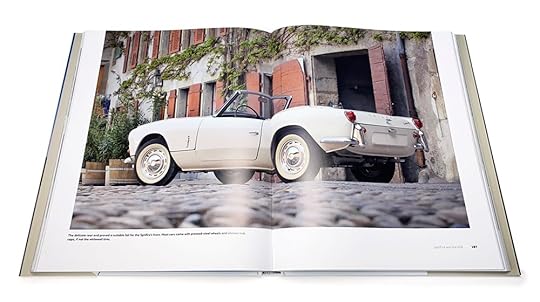
My Review: When I was a kid in Austin of the 1970s, my friend Mike's much-older sister had a Triumph Spitfire that, a couple times, she let him drive me around in...what heaven that was! A little zippy car in the hilly, fun-to-drive city! It was hot, of course, being Texas and a roadster without air conditioning, but such was the price for being able to whip around the Cadillacs and F150s the choked the roads then—and now, I'll bet. It was the same color as this one, even!
What makes Triumph an interesting make of car to learn about is the extent of its history in the UK car market, the sporting niche it occupied for much of its existence, its racing legacy...but here in the US, it was one of the British Invasion little, nimble, fun-to-drive cars that came along with the Beatles.
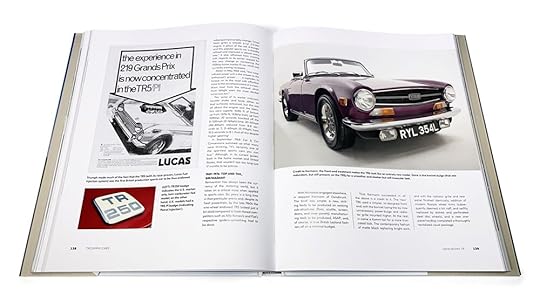
I loved revisiting the Spitfire, and the TR6 that one of the guys I dated in the 1980s had: ...but I also learned about the motorsports heritage of the marque: ...that was largely unknown to me. The Triumph nameplate is, as of now, not applied to any modern cars. BMW owns it, so if it is revived we can expect the product wearing it to be a badge-engineered sporty BMW. Given how well BMW has done with its ownership of the Mini marque, they'll only use Triumph if there's some pressing advantage to doing so. Maybe we'll see some electric cars that look like the older models of Triumph's past! It could happen....
Triumph Cars: 100 Years, by Ross Alkureishi, is an attractive coffee table book that will appeal to both Triumph fans and car enthusiasts in general.
As a history of the company, specifically from the time they started building cars, this gives a complete look without getting into the types of details that would bog down a more corporate-focused narrative. In other words, we get enough of the business side to understand why some changes were made, others discarded, but not too much about the internal politics inherent in any corporation.
The pictures of the cars, cutaways and drafts of models, and advertising material gives this the feel of both the history book it is and also a nice bit of nostalgic meandering. An ex of mine was a big Triumph fan. We (really, she) had three of them, one strictly for parts and the other two running, with one of them as close to original as we could afford. Up to that point (1988) I had had mostly American-made cars, so the first few times we worked on her cars it seemed like I had a lot of room with the entire bonnet flipped up away from the windshield. I could actually reach most of what I needed, though she was the one who knew her way around under the hood. Compared to working on my cars at the time (Fiat X1/9, Pontiac Tempest, and Dodge Street Van) it seemed like heaven.
Whether primarily as a nice display book for a car enthusiast or as a book you will read from cover-to-cover, this is well worth having. If you happen to know a Triumph collector, this would make a great gift.
Reviewed from a copy made available by the publisher via NetGalley.
Triumph Cars is a comprehensive history of the vehicles produced by the company from its inception, through changes of management and ownership, through to its demise. Each chapter covers a specific period in the companies history and is accompanied by plenty of high quality photography and sales material from the UK and USA. The book is well written, structured and unbiased.
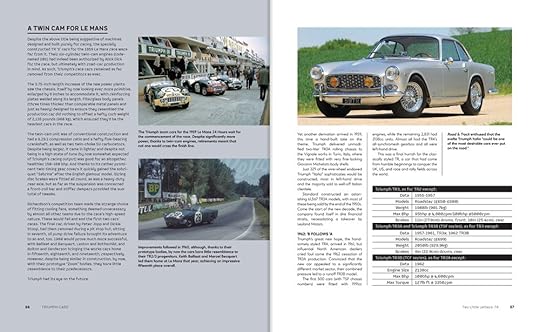
There are carefully placed ‘fact file’ sections about key people in the business, and the car data sheets provide some useful information about each model.
The Triumph is one on many classic car marques that I have grown up seeing at various country shows and fates - the fact that early models survive and and lovingly maintained by enthusiasts shows the love that is still there for a classic, no frills (compared to modern vehicles) cars.
I would throughly recommend this book to car enthusiasts of all ages and interests.