The premier exam-prep guide for surgery―with 800+ board-style practice questions with detailed answers and rationales
Based on general surgery’s cornerstone text, Schwartz’s Principles of Surgery, this unmatched study guide provides everything you need to ace your exams―whether you’re a medical student, a resident, or a practicing surgeon seeking recertification.
Developed by some of the top minds in modern surgery, Schwartz’s Principles of Surgery ABSITE and Board Review delivers the most current, authoritative perspectives on surgical practice. The board-style practice questions are accompanied by answers and comprehension-building rationales, ensuring a complete understanding of the material. Featuring hundreds of illustrations, photos, and tables, this is an essential resource for certification and recertification exam review.
54 updated chapters―all aligned with the latest American Board of Surgery Qualifying Board Examination blueprint800+ board-style questions with answers and rationalesFive NEW Enhanced Recovery after Surgery, Understanding and Evaluating Evidence, Ambulatory/Outpatient Surgery, Skills and Simulation, Web-based Education and Implications of Social MediaQuestions reflect those most likely to appear on the American Board of Surgery In-Training Exam and the Surgery Board Exam300 photos and illustrationsExcellent prep for both written and oral boards
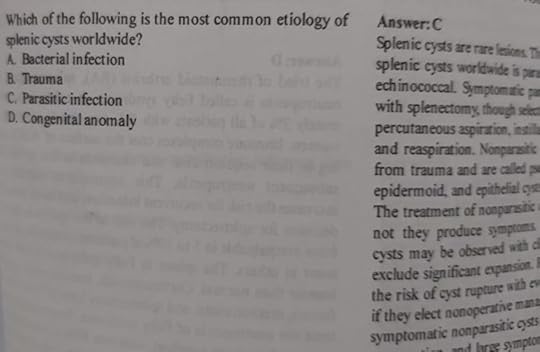
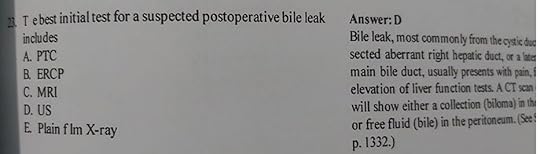
I read this book as a preparation for the final surgery MCQ exam. It happened that my professor repeated only 3 Questions from this book. I immediately answered as 2 of the as presented here with its interpretation, but it became clear from my professor’s point of view that it is not correct. eg:
He said TRAUMA NOT PARASITIC INFECTION and i was lucky not to follow Schwartz here! Primary splenic epithelial cyst is a rare condition with an incidence rate of 0.07% as reported in a review of 42327 autopsies[13-16]. Primary splenic cysts are seen mostly in children, adolescents and young adults[13]. Congenital type is common in girls[17,18]. Non-parasitic splenic cysts are common in Europe and North America, while parasitic cysts are common in Africa and Central America[19]. The prevalence rate of splenic cysts has been increased nowadays due to increased use of non-invasive diagnostic modalities, i.e., ultrasonography (USG) and computed tomography (CT)[20]. https://www.wjgnet.com/1007-9327/full...
Some questions are poorly written and too many with "all of the above" answers. Overall, it is a worthwhile source for general surgery recertification.




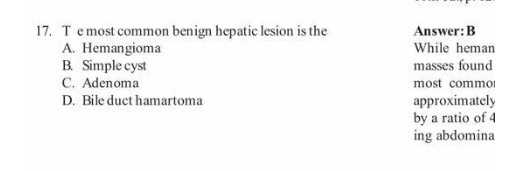 The most common benign solid lesions of the liver is Hemangiomas not cysts