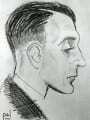
A Savoyard lawyer, diplomat, writer, and philosopher. He was the most influential spokesmen for hierarchical political systems in the period immediately following the French Revolution of 1789. Despite his close personal and intellectual ties to France, Maistre remained throughout his life a loyal subject of the King of Sardinia, whom he served as member of the Savoy Senate (1787–1792), ambassador to Russia (1803–1817), and minister of state to the court in Turin (1817–1821). Maistre argued for the restoration of hereditary monarchy, which he regarded as a divinely sanctioned institution, and for the indirect authority of the Pope over temporal matters. According to Maistre, only governments founded upon a Christian constitution, implicit in the customs and institutions of all European societies but especially in Catholic European monarchies, could avoid the disorder and bloodshed that followed the implementation of rationalist political programs, such as the 1789 revolution. Maistre was an enthusiastic proponent of the principle of hierarchical authority, which the Revolution sought to destroy; he extolled the monarchy, he exalted the privileges of the papacy, and he glorified God's providence. Xavier de Maistre was his younger brother.
Certainly not a bad essay by any means, but the contrast between De Maistre's time and ours is stark. We have no hereditary elites — aristocracies or monarchies — and the ability to recover their rule is rendered null and void due to their transformation into plutocrats or into dust. Revolutionaries certainly want the latter — witness the French and Bolshevist revolutions — but the former degenerates the virtues of nobility just as fast. As Plato wrote in The Republic, aristocracies are the highest form of government. And how do these aristocrats become elites? De Maistre posits that God brings them out of the mists of history, and that thereby God's will has secured them on the throne. But one can add on this by noting that any original ruler must have had natural virtues to be capable to deal with crime and war for the people in his territory (the original goal and raison d'être of the monarch). And, knowing that intelligence, physique, and time-preference are heritable, these virtuous traits would then be passed on to later generations. I posit the origin of these aristocrats to be the Indo-Europeans after studying their social structure (extremely competitive and aristocratic: a K-type tribe) and because of the fact that 90% of the Northern European genome comes from these people.
Some more things I learned:
1. Evil and atheism (which is evil) are negations of being, and this is crucial to keep in mind. The ancients, like Plato, made this point over and over, but we moderns tend to forget. Evil cannot survive long, because inherent in it is the negation of all being and truth. It will destroy itself because of its own nature. It is a parasite that eats through the organism infected with it. Such an observation is good to keep in mind with the massive societal and cultural evils infecting the modern West.
2. Ink cannot establish a well-governed polity. Any constitution (and any theology) is first established by customs and mores, by implicit judgement of the principle to be applied. The people who have this political custom will continue practicing it until an external impetus forces a codification of the principle via ink. Examples: King John's overstretching of implicitly defined kingship constraints -> Magna Carta; British King overstepping assumed rights of American colonists -> Declaration of Independence; Protestant Reformation -> codification of Catholic theology in Vatican I; Early Christian persecution -> codification of Bible.
This pattern continues. The essential point is that words do not make good states. You cannot make a good state without a good nation under it. American "Conservatives" are wholly blind to this notion and worship the constitution as divine. Yet they cannot see that their nation has become an anti-nation (nation = nat- = related by birth [nativity, natal, etc.]) and the fall which such change has caused.
3. The same arguments used by atheists are not new. They were used by the ancient Epicureans who believed that the universe was made out of atoms — just atoms. This ideology then infected Rome, breeding atheism through the writings of Lucretius and others (sound familiar?). This then went along with falling birthrates, bread and circuses, urbanization, mass immigration, inflation, welfare states, the decline of the yeoman, etc. etc. (connect all these woes of Rome to our day!).
Anyways, De Maistre makes an argument that was made by Cicero against the Epicureans. Do you think that if you were to stand on top of a tower and throw letters, you would create the Iliad? How about if you threw atoms and made up the earth? It seems infeasible. In other words, there is an order to the universe that is rationally intelligence to the mind, and the creation cannot be explained without Logos and God.
4. Likewise with language, argues De Maistre. We cannot create language, and when we do we make it trite and emphemeral. Language is ultimately made noble via action and written by God. It cannot be made by a concoction of the mind — whether that be by coining a new term from Latin, someone's name, or by fancy word play. Simple words like constable, scepter, magistrate which used to mean mediocre things (e.g. scepter a simple walking stick) were then made noble by those who wielded them. If someone were to just point at a stick and say "scepter!", it would not make the stick any different than another stick. But via the sluggish but persistent wheels of time and the nobility of those wielding the stick, the stick became a scepter and language was risen up to signify nobility and aboveness.
5. The religious impulse in Man is essential for his being. Consecration in any era but our own is enough to protect something which nominally has but the smallest worth. Furthermore, religion drives people to the best of accomplishments: think of the ancient Egyptian pharaohs, who to preserve their bodies the best for the afterlife, decided to build the pyramids!
6. America is a category mistake. We made our constitution thinking we were the best in the world. It was the epitome of progress and then the rest of the world copied us or we imposed our great Liberal values upon them. But we did not realize our nation was not made via words, but via the inherited tradition of Anglo-Saxon independence, enterprise piety, and adventurousness. The American Constitution was an explicit declaration of British political customs and mores that was defined when under attack. This worked great when our polity was made up of people with that tradition. But when heterogenous elements came in from Europe without those traditions, everything began its fall. Why does socialism, international "democracy" exportation, the income tax, the rise of the bureaucracy, and roaring 20s degeneracy appear all at once after this wave of immigration? We had literally became a new nation, i.e. changed our population makeup via immigration. Likewise with the continual progressive struggle until the 60s, and hypertrophying since then. The current Eternal Struggle Session is just the endpoint of the downfall of the original founders — not just George Washington and co., but their kin as well.
Some good insights. Maistre’s section on names reminds me a lot of Adam Katz’s article, Onomastician In Chief… there’s a lot take from it as a conservative, but if you’re not religious then Maistre’s appeal to a living God may not work. So it’s good to keep in mind that he wrote in a completely different era than our own.
The writings of a man clearly disturbed by the French Revolution. There is both a lot of reactionary ravings, as well as a lot of profound gems to be found here. Burke is far more measured and profitable, but de Maistre has sound religious instincts and explores the religious dimension more than Burke.